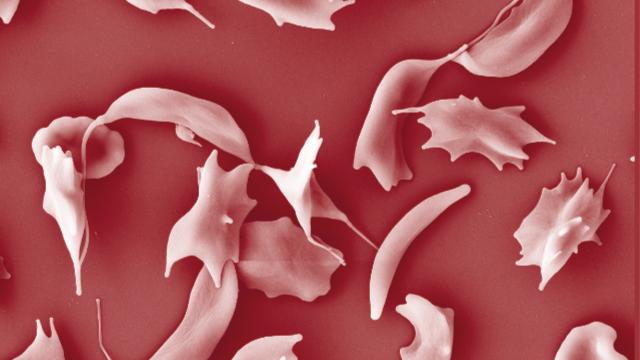
Alzheimer’s Drug Demonstrates Efficacy Against Sickle Cell Anemia
Memantine, a cost-effective drug used to treat Alzheimer’s disease, could also benefit patients with sickle cell anemia in the future. Initial clinical data indicate that the active ingredient is well tolerated.

Honing Anesthesia Techniques Using Silicone Animal Models
Fabiola Jörger received the UZH 3R Award 2025 for her practical training in clinical procedures using silicone animal models. The second prize goes to Markus Seeger and Johannes vom Berg for developing flycode technology.
The yeast Candida albicans can cause dangerous infections. UZH researchers have now discovered how the immune system prevents it from transforming to a pathogenic mode.
Elephants, Giraffes and Rhinos Go Where the Salt Is
In some regions in Africa, large herbivores struggle to get enough sodium. As many of the continent’s protected areas are in regions where salt levels are low, this scarcity may also affect conservation efforts.
“The Research is Better When Both Sexes are Included”
Neuroendocrinologist Ivana Jaric is spearheading the first pan-European network aimed at integrating sex as a biological variable into preclinical research.
Thomas Van Boeckel investigates environmental factors, global patterns of infectious disease and antibiotic resistance in order to better combat these issues.
Until now, zoos used contraception to avoid surplus animals. Scientists argue for preserving breeding populations and raising awareness of conservation challenges by allowing animals to reproduce naturally and culling surplus animals.
In her Master’s thesis, veterinary science student Natalie Miller-Collmann dared to take her own stand on a contentious research question, earning her a semester award.
One in 10 women suffer from depression during pregnancy. The illness often goes untreated and can have negative effects on the child. Now, in a large-scale international project, UZH researchers are analyzing the biological interactions at play and seeking treatment methods that are safe for mother and child.
Every year, many people in Uganda die from rabies after being bitten by a dog. Veterinary epidemiologist Sonja Hartnack is working together with Makerere University in Uganda on ways to effectively combat the deadly virus.
Urs Meyer, professor at the Institute of Veterinary Pharmacology and Toxicology at UZH, and his team have developed a new method of orally administering pharmaceutical substances to mice. The new method benefits both the animals and the researchers. The method will now be rolled out more widely as part of the National Research Programme 79, “Advancing 3R”.
UZH is present at this year’s OLMA with two projects exhibited in the trade fair’s “research garden.” One project demonstrates how supplemental feeding with algae makes pigs healthier. The other project explains the arms race underway on farm fields between new grain varieties and mildew.
Award-Winning 3R Research Reduces Animal Experiments
UZH is developing alternative methods to animal experiments in line with the 3Rs principle. To highlight outstanding achievements of its members in the field of 3Rs, the university has introduced the UZH 3R Award, which has now gone to Giuseppe Esposito and Melanie Generali.
The establishment of the One Health Institute at UZH is well under way. An inaugural symposium will be held on 21 September, focusing on the two key research areas, epidemiology and evolution.
UZH the First European University to Establish One Health Institute
Researchers from veterinary medicine, human medicine and the natural sciences have joined forces to establish Europe’s first university-based One Health Institute at UZH. Together, they want to explore the links between human, animal and environmental health.
The Alongshan virus was discovered in China only five years ago. Now UZH researchers have found the novel virus for the first time in Swiss ticks. It appears to be at least as widespread as the tickborne encephalitis virus and causes similar symptoms.
Mosquitoes are responsible for transmitting many disease-causing pathogens. In Switzerland, biting midges in particular make life difficult for sheep and horses. Entomologist Niels Verhulst researches methods to keep the unwanted insects away.
Researchers at UZH are exploring sustainable agriculture and the future of food, from transforming our eating habits and growing our own greens to breeding crops with new techniques, distributing seeds more fairly and farming with biodiversity in mind. The latest UZH Magazin explores how we can eat and produce food in a way that benefits both our own health and the health of our planet.
Boost for One Health and Quantitative Legal Research
With its new funding instrument, TRANSFORM, UZH is laying the groundwork for innovation across the whole university. The Institute of One Health Research and the Center for Legal Data Science are set to receive seed funding of around CHF 2.7 million in total over the next four years.