One Planet, Interconnected Health
When former French President Jacques Chirac addressed the World Summit on Sustainable Development in Johannesburg in 2002, he opened with a stark warning: “Our house is on fire, and we are looking the other way.” Almost two decades later, climate activist Greta Thunberg attracted global attention with the same metaphor when she urged political and business leaders in Davos “to act as if the house is on fire, because it is.”
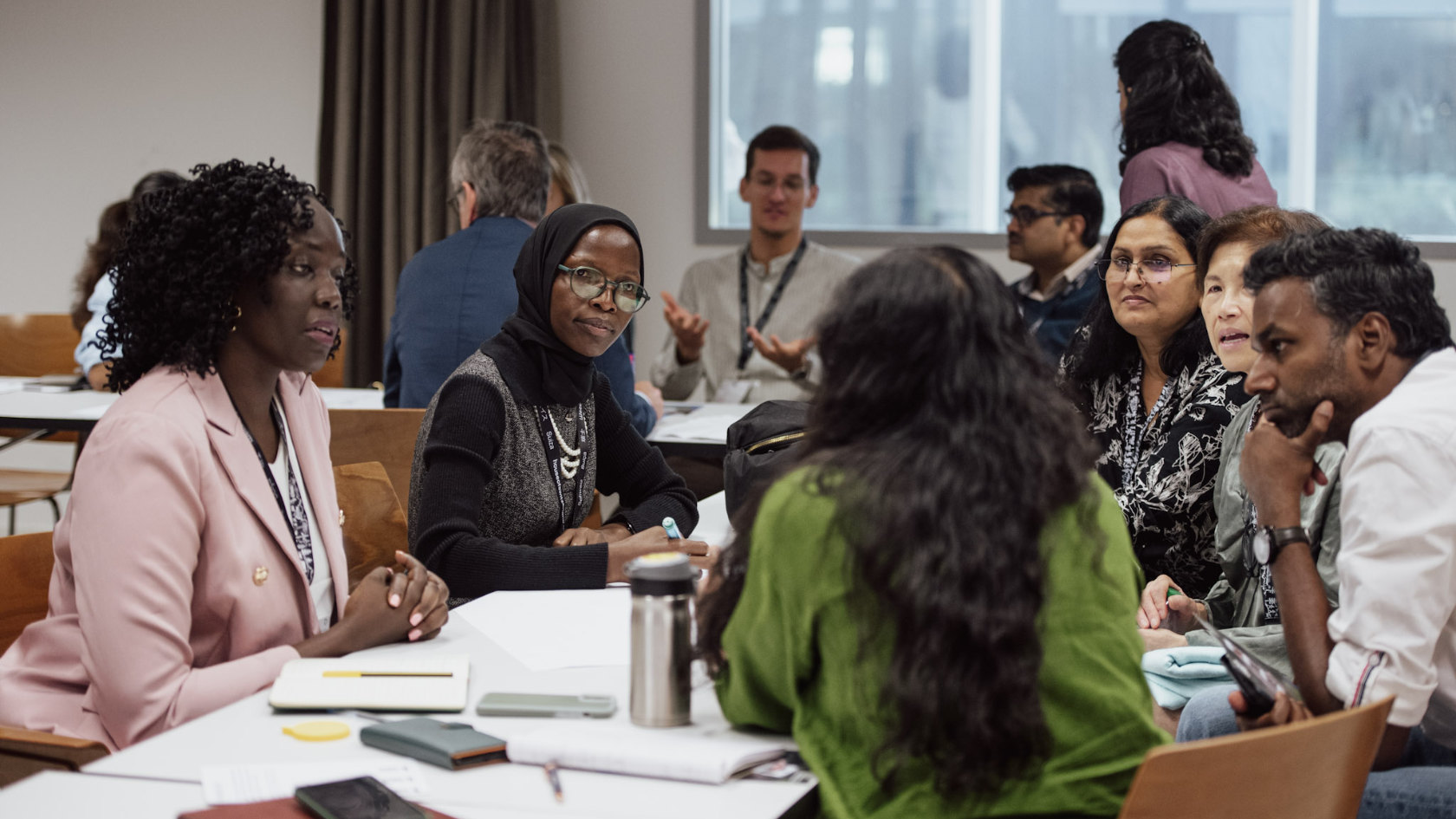
This year’s Trialogue Days took the metaphor of our planet as the house we live in quite literally. Under the motto “Planetary health begins at home,” more than 120 scientists, physicians, urban planners and policy experts from India, Uganda and Switzerland explored how climate change and environmental degradation affect health in different parts of the house – from the bedroom and kitchen to the office and garden – as well as in forests, wetlands and other natural habitats.
Planetary health builds on the ‘One Health’ idea that human, animal and environmental health are interconnected, but widens the lens to the planetary systems on which all depend. With the effects of climate change becoming increasingly apparent, the question was not only how these connections can be better understood, but also how societies can respond.
Trialogue Days 2026
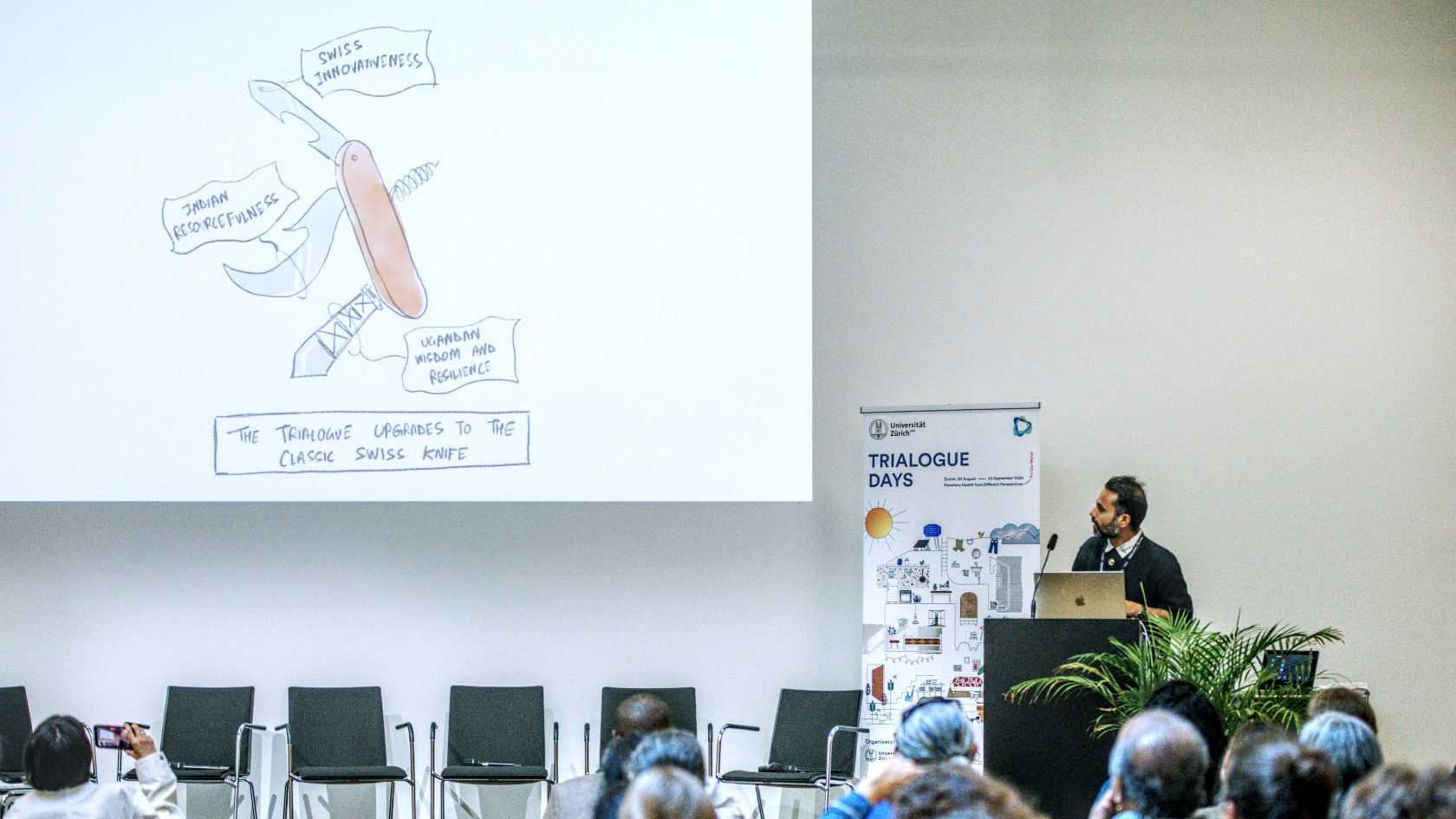
The biennial event, held at Zurich University of the Arts at the beginning of September, brought together participants from academia, industry and politics from India, Uganda and Switzerland. It was organized by the University of Zurich (UZH), Makerere University in Uganda, the Indian Institute of Science (IISc) in Bengaluru and Swissnex in India.
Over five days, participants compared approaches, identified shared questions and made new connections under the motto “Planetary Health from Different Perspectives: It’s Our Move!”. Workshops and open networking sessions provided space to explore research partnerships and begin developing joint proposals.
Different perspectives on a shared challenge
Keynotes by economist Esther Duflo, global health expert Ilona Kickbusch and wildlife veterinarian Gladys Kalema-Zikusoka approached the question from very different angles. Duflo, Nobel Laureate and newly appointed UZH professor, focused on climate justice and the role of low- and middle-income countries in shaping the future trajectory of global emissions. These countries will continue to develop – and development will inevitably require energy and infrastructure. She advocated for a “Climate Grand Bargain” that acknowledges both the unequal responsibility for climate change and the burdens poorer countries face in responding to it.
Kickbusch widened the perspective further. Global health, she argued, cannot be separated from questions of political power, foreign policy and global governance. Nor does the old binary distinction between developed and developing countries adequately describe today’s world. Climate change, pandemics and technological transformation cut across national and economic categories and require forms of cooperation that do the same.
The workshops translated these broad questions into everyday settings. A breakout session centered on the bedroom, for example, moved from sleep and mental health to traditional architectural approaches for heat-adapted housing and prevention against mosquitoes. This juxtaposition of perspectives was characteristic: rather than separating medicine, architecture, ecology, economics or public policy, the Trialogue Days deliberately brought them into the same conversation.
-
 The participants of the Trialogue Days 2026 in Zurich included early-career researchers, eminent scientists from different fields of academia, and industry and political leaders from India, Uganda and Switzerland. (Pictures: Michelle Ettlin)
 -
 UZH economist Esther Duflo in conversation with global health expert Ilona Kickbusch.
 -

-
 UZH historian Debjani Bhattacharyya contributed to the discussion.
 -
 Allowing ideas to develop through encounters between people who might otherwise never work together.
 -

-
 This Ugandan Hero bicycle had already traveled to the first edition of the Trialogue Days in Bengaluru two years ago. It served as a reminder of climate-friendly mobility, as well as a symbol of the connection between the three Trialogue Days founders: Andrew Kambugu, Jan Fehr and Utpal Tatu.
Planetary health in action in Uganda
Few examples illustrated the potential of such an approach as vividly as the work of Gladys Kalema-Zikusoka, an eminent wildlife veterinarian and founder of the NGO Conservation Through Public Health (CTPH) in Uganda. During her work in Bwindi Impenetrable National Park in southwestern Uganda, Kalema-Zikusoka discovered that mountain gorillas were picking up diseases such as scabies from people living nearby. At the same time, gorillas entered community gardens in search of food, bringing humans and wildlife into ever closer contact. “Very soon I found out that you can’t protect the health of gorillas without protecting the health of their human neighbors,” she recounted in her keynote. What initially appeared to be a veterinary and conservation problem therefore proved inseparable from human health, livelihoods and the surrounding ecosystem.
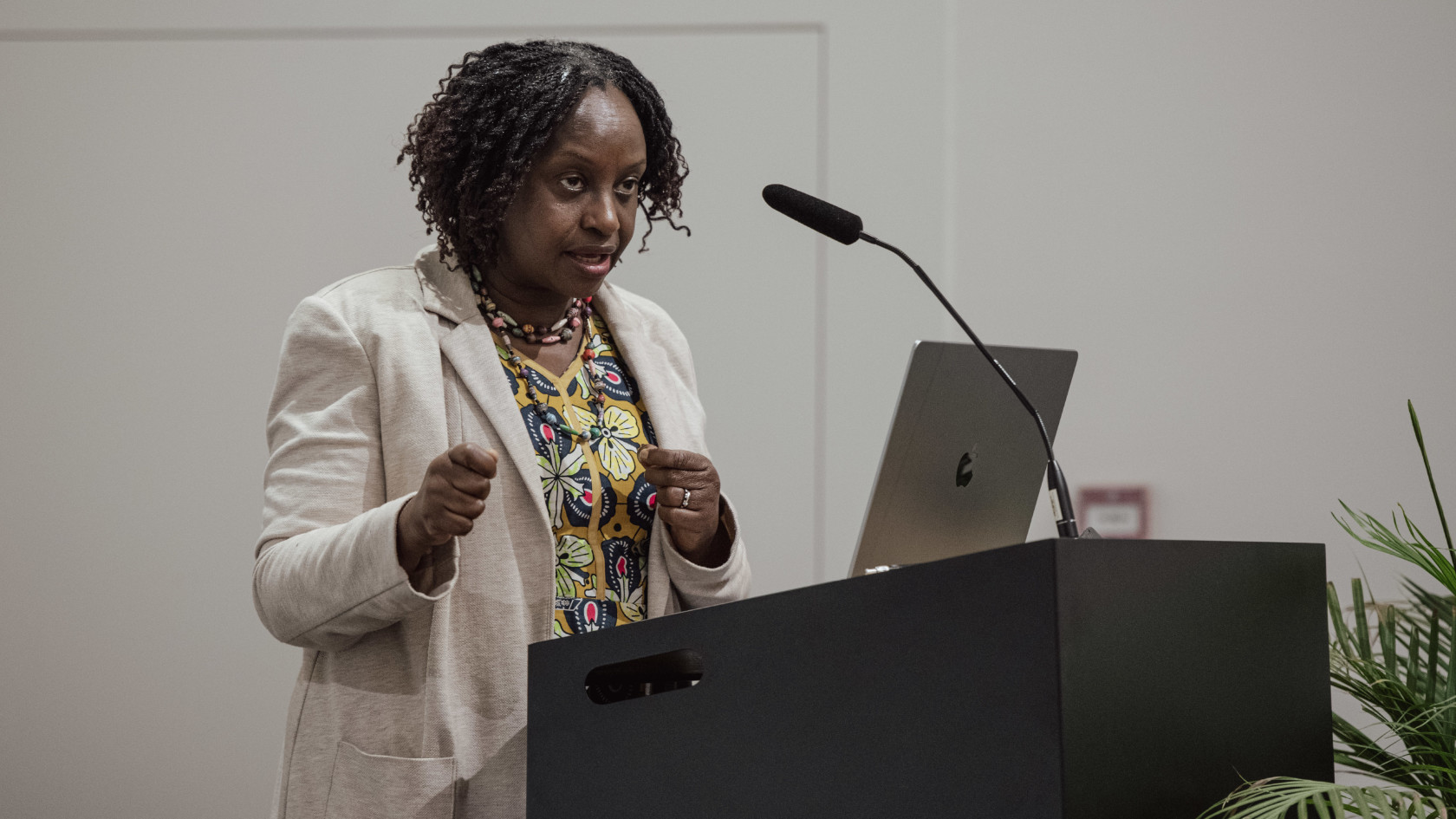
In response, Kalema-Zikusoka founded CTPH to work with the communities living around the gorilla habitat. The NGO combines measures such as better access to health services and health education with livestock health and the management of human–gorilla conflict. Community members are trained to deliver health and conservation services locally, while tourists wear masks to reduce the risk of transmitting infections to the gorillas. The forest itself also forms part of this interconnected system. Besides providing a habitat for the gorillas, Bwindi is an important water catchment area. Protecting wildlife, human health and the ecosystem therefore cannot be treated as separate tasks.
Kalema-Zikusoka’s work also illustrated a principle that resurfaced throughout the Trialogue Days: solutions are more likely to work when they are rooted in local realities and developed together with the people affected. In Bwindi, community members helped identify problems and shape responses. Elsewhere, during the workshops, participants similarly emphasized the value of local and indigenous knowledge in finding solutions adapted to particular social, cultural and ecological contexts.
Interview with Uganda’s State Minister of Health: “We must adopt the collective mindset”
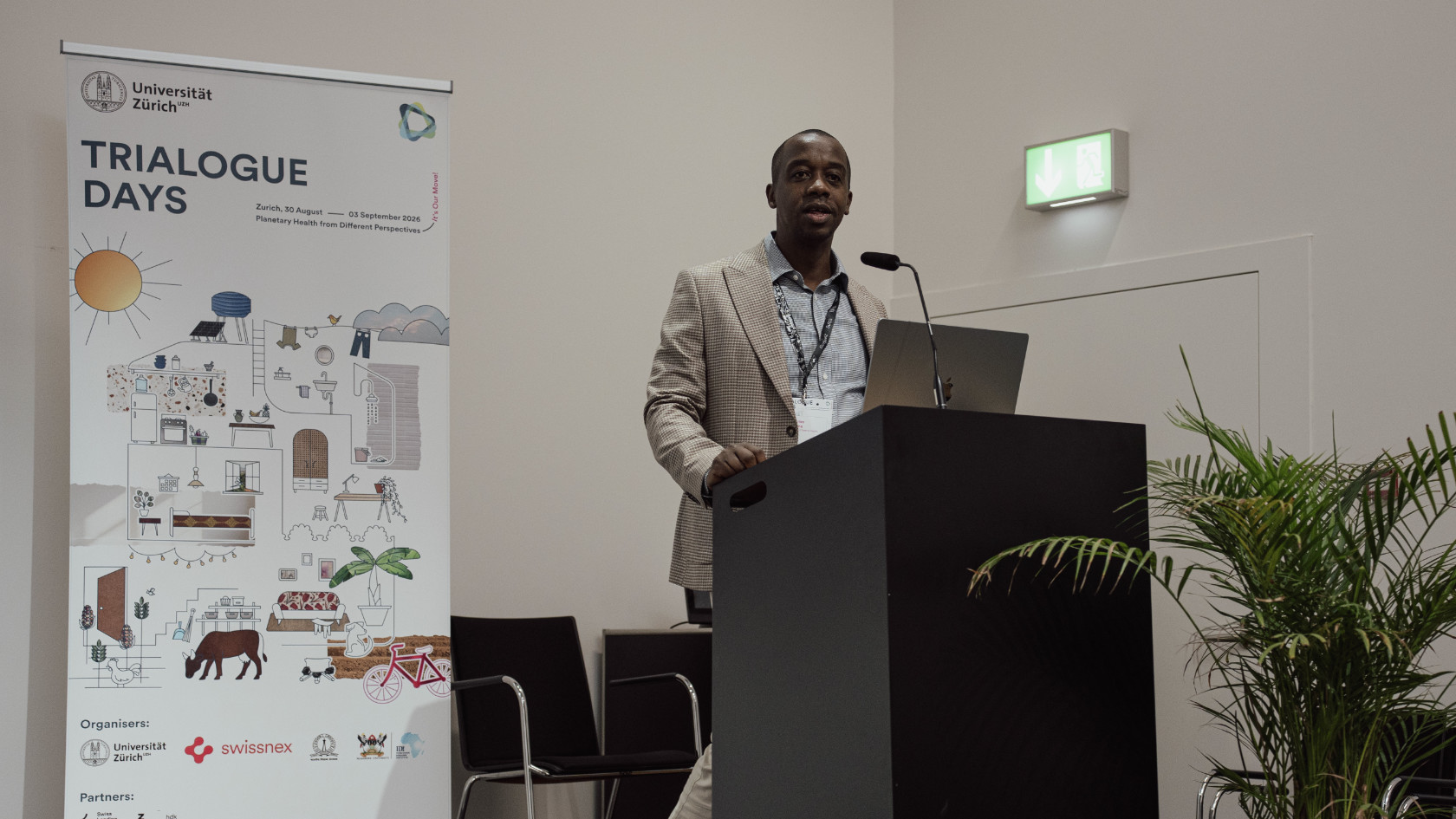
Uganda’s State Minister of Health, Charles Ayume, brought a policy perspective from the Global South to the Trialogue Days. In this interview, he reflects on Uganda’s planetary health challenges, the value of cross-continental exchange and the potential for future collaboration.
Interview: Martin Boyer
What are concrete planetary health challenges for an African nation, such as Uganda?
Charles Ayume: During these 2026 Trialogue Days, we examined challenges in Europe and North America. While we may not experience all of them directly, we bear the spillover. Take carbon emissions and global warming: the carbon footprint is significantly higher in the Global North, yet nations with minimal footprints are bearing the brunt of the consequences.
Within our own borders, we face challenges related to legislation and fragmented markets. We tend to plan within small national boundaries rather than at a regional level. If we are to manufacture essential medicines and antibiotics, how do you achieve viability? To attract foreign direct investment, we need regionalization and larger unified markets. COVID-19 made that abundantly clear across the African continent: we must work together.
Recently, Uganda emerged from an Ebola outbreak and was declared Ebola-free by the WHO. But we did not sit back and pop champagne. In the spirit of Pan-Africanism and good neighborliness, Ugandan medical teams traveled to the DRC at the invitation of the Congolese government to support their Ebola treatment centers. That is the collective mindset we must adopt – not only for global health security, but for planetary health as a whole.
How important is the exchange with partners from diverse professional, cultural and historical backgrounds who encounter the same problems from different angles?
Charles Ayume: It is vital. When you listen across different perspectives, you see both our contrasts and our commonalities.
In Uganda, arriving at an office or meeting in a personal vehicle is often perceived as a mark of prestige. Here in Switzerland, we walked to the venue, surrounded by an active cycling culture. In many ways, Europe is returning to practices Uganda had decades ago: in the 1960s, Ugandan streets had very few cars and people predominantly cycled, while the West was motorizing rapidly. Now the dynamic is reversing.
On the cultural front, our underlying aspirations are shared, even when our practices differ. Dialogue allows us to tackle these cultural dynamics together.
Finally, global partnerships must address equity and sustainability. Interventions in Africa cannot be five-year programs that leave communities stranded, forcing people back into poverty and environmental degradation.
Looking ahead to the upcoming Trialogue Days 2028 in Kampala, Uganda, where do you see the greatest potential for collaborative projects between Bangalore, Kampala and Zurich?
Charles Ayume: Research represents our greatest opportunity. Uganda sits directly on the equator, providing a rich ecological setting where human and plant life thrive – but also where pathogens flourish. Historically, numerous viral and infectious agents were first isolated in Uganda and our immediate region: the Zika virus, West Nile virus, Buruli ulcer and O'nyong'nyong virus. Ebola remains on our doorstep, and malaria is endemic.
This creates an exceptional foundation for joint academic and clinical research with institutions in Zurich and Bangalore. Beyond human medicine, our wildlife and national parks are central to the equation. You cannot address planetary health without accounting for animal and ecological health. When Kampala hosts the Trialogue Days in 2028, we want to approach health in “3D”: human health, animal health and plant health. Delegates will not only engage in conceptual debates; we will bring you into the field to witness firsthand both the frontline impacts of environmental pressure and the restoration initiatives Uganda is driving to mitigate climate and ecological risks.
Read the full interview on the Faculty of Medecine’s website.
From exchange to collaboration
The same principle – bringing different forms of knowledge together to develop workable solutions – also shaped the Trialogue Days themselves, which grew out of an earlier collaboration on infectious diseases and tuberculosis research between Uganda and Switzerland. This history helps explain why the event is not designed simply for researchers present finished work, but as a place where new work can begin.
In the discussion following her keynote, Ilona Kickbusch had urged: “Something drastic is happening and we have to use our imagination to respond.” The Trialogue Days were intended to provide precisely that space – to allow ideas to develop through encounters between people who might otherwise never work together. As organizer and UZH immunologist Jan Fehr put it, the “fermentation of ideas” would continue over the following days, weeks and months.
-
 “74% demand more climate action”: Jan Fehr holding up the daily newspaper. In her talk, Ilona Kickbusch had reiterated the need for imaginative solutions to the climate crisis. (Pictures: Michelle Ettlin)
 -
 Rather than presenting research results, the Trialogue Days were intended to provide space for creativity and collaboration.
 -
 That included a farewell evening by the lake. (Pictures: Martin Boyer)
 -

-
