Innovative Mini Robot for Dentistry
A trip to the dentist is not always pleasant, especially if drilling is necessary or a tooth needs a crown. A dental treatment of that kind today usually requires multiple appointments. First, caries and damaged tooth material are removed and the tooth is prepared for a crown. Afterward, an impression or digital scan is taken to fabricate a perfectly fitting crown. Finally, the permanent crown is placed at a later appointment.
This process could speed up in the future because close interdisciplinary cooperation between the Clinic of Reconstructive Dentistry at the University of Zurich (UZH) and engineering researchers at the Universities of Basel und Bern has given birth to a dental robot that can automate and shorten the procedural steps.
Tiny and mounted directly inside the mouth
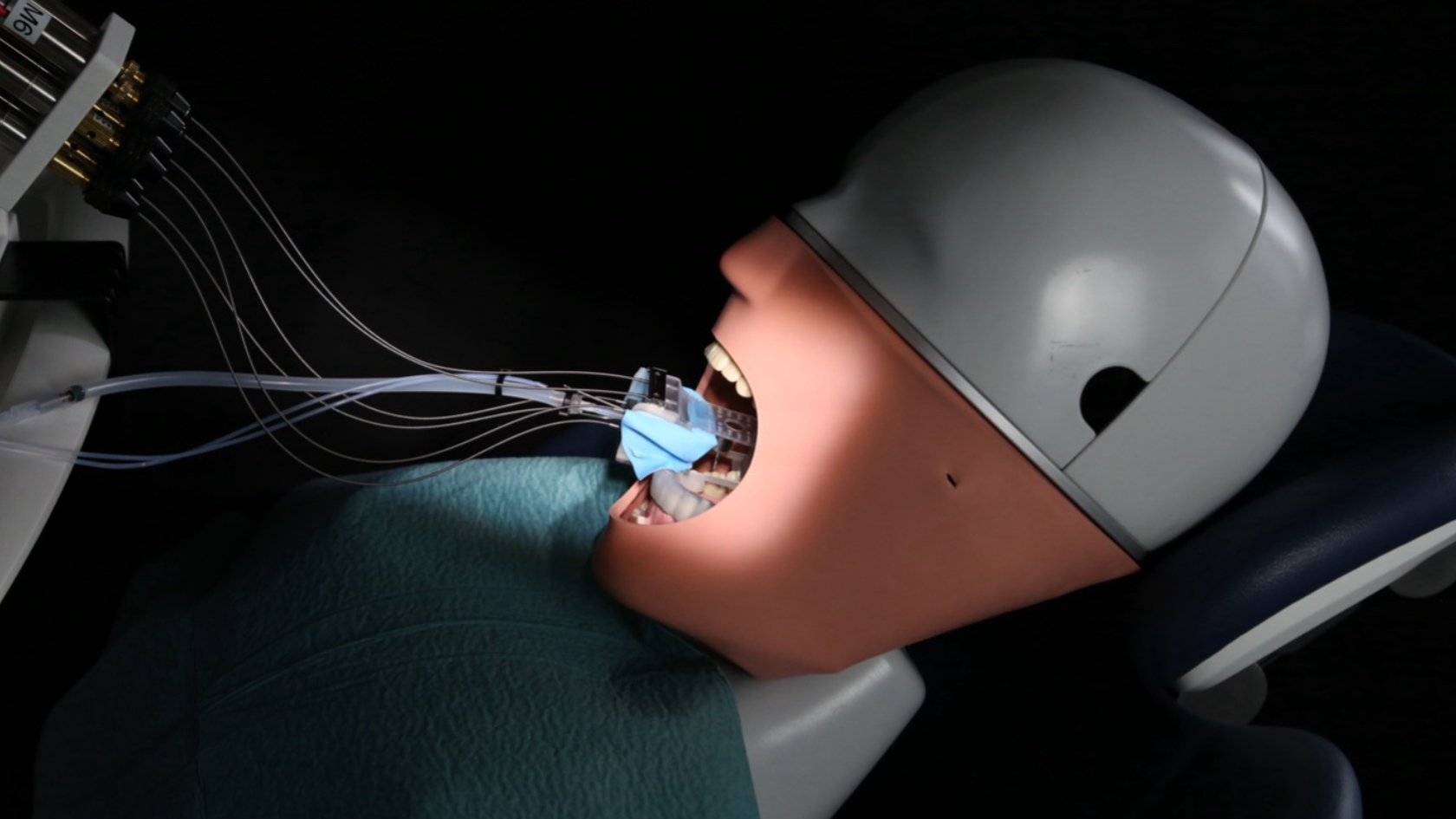
The prototype of the new miniature intraoral robot (MIR) is about the size of a human thumb, making it small enough to be mounted and fit comfortably in an open mouth. Its motors and guidance system are located outside the robot and are connected to it via flexible drive shafts, cables and tubes.
The MIR thus differs from dental robotics systems already in existence, which are normally mounted outside the oral cavity on large robotic arms and which restrain patients from moving or require navigation systems to track and compensate for patient movements. The MIR, in contrast, is mechanically affixed to the patient’s bite and moves with the patient.
Clinical practice intermeshes with engineering
“The objective behind the development of the MIR was to revolutionize the workflow involved in reconstructing a defective or damaged tooth with a crown, onlay, inlay or veneer,” says Professor Ronald E. Jung, the clinic director of the Clinic of Reconstructive Dentistry at UZH’s Center for Dental Medicine. He and his team realized this vision in collaboration with research groups led by Georg Rauter, a professor of surgical robotics in the Department of Biomedical Engineering at the University of Basel, and in cooperation with Professor Manuela Eugster, the head of the Neuro Robotics Group at the University of Bern and University Hospital Bern.
“This tight intermeshing of engineering design and development with clinical expertise was a key factor in the successful development of the dental robot,” Jung explains. The close cooperation and active exchange of knowledge and ideas enabled the MIR’s scope of application to be optimized for deployment in dentistry.
Benefits of the dental robot
The remote-controlled dental robot indeed offers a number of advantages. It, for instance, enables personalized treatments in which only the exact amount of tooth material calculated digitally beforehand is removed. Conventional manual tooth preparation, in contrast, can often result in substantial variances in the removal of tooth material, depending on the dentist.
In addition, fewer appointments are required, and the total time spent in the dentist’s chair decreases. Patients can get a better understanding of what exactly will be done to them before the actual procedure begins. And patients can move their head relatively freely during the procedure without compromising the tooth preparation because the robot moves with the jaw to which it is affixed.
Prototype needs further refinement
The researchers at the Universities of Zurich, Basel and Bern have already tested the dental robot on tooth models made of plastic and a ceramic material with a hardness similar to that of tooth enamel. The robot prepares a tooth in two steps: first, it uses a wide drill to reduce the tooth surface, milling from the outer surface inward to remove material. In the second step, a longer, thinner drill shapes the sides of the tooth. What is remarkable is how precisely the dental robot already works.
As a next step, the current MIR prototype is to be outfitted with sensors and a camera to enable the robot to monitor the position of the drill in real time with pinpoint accuracy and to correct any positioning errors during the milling process. “Even after a power outage, the MIR would know where it is and where it needs to continue based on the sensor data,” explains Professor Rauter from the University of Basel. The engineer is confident that the dental robot will pass its test in the clinical setting one day.