Tailored Development Aid
Esther Duflo, Abhijit Banerjee, you’re joining the University of Zurich this summer. What excites you most about this move?
Abhijit Banerjee: For us, the idea of being back in Europe is exciting, especially at this moment where Europe must affirm its values. Zurich is an ideal combination for us. The atmosphere and the researchers at UZH are great, and there is a very strong group working in development economics, in climate change, and in related areas.
In 2019 you were awarded the Nobel Prize for your experimental approach to alleviating global poverty. What is your fundamental insight from this work?
Esther Duflo: One fundamental insight might actually be that there is no fundamental insight. There is no silver bullet to get rid of poverty. To make progress, it’s important to look carefully at the various problems that are associated with being poor – education, health, environment, climate, governance, social protection, and many others – and then address these problems one by one.
And when we say addressing them one by one, we really mean addressing them with the same seriousness and rigor that you would apply if you were testing a new medical treatment or a new educational method. You ask a precise question, you test it carefully, and you analyze the results. In the same way that there is not one cure for cancer – because there are many types of cancers – there is not one fundamental insight that tells us how to solve poverty. That’s probably the most significant insight from our work.
Your strategy is to break complex issues down into smaller, testable questions.
Duflo: I don’t know if “small” is the right word, because “small” can suggest something very local or trivial. I would rather say “more precise” or “well-defined.” When you pose a well-defined question, you have a chance of getting a well-defined answer. And once you have such an answer – say, this particular approach to addressing this particular problem works – then you can think about scaling it up. If, instead, you find that an approach doesn’t work, which often happens, you can decide not to move in that direction.
A large part of the work of the Abdul Latif Jameel Poverty Action Lab (J-PAL) over the past 20 years has been not only to conduct thousands of research projects, but also to work very closely with policymakers to scale up what has been shown to be effective. Now, more than 800 million people have actually been reached by programs scaled up after they were evaluated by researchers in our J-PAL network. That is, of course, a very large number of people. But it didn’t happen all at once. It happened one step at a time, over many years.
With which project have you had the most success so far?
Duflo: One of the most interesting stories actually started in Davos. In one of the earliest J-PAL studies, Michael Kremer and Ted Miguel showed that it is extremely cost-effective to treat children preventively against intestinal worms in places where worms are prevalent. This study was conducted in Kenya, in areas with a lot of schistosomiasis, a parasitic worm infection which can be prevented by a pill given every six months. The pill itself is essentially free, and the cost of delivering it isn’t very high. Children who take this pill miss fewer days of school, and when they grow up, they earn about 25 percent more than children who didn’t receive the treatment. That is an extraordinarily significant effect.
In 2007, Michael Kremer and I were Young Global Leaders at the World Economic Forum in Davos, where we were encouraged to come up with ideas that could make a real difference in the world. So we proposed Deworm the World, a program to scale up this intervention. Of course, it took a long time to develop after that initial Davos meeting. It took a lot of work, and many people contributed. But the Young Global Leaders network was very helpful in getting it off the ground. It became a national policy in India, and has also reached many children in sub-Saharan Africa and elsewhere.
How does your approach differ from classical development economics?
Banerjee: Basically, the same questions have been asked for a long time. There is nothing particularly original about being interested in impact. What we succeeded in doing was convincing people that experiments were actually easier and more practical than people thought for answering these questions. Often, governments introduce programs that have many components. You observe the program as a whole, but you don’t know which component matters most. With experiments, you can vary specific elements – such as, how teaching is done, what materials are used – and see what actually leads to good results. This allows you to work on specific hypotheses and to test them rigorously. There used to be a lot of frustration because there was so much uncertainty about impact. Experiments offer a way to reduce that uncertainty.
You mentioned your interest in climate change. Are you working on a new project related to this topic?
Duflo: We’re working on a book that shares what has been learned about the impact of climate change on the poorest people in the world, and what can be done to mitigate that impact. For this, we’re collaborating with Michael Greenstone from the University of Chicago, who has been working on climate change for a long time.
One striking observation is that most of the damages caused by climate change will take place in poorer countries. People in rich countries like Switzerland or Norway are understandably very concerned about climate change, but if you look at excess deaths due to climate change, they will be concentrated in lower-income countries. That’s partly because these countries are already hot, so additional heat has very serious health effects, and partly because they are less wealthy and therefore less able to adapt.
Giving people the option not to work on very hot days, by providing a cash transfer on those days, would save a lot of lives.
We try to put a number on what this means in terms of damages inflicted by rich countries on poorer countries each year. Based on that, we propose a system in which poorer populations are compensated for these damages, in exchange for strong climate action by their governments. This could help break the paralysis we’re currently seeing in global climate policy.
In countries such as India, temperatures of 40 to 50 degrees may become normal. How can money help in such situations?
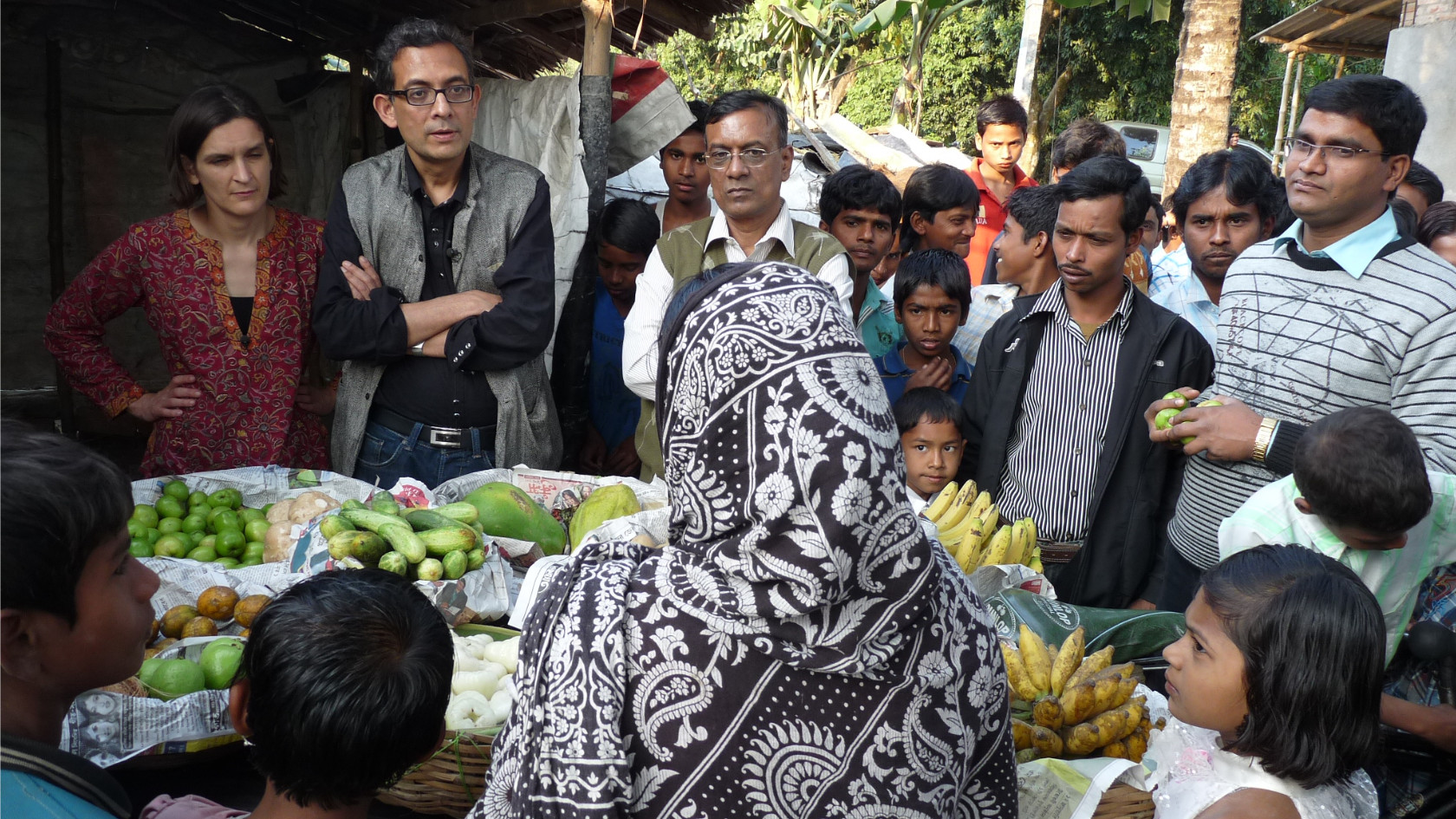
Duflo: One thing that kills people is working outside when it’s extremely hot. There is already research, including by Michael Greenstone, showing that most heat-related deaths in India occur in rural districts. That is because people in rural areas work outdoors, in agriculture or construction. Giving people the option not to work on very hot days, by providing a cash transfer on those days, would save a lot of lives.
We did fieldwork for the book in India, and we asked people who work outside whether they could stop working on very hot days. The answer was almost always no; they can’t afford not to work. If they don’t work, they don’t get paid. That’s why money is crucial. It allows people to protect themselves on extremely hot days. It also allows for small investments, such as cooling shelters, where people can rest during the hottest hours.
You have argued that economics as a discipline should show more humility. What do you mean by that?
Banerjee: Without experiments, economics tend to remain at the level of general propositions: human nature is this way, therefore policy should be that way. But those general propositions are often wrong. A good example is microcredit. In the early 2000s, there was a very popular idea that every poor person should be given credit. It turned out that many poor people don’t want credit at all. Others do want credit, but not necessarily to start a business. The whole narrative – that people would take credit, start a business and become less poor – was based on assumptions about behavior that didn’t always hold. It’s not that credit is useless. But you have to think very carefully about what purpose it serves in the lives of specific people. Different products are useful for different people in different circumstances.
You do a lot of evidence-based research. In your experience, what are the biggest obstacles to implementing these findings in politics and society?
Duflo: What we are finding – and this may even be more true for low- and middle-income countries than for rich countries, especially at the moment – is that there is actually quite a lot of openness to trying things that are more effective. Part of the reason is that there has been less focus on the idea that only macroeconomic stability matters and nothing else. With the UN Sustainable Development Goals, there has been a stronger emphasis on human and social objectives, such as education, maternal mortality and infant mortality. These goals allow governments to focus on specific social outcomes. Once these outcomes are explicit, there is real space for evidence-based decision-making, because governments face genuine choices between different policy options.
I recently attended a meeting as part of the Presidential Advisory Committee of the President of South Africa, at which the president himself explicitly emphasized how important it is to focus on evidence and to adopt policies that are based on evidence. He stressed the willingness to adopt policies that have been shown to be effective in other contexts. That kind of statement, coming directly from the highest political level, is very significant.
Your advice seems to be welcome in many countries. At the same time, the country you are leaving, the United States, appears to be moving in the opposite direction, where evidence-based science seems to matter less. How do you feel about that?
Duflo: It reminds us that the world is a big place. I don’t think we should say that because the US is paying less attention to evidence, the rest of the world has stopped paying attention as well. In fact, what we observe is that policymakers in many low- and middle-income countries are often very rational. They are very focused on what works.
Does your prestige – your Nobel Prize – play a role in being heard by policymakers?
Banerjee: Prestige might help to open doors initially, but it’s not enough. What really matters is the work of the organization. J-PAL has spent years working with government departments, sometimes at the national level, sometimes at the local level. This long-term investment in relationships is extremely important. What really counts is that J-PAL has a large number of extremely dedicated and highly competent people who are willing to engage deeply with policymakers. That means patiently explaining what the evidence shows, persuading policymakers to try evidence-based approaches, following up repeatedly, sometimes writing memos, sometimes explaining the same results again and again. This whole process is very time-consuming, but it is essential. Our relationship with our government partners developed over many years, often decades. It’s more about mutual trust than prestige.
What are the issues that scientists and policymakers should address most urgently right now?
Duflo: The impact of climate change on the poor is clearly one of the most critical issues. More broadly, it’s important to refocus on the lives of the poorest people. There are still many people living in extreme poverty. There are still many children dying from preventable causes – lack of immunization, malaria, diarrhea, and so on. From time to time, it’s necessary to bring attention back to these very basic issues: who the poorest people are, how they live, and how their lives can be improved.
From your perspective, how can economic research help make the world a better place?
Duflo: We live in a very complicated time. We have built our careers largely by not making predictions, and that’s probably something we should continue to do. What I can say is that addressing the twin problems of climate change and its impact on the poorest people is absolutely critical. From a technical point of view, this is feasible. Many relevant technologies already exist, and the costs aren’t insurmountable. The real difficulty lies in political coordination. Climate policies create winners and losers, and that makes implementation difficult. But the problem is not a lack of technical solutions. To us, climate change is inseparable from the question of how it affects the poorest people and how they can be helped to cope with it.
There is a lot of high-quality research happening at UZH. We know the work of several researchers very well and expect collaboration to develop quite naturally, as a continuation of work that is already closely connected.
More generally, making the world a better place means having better policies. And better policies come from focusing on specific problems, asking precise questions, giving precise answers, abandoning what doesn’t work, and scaling up what does.
You will be coming to Zurich this summer. What are your hopes for collaboration here at UZH?
Banerjee: There is a lot of high-quality research happening here. We know the work of several researchers very well and expect collaboration to develop quite naturally, as a continuation of work that is already closely connected. So we don’t see this move as entering a completely new or unfamiliar environment.
Your professorships in Zurich are funded by the Lemann Foundation, which is connected to Brazil. What will you research concerning Brazil?
Duflo: J-PAL has an office in Brazil, so we have been engaging with the country for a while already, and we have many connections in academia and in the policy world. What we hope to do, with the support of the Lemann Foundation, is to strengthen the evidence-to-policy pipeline there. That means making sure that the evidence produced within J-PAL, from all other the world, is effectively shared with policymakers, social entrepreneurs and other actors in Brazil, and that it is actually used on the ground.
We also have a platform called ADEPT, which provides education and training for future researchers and policymakers on how to conduct research on development and economic policy. We would like to bring this platform more strongly to Brazil and to UZH. That would involve training students and policymakers, both through UZH and through our online platform, and building collaborations between UZH and Brazilian universities.