Paving the Way for Dialogue
Morana Mihaljević: “People are curious by nature”
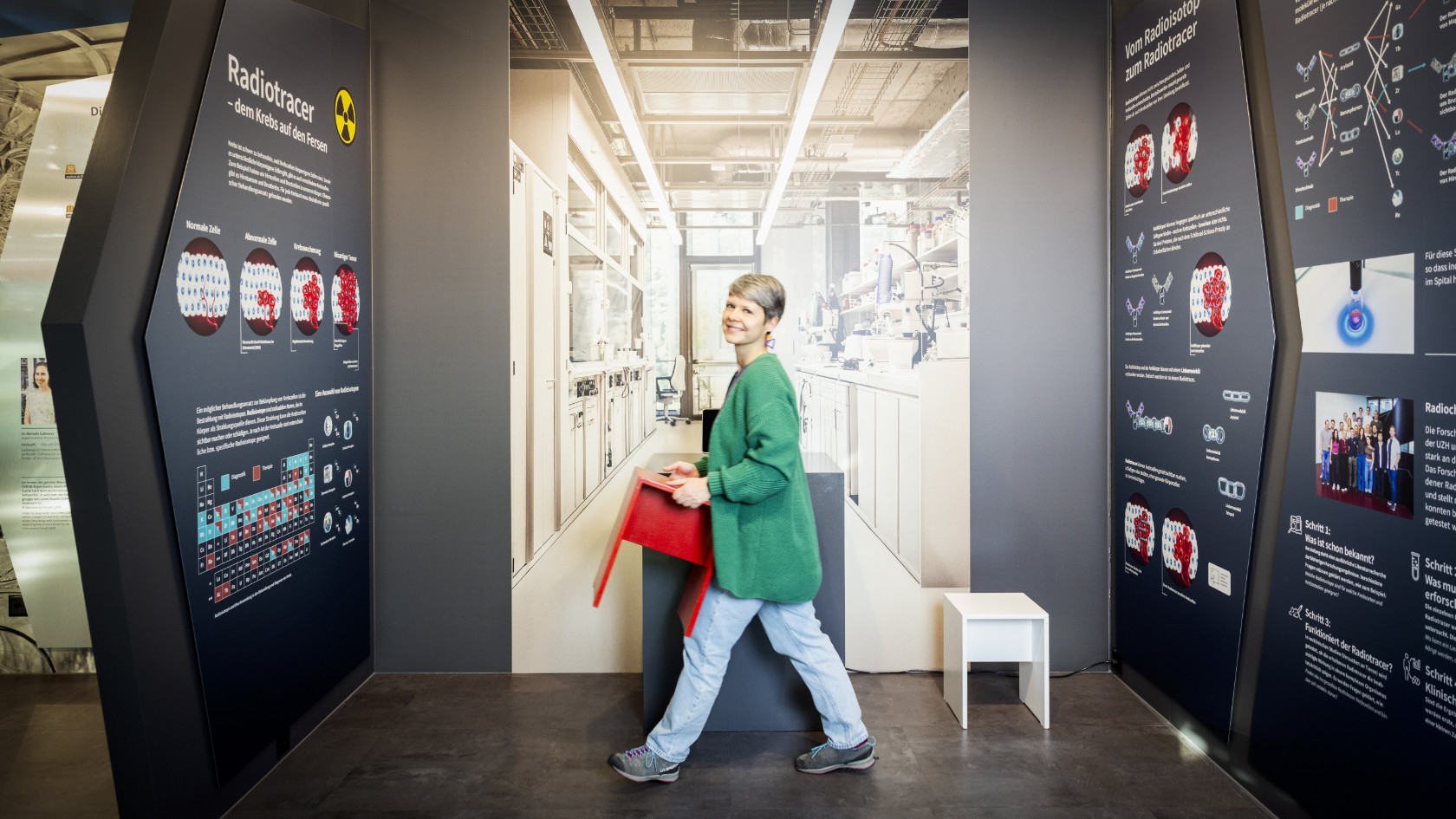
“How did the universe begin? How do animals communicate? And how do new cancer therapies work? At the Science Pavilion, visitors can explore these questions and many more and gain insight into the research carried out at the Faculty of Science. At the Science Lab, we organize more than 200 workshops each year for school classes – from primary school to upper secondary level – and also help shape the program of the Children’s University.
We’ve developed our own approach to exhibitions at the Science Pavilion, moving away from display panels packed with text and toward interactive formats with a clear narrative structure. We now often use screens to provide additional information. Not every idea works perfectly right away, but we learn something new with every exhibition.
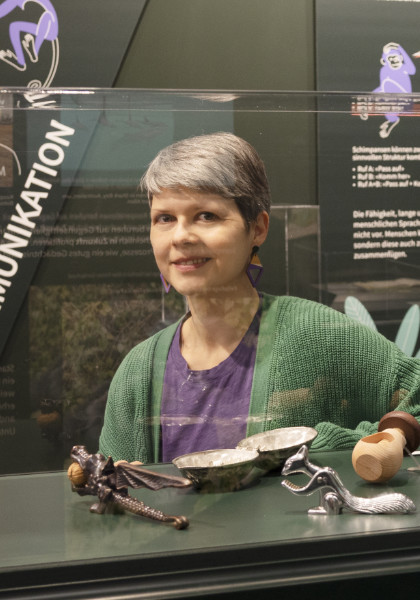
We want to show how science really works and how knowledge is generated.
For me, it always comes down to one question: what’s the core message? What do we want visitors to remember or feel three months after their visit? Distilling complex topics down to their essence is challenging, but it’s also something I really enjoy. I believe people are curious by nature. Our task at the Science Pavilion is to present research findings in a way that makes them tangible. When we focus on elementary particles, for example, we work with experiments. In evolutionary anthropology, we show the tools researchers use. For mathematics, we’ve introduced hands-on elements.
My role as head also includes responsibilities in human resources, finance and strategy – the latter in close collaboration with the dean’s office at the Faculty of Science. One moment I’m working on budgets and timesheets, the next I’m discussing with researchers how to present their topic so that it’s clear without oversimplifying it.
At the moment, I’m particularly excited about our new permanent exhibition, which, if everything works out, will open this summer. Its concept is a kind of journey – like an adventurous train ride – that moves through themes that are part of every research process: teamwork instead of the myth of the lone genius, perseverance, models, curiosity, precision, but also uncertainty. We want to show how science really works and how knowledge is generated.
I used to conduct research in paleoecology, which I found fascinating. What I discovered usually interested only a small circle of specialists. Today, I’m constantly learning about new topics and can share them with a broad audience. That’s incredibly rewarding.
My hope for the future? That the Science Pavilion UZH will increasingly be seen as a place where people come together, including our students. A place to linger, discuss and be amazed. And a place that reveals the things that normally take place behind closed doors.
Elyas Sugiarto: “I help turn ideas into reality”
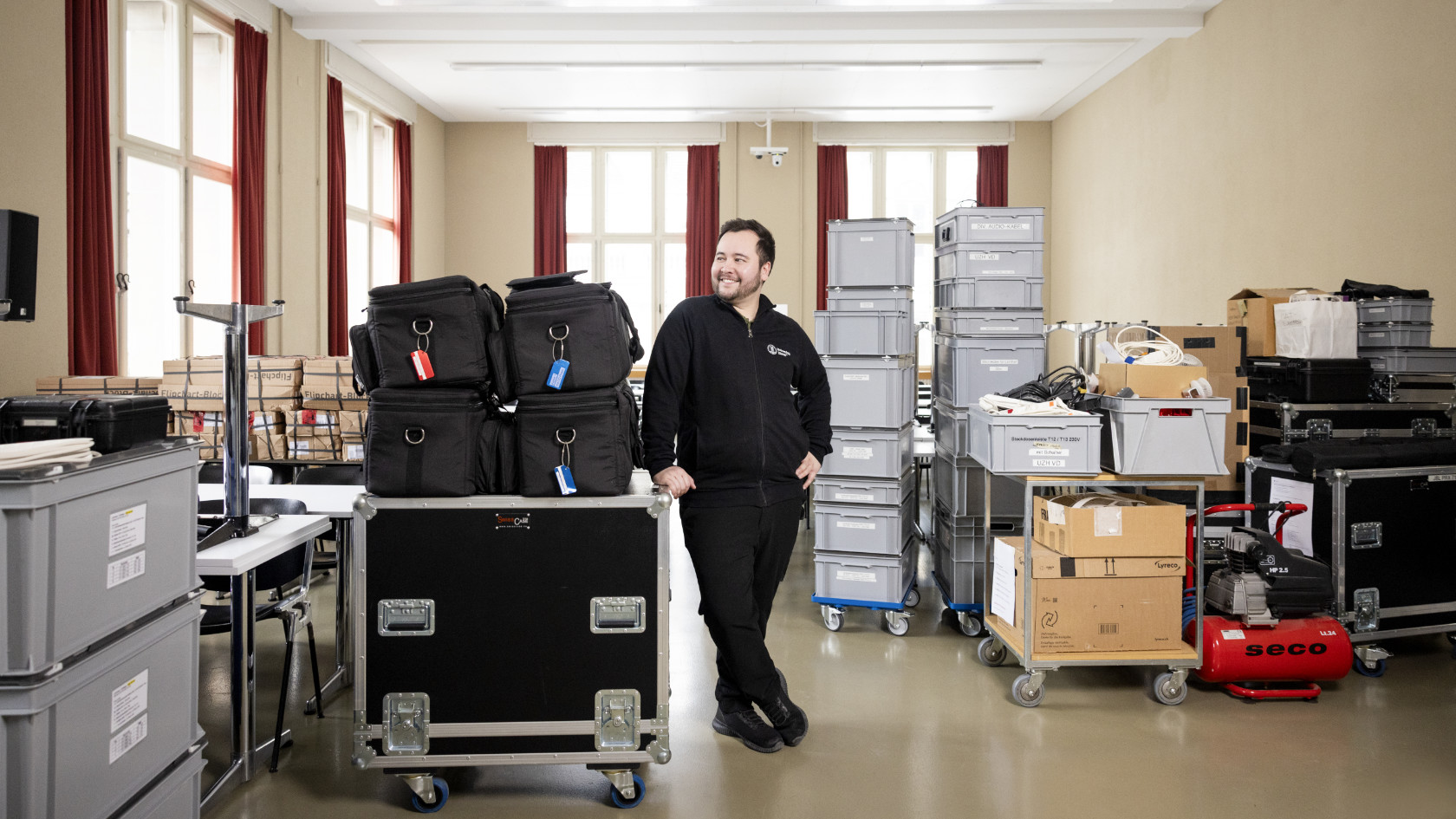
As an event project manager, I serve as the bridge between the organizers – usually departments or university staff, sometimes external partners – and the many teams across the university that are involved in making an event run smoothly. Technology, infrastructure, coordination: I know the processes, the responsibilities and some of the stumbling blocks along the way.
Projectors, microphones, sound systems – it might sound simple, but it rarely is. Where should the speaker stand in the lecture hall? How should a panel discussion be staged? Is there enough power in the room for additional equipment? Do we need high-voltage connections or special setups? I coordinate all of this with the Event Management team, which is part of Facility Management on City Campus. There are 14 of us working across the City and Oerlikon campuses. We work in two shifts and are usually the first to arrive in the morning and the last to leave at night.
Beyond the day-to-day business, I also work on various concepts, for example seating plans for different teaching spaces. Accessibility is another key issue. We’ve developed a concept that we can apply whenever needed. There are now good tools for automatic live captions during talks, for example. Another aspect is the placement of wheelchair users: we set up dedicated spaces for them at various places in the room, rather than putting them all in the back row.
What I like about my job? Every day is different. I start at seven in the morning, answer e-mails, check event setups or work at our service desk, where we lend out equipment such as webcams, headphones, cameras and speakers. In the afternoon, I work on concepts or look for ways to improve processes. When I’m supporting evening events, the day can be long. Still, compared with the private sector, the number of evening and weekend events is quite manageable. That’s something I appreciate as the father of two school-age children.
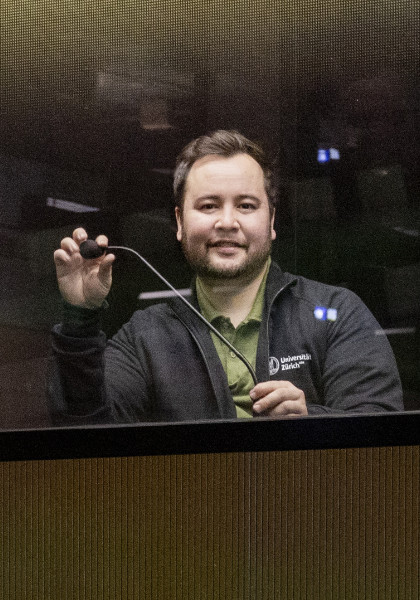
I know the processes, the responsibilities and some of the stumbling blocks along the way.
One of the challenges is that I sometimes have to turn down ideas for safety reasons. The fire disaster in Crans-Montana has once again shown how important these regulations are. My approach isn’t to say “no,” but “no, but.” I try to suggest a suitable alternative so that organizers stay motivated. My job is to help make ideas happen without losing sight of the rules.
When I receive positive feedback after a successful event, it means a lot to me. One example that stands out is the Una Europa General Assembly held at UZH in 2024. It involved a great deal of coordination both in the lead-up and during the event itself, but in the end, everyone was happy, and participants from across Europe praised how well organized it was. In moments like that, I know exactly why I enjoy my job.