What God Tells Us about Ourselves
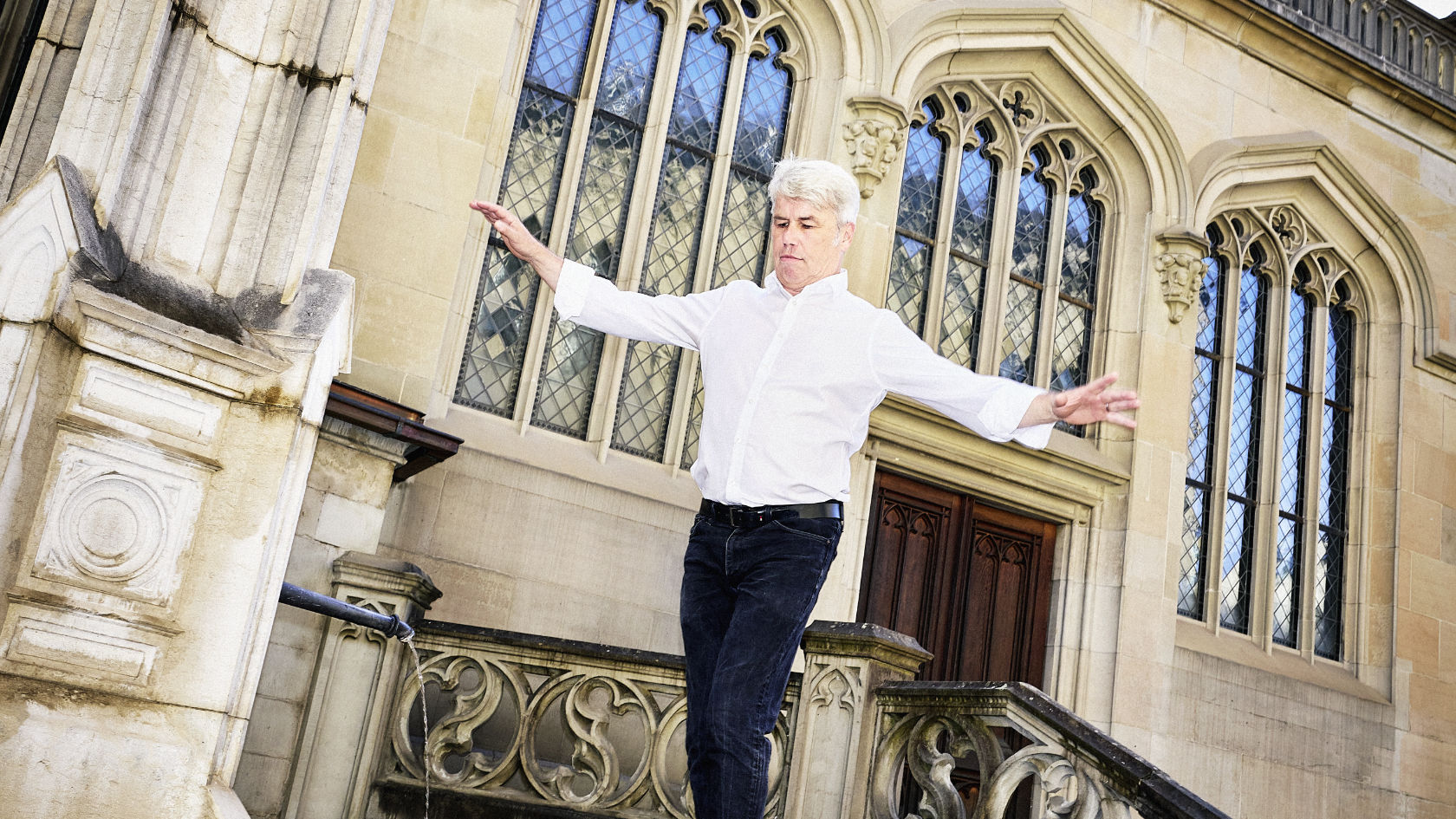
“If I asked you right now, ‘Who are you?’, how would you answer?” Konrad Schmid asks, seated in a cool corner of the cloister beside Zurich’s Grossmünster on a sweltering day in July. While I’m still deciding which facts – age, profession and nationality, perhaps – to give in my superficial answer, he cuts in: “Details such as your height, hair color, eye color, date and place of birth would tell me almost nothing about you.”
Schmid is a professor of Hebrew Bible and Ancient Judaism at the University of Zurich. To truly understand a person, he says, you need to know their story: the experiences that shaped them, the different stages of their life and the crises they’ve faced. “And that’s true not just of individuals but of the human species as a whole.” Even our ideas about what’s fair and what isn’t, for example, are products of our history.
I’m here to find out how theology can help us with our understanding of human beings. Schmid clearly believes the roots of our modern ways of thinking and ethical patterns are to be found in the earliest texts of the Old Testament. “If we want to understand who we are, we need to know our history and, above all, our cultural history” – a history rooted not only in classical ancient Greece but also in the great civilizations of the Fertile Crescent, stretching from Egypt to Mesopotamia. This is the world in which the Bible took shape.
Texts that evolved over time
As a scholar of Old Testament scriptures, Schmid’s research goes into the foundations of our cultural history. He studies how the texts came into being, which prevailing ideas they absorbed and developed, which historical events they referred to, and how they were later reinterpreted. His work also draws on archaeological and anthropological findings.
Many biblical books are texts that evolved over time, he explains. “The Bible is made up of different documents written over a thousand-year period, in different places, at different times and by different people.” In that respect, it’s more like a library than a book: a widely diverse collection of stories, legal texts, psalms, prophetic writings and wise sayings.
Sacred Scripture or not, Schmid doesn’t approach the Bible as the word of God but as the most impactful book in human history. Precisely because it’s a human document, it’s of immense interest to scholars, and its influence extends far beyond the church and religion. “Whether you go to church or not, you’ve been shaped by the Bible’s world view, by the intellectual developments it records and those it inspired,” Schmid explains as a group of tourists are led through the cloister, briefly interrupting our conversation. Without losing his train of thought, he adds: “And one of the most consequential intellectual developments was the emergence of monotheism.”
World religion emerges from the margins
For Schmid, this raises one of the most intriguing questions in his field: how did a small state, wedged between the great empires of the time, come to conceive of a single God? To answer that question, he says, we need to upend our usual perspective. Today, the land where the Bible emerged can seem like an ancient cultural center largely because the Bible went on to have such enormous influence. But in the first millennium BC, it was very much on the margins. “Egypt and Mesopotamia were much older civilizations, reaching back to the fourth and third millennia BC. The small state of Israel didn’t even enter the picture until around 1000 BC.” Israel, Schmid says, was “not only a political, military and economic pawn between the great powers of the ancient Near East but a cultural and intellectual one as well.”
In that world, every country had its own gods. The larger states had complex divine hierarchies – Egypt’s belief system, for instance, included some 20 major deities next to many hundreds of minor gods and goddesses. Smaller states often had just one local deity. To explain this contrast, Schmid draws on a fundamental anthropological principle: as a rule, people tend to imagine the divine realm as analogous to their own form of organization. The god of Israel and Judah was called Yahweh. For Schmid, the fact that this god had a name already points to a polytheistic environment. A god only needs a name when other gods are conceivable. If there’s only one, “God” is enough.
So how did this local deity become the one God recognized across the world? Schmid’s surprising answer lies in the political history of the ancient Near East. “From an intellectual-history perspective, monotheism is a political category.” The idea of a God who rules over the world, he argues, necessitates the experience of a worldwide empire.
Opposition to occupation
The small states of Israel and Judah were subject to that experience in the 8th century BC, when they came under pressure from the Assyrian Empire and later Babylon. Usually, the conquest of a small state generally signaled the end of its deity too: when a people were defeated, their god appeared to have been too weak to protect them.
But in Israel and Judah, a different story began to emerge. Their defeat came to be understood as part of a larger divine plan. According to this interpretation, the imperial powers were merely instruments in Yahweh’s hands: used, for instance, to punish Israel or to steer the course of history. Even though Israel had been defeated, their own god had been responsible for everything that happened – and was therefore more powerful, not less. In this sense, Schmid argues, the unequivocal call to monotheism found in Deuteronomy “Hear, O Israel: The Lord is our God, the Lord alone” can be read as an intellectual response to the experience of occupation. Loyalty was not owed to the Assyrian ruler or to Ashur, the chief Assyrian chief, but to Yahweh alone.
The political realities of the time are also reflected elsewhere in the Old Testament – in ideas that sound surprisingly egalitarian today, Schmid says. “Above all, the idea that human beings are made in the image of God.” He becomes animated as he describes his semantic explorations through the book of Genesis, a line of inquiry that led him to some of the deepest roots of ideas about equality in the ancient world. In the Near East at this time, the king was considered the image of God. In Genesis 1, however, this dignity is extended to humanity as a whole: “And God created mankind in his own image; in the image of God he created mankind; male and female he created them.” God also gave them dominion over creation, we learn.
Every journey has to begin somewhere, and it helps to know where those beginnings lie and who paved the way, and why.
The revolutionary idea contained in these familiar lines is easy to overlook today, Schmid says. Genesis was written at a time when Israel and Judah no longer had their own kings, and it was precisely then that the texts record a significant shift. The king is no longer the one who is godlike or serves as God’s representative – which, in the context of the time, would have been the Assyrian or Babylonian king. Instead, the privilege of being created in God’s image was extended to everyone.
And there’s another important detail. In Hebrew, Schmid explains, “image” doesn’t mean a likeness or portrait but a “statue” – “something intended to symbolize the presence of the person represented.” Human beings therefore don’t physically resemble God; they stand for God’s presence and function in creation.
Of course, Schmid acknowledges, it was then a long journey from this pronouncement in Genesis to the words of the American Declaration of Independence (“We hold these truths to be self-evident, that all men are created equal…”). Along the way, he points out, Greek philosophy, the Reformation and the Enlightenment all played their part in shaping this idea of equality. “But every journey has to begin somewhere, and it helps to know where those beginnings lie and who paved the way, and why.”
The stories that shape us
So what does this one God tell us about the people who imagined him? For Schmid, the emergence of monotheism marks a fundamental change: “Here we find a view of humanity that continues to remain relevant even in the 21st century – the idea that human beings, standing before the one God, are limited beings.” Humans are to be seen as “creatures not creators”, existing within a reality that transcends them. This is the image the Bible uses to develop ways of thinking about how we, as humans, are to manage what we can’t control: chance, mortality and things beyond our power.
What makes Schmid’s research valuable is the way it traces these ideas back to the historical circumstances in which they emerged. The Old Testament texts grew out of conflicts, crises and exchanges with the great neighboring superpowers. They show how concepts as fundamental as monotheism developed in situations where people had to make sense of what was happening to them: defeat, foreign rule and loss of security. For Schmid, the fact that this kind of research produces no immediately applicable results is no shortcoming. “Universities are defined by the fact that they conduct research free from vested interests.” Its value lies in insights “that may only become relevant later.”
That said, Schmid’s scholarly approach already matters today. It stands in contrast to a resurgent form of biblical fundamentalism that has gained considerable political influence, particularly in the United States. These evangelical movements treat the Bible as a firmly fixed foundation to be understood literally. Schmid, by comparison, takes an inquisitive and interdisciplinary approach, describing the ancient biblical texts more like fertile earth in which some of our essential ways of thinking took root. In terms of intellectual history, this comes as a surprise – and with clear political implications across the Atlantic too.
For Schmid, theology ultimately circles back to the questions people have been asking for thousands of years: “Where are we actually heading? Where do we come from? What matters in life?” He is convinced that the Old Testament “contains ideas that are still worth pursuing today.” So, if we ask ourselves once again, “Who are we?”, at least part of the answer lies in those ancient stories that Konrad Schmid finds in his explorations. We leave the cool shade of the cloister. At this “Reformation power spot,” as he calls it – a place where a new way of interpreting biblical texts has already had historic impact – this idea doesn’t seem quite so abstract after all.