Fragile Stability Between China and the U.S.

The timing couldn’t have been better: Just as the U.S. midterm elections were reshaping the political landscape in Washington, Kevin Rudd took to the stage in UZH’s main auditorium to discuss the “State of Asia." Until earlier this year, Rudd served as Australia’s ambassador to the U.S., the latest diplomatic posting in a distinguished career. He served twice as Australia’s prime minister, with a term as foreign minister in between.
In Addition, as a trained sinologist with extensive political and economic experience in China, Rudd has a thorough understanding of the country and it’s president. In 2022, he completed a doctoral dissertation on Xi Jinping’s ideological worldview.
Rudd sees the U.S. election results as a message from voters that politicians should focus more on domestic issues, above all the rising cost of living for workers and the middle class. In particular, he believes that, for many voters, U.S. involvement in the war in Iran has gone too far: “I think what the American people are saying to the President of the United States is: enough is enough.”
Clarion call for Trump
“The open question is how will President Trump respond to this clarion call from the American people to rein it in?” During his time as ambassador, Rudd visited the Oval Office several times and observed Donald Trump up close. “Anyone who pretends that they can predict the behavior of the President of the United States tomorrow is deluding themselves”, Rudd said. “The President's creative position to deliver political surprises remains constant.”
With Democrats controlling Congress for the final two years of Trump's term, Rudd argued that the president would have less room to shape tax, economic and social policy and build a domestic legacy. In foreign policy and as commander-in-chief, however, he has considerable scope to act without congressional approval. Rudd warned that Trump might use these powers to secure a lasting legacy.
-
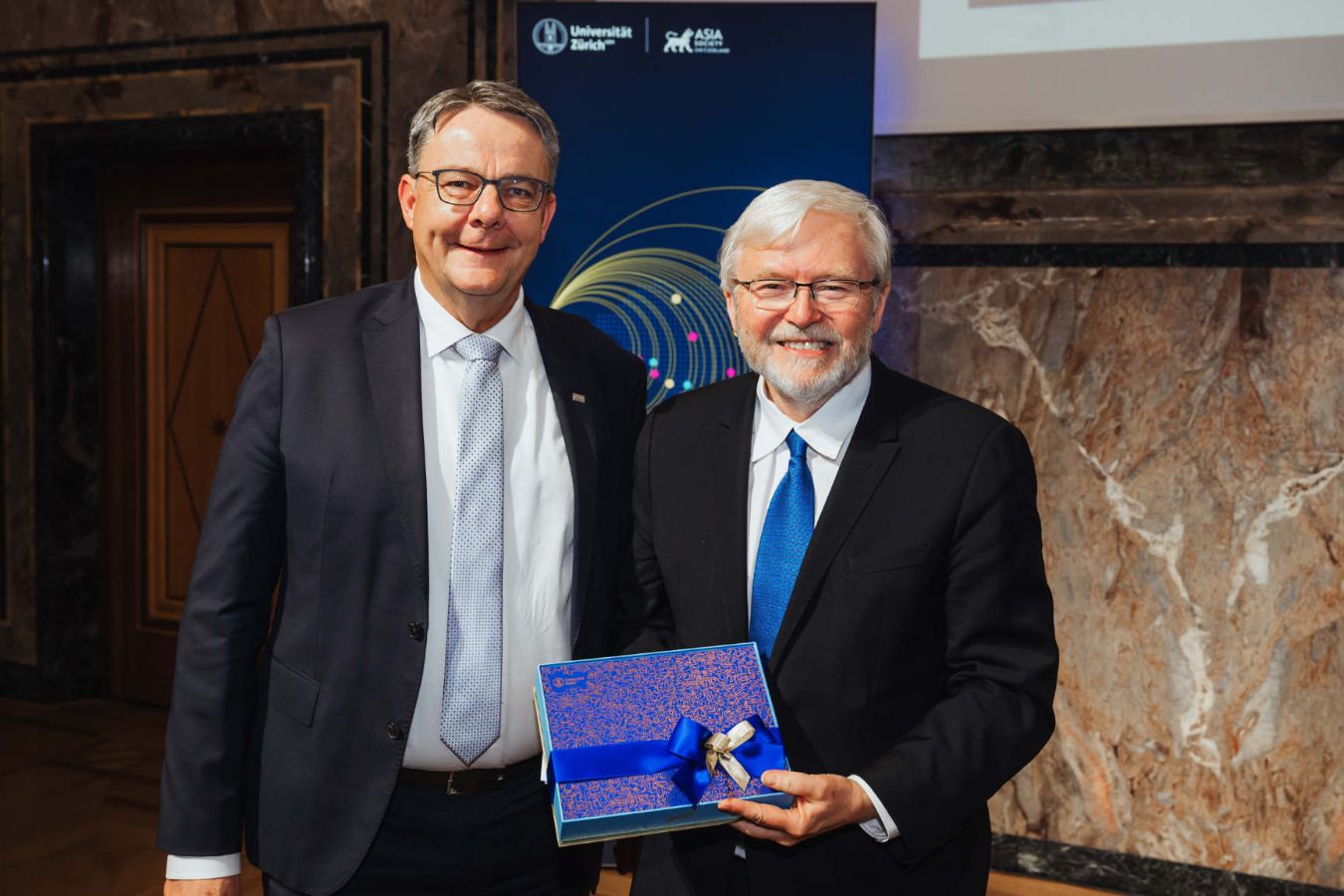 President Michael Schaepman welcomed Kevin Rudd on behalf of UZH.
-
-
-
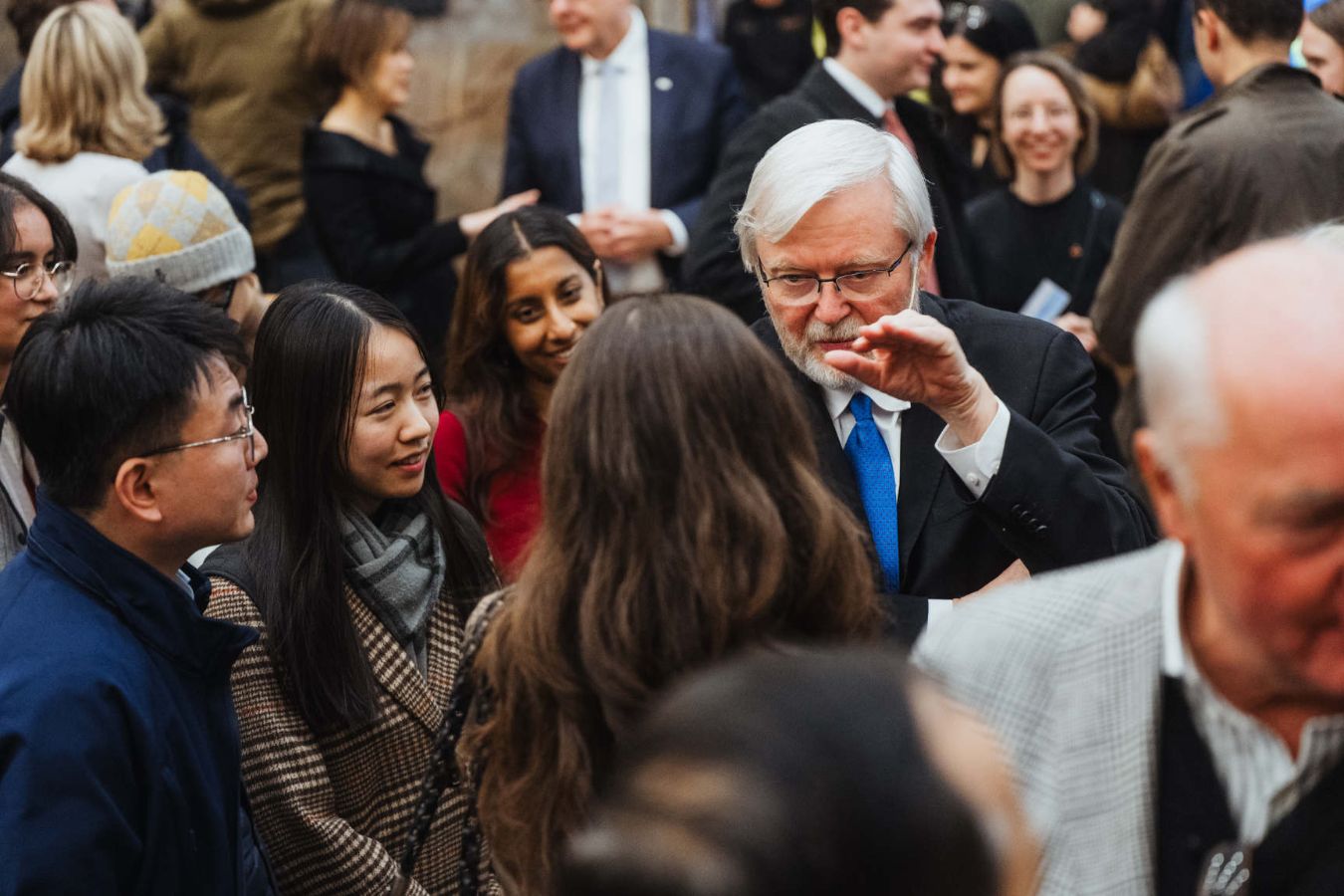
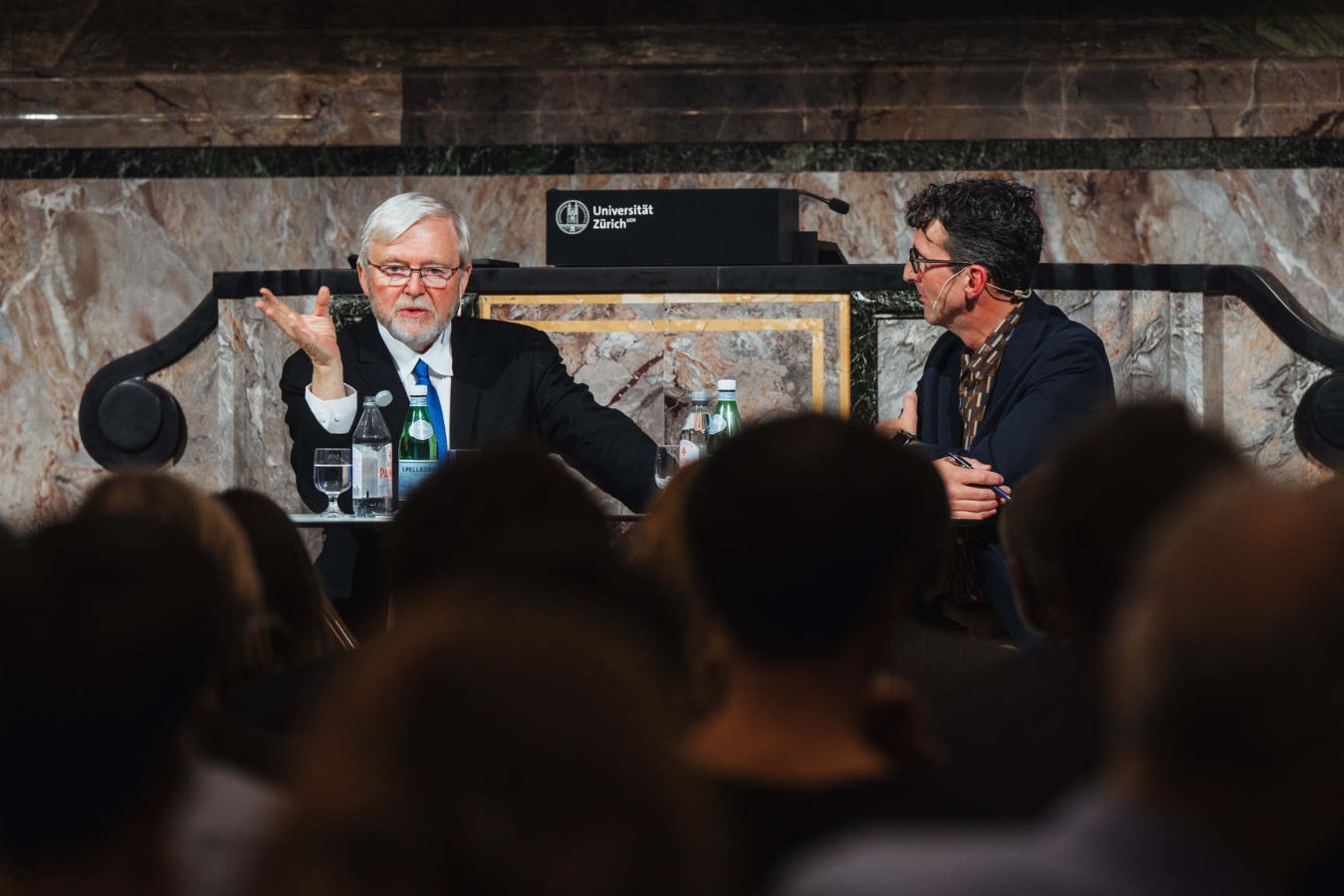 Kevin Rudd with Remko Tanis, Managing Editor of Asia Society Switzerland, who moderated the Q&A session.
-
Rudd focused on two potential flashpoints: Iran and Cuba. Will Trump order a major military operation against Iran following the midterm elections? Having closely observed the region for many years, Rudd believes it would be “unwise in the extreme” to think that a military strike could force Iran to the negotiating table. He is convinced that ending the conflict and reopening the Strait of Hormuz would become even more remote prospects, as both sides would be drawn into a far more devastating war than the current conflict.

We should all buckle up and get ready for Xi Jinping being in office not just for another five years, but another 10 or 15 years.
He is equally clear in warning the U.S. against taking military action against Cuba to force regime change. “American presidents have tried this once before in history and it did not turn out well,” Rudd said, referring to the Bay of Pigs invasion under President John F. Kennedy in 1961.
Long-term perspective in China
While the U.S. is experiencing a shift in the political balance of power, China is heading in the opposite direction. “We should all buckle up and get ready for Xi Jinping being in office not just for another five years, but another 10 or 15 years.”
Rudd describes Xi as a Leninist whose overriding aim is to secure the Communist Party’s long-term hold on power. To that end, Xi trusts only party officials who have risen through the ranks under his ideological guidance. According to Rudd, it takes thirty years for party members to reach leadership positions. By his reckoning, Xi has led the party for around 15 years and will therefore need another 15 years before officials schooled in his doctrine occupy the top positions. “There is a method, therefore, in Xi Jinping's approach to what he's doing.”
In economic policy, Xi has shifted China’s center of gravity toward the Marxist left. “You see it, for example, in a much greater emphasis now on central planning as opposed to the role of the market,” Rudd explained. Similarly, there is a greater emphasis on revitalizing state-owned enterprises rather than relying on the private sector. This approach is also reflected in Xi’s long-term strategy to modernize China’s technology and industrial sectors rather than leaving their development to the free market.
This strategy, backed by government investment, is one of two drivers of the Chinese economy. The other, according to Rudd, is large-scale production for export. Rudd cited a study published just a few days ago showing that China accounts for 38.5 percent of global manufacturing output. A conservative projection puts its share at 40–45 percent by 2030.
Stable but fragile
What does all this mean for U.S.-China relations? “Both sides have decided that their interests at this stage lie in stabilising the bilateral relationship,” Rudd said. He identifies three reasons for this. First, China relies on the U.S., its third-largest export market, to sustain economic growth. Second, China wants the U.S. to lift restrictions on semiconductor exports to China.
Third, Donald Trump wants China to normalize U.S. access to certain minerals and rare earth elements that are critical to industry. These interests underpin a fragile understanding between the two countries. Rudd remains uncertain about how the relationship will develop: “This could go either way.”