Automobiles and Old Irish
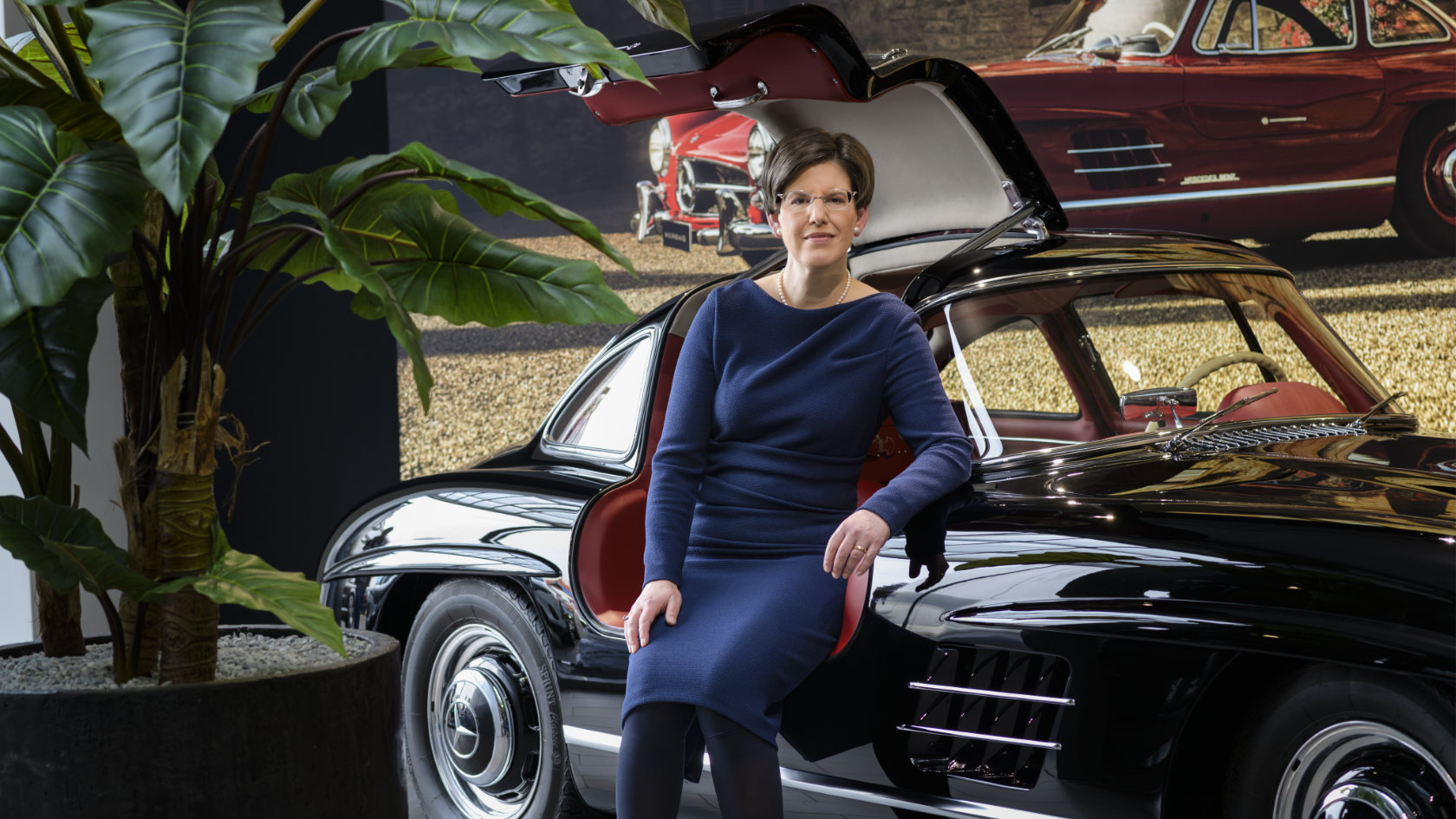
Karin Stüber stands at the window of her fifth-floor office in Schlieren, gazing down at the sleek machines parked on display, outdoors and in the showroom, like exhibits in a museum. Shimmering in silver, blue and anthracite, and boasting up to 265 horsepower, the line-up ranges from classic, hybrid and electric to compact, elegant, sporty and bold – all bearing the Mercedes star.
Stüber smiles. As a child, she spent more time reading books than playing with toy cars. Since then, language has always been her world. And yet here she stands, following in her father’s footsteps as chair of the family business, Merbag Holding, one of the top five Mercedes-Benz dealers in Europe. Two billion francs in annual revenue. 4,100 employees.
From academia to the boardroom
Six years ago, Stüber left her professorship in Comparative Linguistics at the University of Würzburg to join the family business. Since 2022, she has also served as president of the German-Swiss Chamber of Commerce. Her days are now taken up with strategic and entrepreneurial planning, punctuated by meetings with staff members, the executive team and the board.
Accordingly, the books on her shelves focus on management and business strategy – and contain figures and models, not Indo-European vocabulary. Those are found at home in Zollikon, or in the university library. And they’re certainly not gathering dust as Stüber is still firmly dedicated to her research. As head of the Celtic Studies Group at the UZH Institute for the Interdisciplinary Study of Language Evolution (ISLE), she and her colleague are studying how languages transform and diversify.
What makes Old Irish so exciting is how much it differs in structure from other Indo-European languages – and how little it has been studied.
Stüber’s primary interest is Old Irish, a language spoken mainly in Ireland between roughly 700 and 900 CE. Through a SNSF research project, the team is investigating the syntax of Old Irish – specifically how subordinate clauses are formed and used. Together with her associate, she has compiled a database of nearly 10,000 text passages, which they are now analyzing in meticulous detail.
What makes Old Irish so exciting, she says, is how much it differs in structure from other Indo-European languages – and how little it has been studied. “This is a field where we can do genuinely original research,” Stüber says, her eyes lighting up. She has already proven the point: the linguist recently identified a conjunction that doesn’t appear in any existing dictionary.
Sources for exploring the ancient language are few and far between. Most are glosses: explanations or translations of manuscripts written in tiny script, legible only with a magnifying glass and a good deal of patience. “Fortunately, the collections have now been digitized,” Stüber says with a smile.
Whenever possible, she reserves at least one full day or half-day each week to ensure the project makes progress. “Now I can decipher and analyze the texts on my computer. In the old days, you’d have had to physically travel to monastic libraries with a magnifying glass.” One manuscript is kept in St. Gallen, another in Milan, and a third in Würzburg – an advantage she enjoyed when she still held her chair in Comparative Linguistics there.
A fascination for the ancient world
Here in Schlieren, rain beats against the office windows. Outside, cars race past on the wet road, sending up fans of spray behind them. It’s a rather austere environment – a main arterial road lined with car washes, fast-food chains, furniture warehouses and gas stations. How in these uninspiring surroundings does the car dealer still manage to find room for Old Irish vocabulary?
Karin Stüber tucks a strand of hair into place and begins to talk about her family. She grew up in a culture-loving household. Her father, Peter Stüber, gave his eight-year-old daughter a youth edition of Homer’s Odyssey and Iliad – and she was instantly thrilled by that ancient world. “The fascination never left me,” she says. She chose classical languages in upper secondary school and later went on to study Greek at university.
On discovering linguistics, she was hooked when she realized there were even more of those mysterious ancient languages waiting to be explored. “A whole new world opened up to me,” she says excitedly. At home, no one raised an eyebrow when she turned to Indo-European studies – a niche field often regarded as rather futile. “It was, of course, a privilege to be able to follow my passion,” Stüber acknowledges.
In the private sector, you can take a chance without having to worry about academic constraints.
It wasn’t as though the Stüber household smelled of gasoline. Life in the family’s villa had a decidedly more cultivated air. And perhaps her parents were so supportive of her following her passion because her father himself had been denied that chance. “For my father, it was always understood that he would take over my grandfather’s automobile business,” she says, even though he was attracted to the fine arts.
His daughters, by contrast, would be free to find their own paths. Her father pursued his artistic passion by attending concerts at the Tonhalle concert hall and served for 22 years as president of the Tonhalle-Gesellschaft Zürich. In this, too, father and daughter are alike. Today, Karin Stüber is vice president of the Tonhalle’s Circle of Friends and plays an active role at the Zürcher Sing-Akademie, where she chairs the foundation board. She herself plays both piano and organ.
Piano and singing
When she was in Ireland working on her dissertation – immersing herself in Celtic morphology at the National University of Ireland in Maynooth – she occasionally stepped in for the organist at services in the local Anglican church. “As a pianist, I could play Anglican organ literature well, because it’s often written without pedal,” she explains.
Back in Switzerland, she began taking organ lessons to become better acquainted with the instrument, and before long was substituting for her teacher whenever a stand-in was needed. She also played at services from time to time in the Anglican church here. These days, she only plays the piano at home for herself and has recently started singing with a newly founded vocal ensemble named Klangwelt, which is currently rehearsing a program of German and French Romantic vocal music in preparation for a concert in March.
Keeping the company culture
How ever does such sophistication survive alongside the day-to-day business of wired engines and welded car parts? And how did a professor manage to establish credibility in the auto industry? Of course, Stüber was no stranger to the family firm, and people there knew her; she and her sister had long served on the board.
Even so, the plan had been to bring in an external manager to run Merbag once her father stepped down. But when the moment came, things took a different turn. Handing over this historical family business simply didn’t feel right, she recalls. “The company culture is something precious and closely interwoven with our staff’s personal stories – and you don’t put these at risk lightly.”
Responsibility towards employees
Take the new CEO, for example, who completed his apprenticeship at the company and whose father had already worked there as a mechanic. After his years of training and gaining experience elsewhere, he returned and ultimately rose to lead the business. “The decision to keep the company in the family was also driven out of a sense of responsibility toward our employees,” Stüber says.
Despite initially pursuing an academic career, she always maintained a bond with the business. Her sister, who had studied economics, was too occupied with her own family to take on that level of responsibility. So the two divided the roles: while her sister chose to oversee the branch of the business that manages non-operational real estate, Karin Stüber stepped into the automotive side. After her linguistics professorship in Würzburg, she completed an MBA to equip herself for the task.
What’s the difference between business life and academia? Stüber laughs. “Freedom! In the private sector, you can take a chance. You can make a decision and accept a risk without having to worry about academic constraints, cumbersome hurdles and theoretical assumptions.” Of course, things can go wrong, a deal can fall through. You have to understand the risks. But Stüber can already point to several successes, having seen the company grow and move closer to its goal of becoming the largest Mercedes dealer in Europe.
Future challenges
However, things are not looking rosy for the automotive industry. The market is in danger of stagnating, with the climate crisis and shifting consumer behavior both raising questions on how the industry needs to shape up for the future. Mercedes-Benz, too, has taken action to respond to changing demands, Stüber says. Production of electric models has been ramped up, and workshops adapted for flexibility.
And what about the future of the linguist? Karin Stüber laughs again. For now, there is still plenty of Old Irish syntax left to explore, and countless glosses to be broken down into their component parts. The SNSF project is a four-year endeavor. And then there’s the vocal ensemble heralding the start of spring in March. For Karin Stüber, intellect and industry continue to live comfortably side by side.