“A key player in matters of digital transformation”
Exactly 10 years ago, on 14 September 2016, UZH launched the Digital Society Initiative (DSI) with the goal of establishing UZH as a center of excellence in matters of digital transformation. Informatics professor and DSI Director Abraham Bernstein, who initiated the founding of the initiative, explains whether this has been successful, and why AI was barely a talking point 10 years ago.
When the Digital Society Initiative (DSI) was founded 10 years ago, UZH set itself the goal of becoming the Center of Competence for digital transformation in Switzerland. After 10 years, has the DSI achieved that goal?
Abraham Bernstein: Yes, in fact we’ve made much more progress than I could have ever imagined. Ten years ago, a small group of us began thinking about how to navigate the radical changes being brought about by digitalization. Now, the DSI is a network comprising 1,600 researchers, more than 300 of whom are professors. I don’t think there’s any other topic that unites so many researchers at UZH.

Most of the opportunities offered by digitalization can only be realized by incorporating a wide range of different perspectives.
This seems to show just how deeply digitalization now permeates every sector. What role has the DSI played, and what role does it continue to play, in addressing this development?
From the outset, we designed the DSI to serve as a catalyst and a focal point for coordination. A key aspect of digitalization is that many opportunities – and also risks – cannot be addressed within the scope of a single discipline. There are always various elements at play, each requiring different perspectives. There are technical, legal, psychological and sociological factors, all of which must be taken into account. Most of the opportunities offered by digitalization can only be materialized by incorporating a wide range of different perspectives.
All universities have been forced to respond to the challenges posed by digitalization. What’s special about the DSI?
In my view, what makes the DSI special is that we’ve managed to bring together so many researchers from such a wide variety of fields. There are similar initiatives, for example, in the Netherlands, where they are structured more like NCCRs, or in Germany, which has established the Weizenbaum Institute. But ultimately, they are comprised of a handful of outstanding researchers conducting research in the field. I’m not aware of anything comparable to how the DSI permeates the entire structure of the university and all subject areas, from Study of Religions to Veterinary Medicine. That’s definitely a stand-out feature.
-
 DSI Founding Director Abraham Bernstein in conversation with Federal Councilor Johann Schneider Ammann on the first Digital Day in 2017. “Back then, many people didn’t yet realize how profoundly digitalization would change society,” Bernstein says today. (Image: Frank Brüderli)
 -
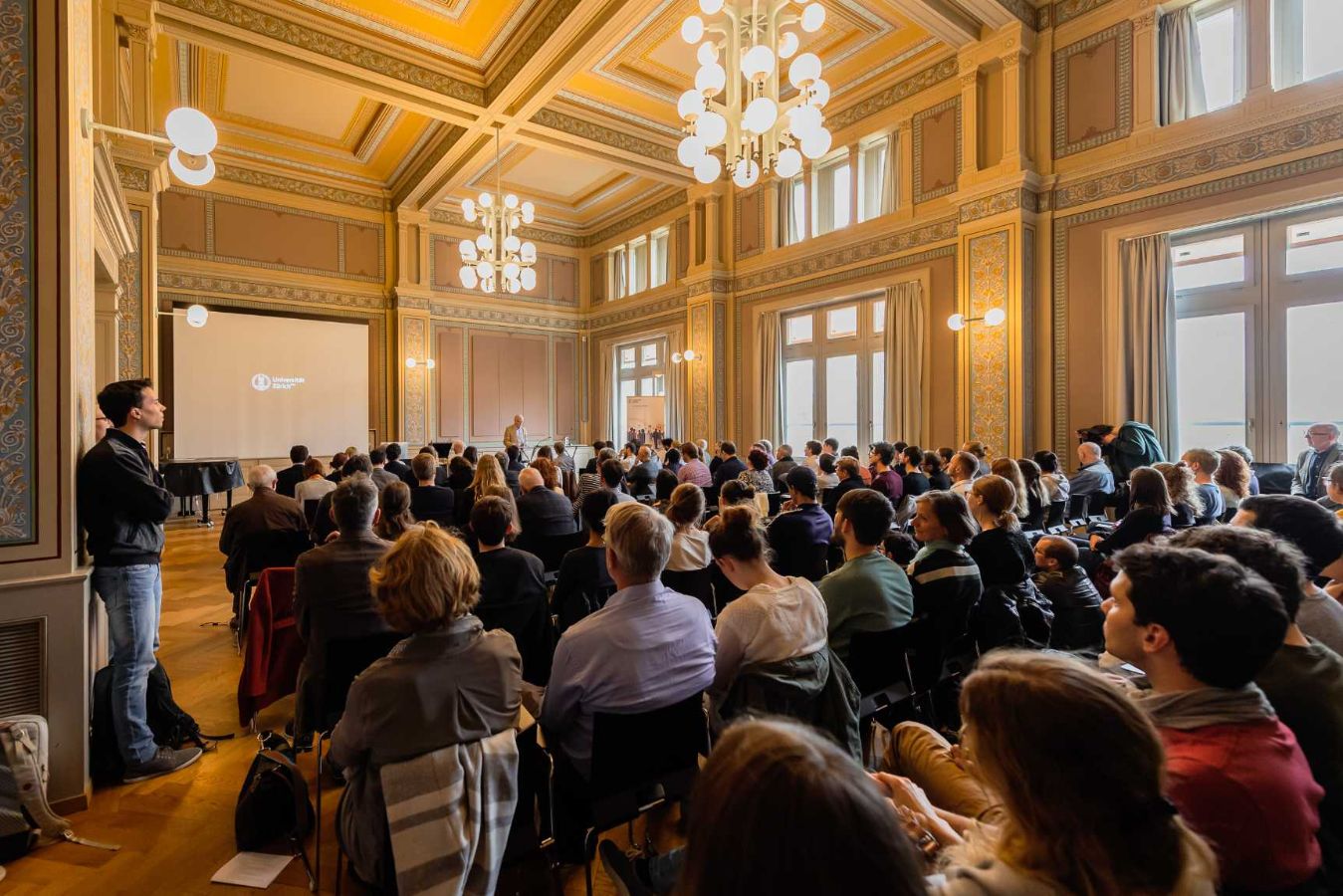 There was great interest in the UZH Digital Forum 2019, which addressed issues related to big data and artificial intelligence in a series of events. (Image: PD)
 -
 The first Digital MasterClass took place at the Federal Palace in Bern right in the midst of the COVID-19 pandemic. “We managed to engage regularly with members of Parliament and discuss technical developments and their societal implications with them,” says Bernstein. (Image: Video still, Brigitte Blöchlinger)
 -
 Networking is an important part of the DSI, even in informal settings, such as here at the 2023 summer party. (Image: PD)
 -
 At the 2024 AI-X Conference, the DSI made a highly acclaimed presentation on the topic of artificial intelligence (AI). “The DSI’s strategy paper on the regulation of AI in Switzerland influenced how Switzerland now intends to regulate AI,” says Bernstein. (Image: PD)
 -
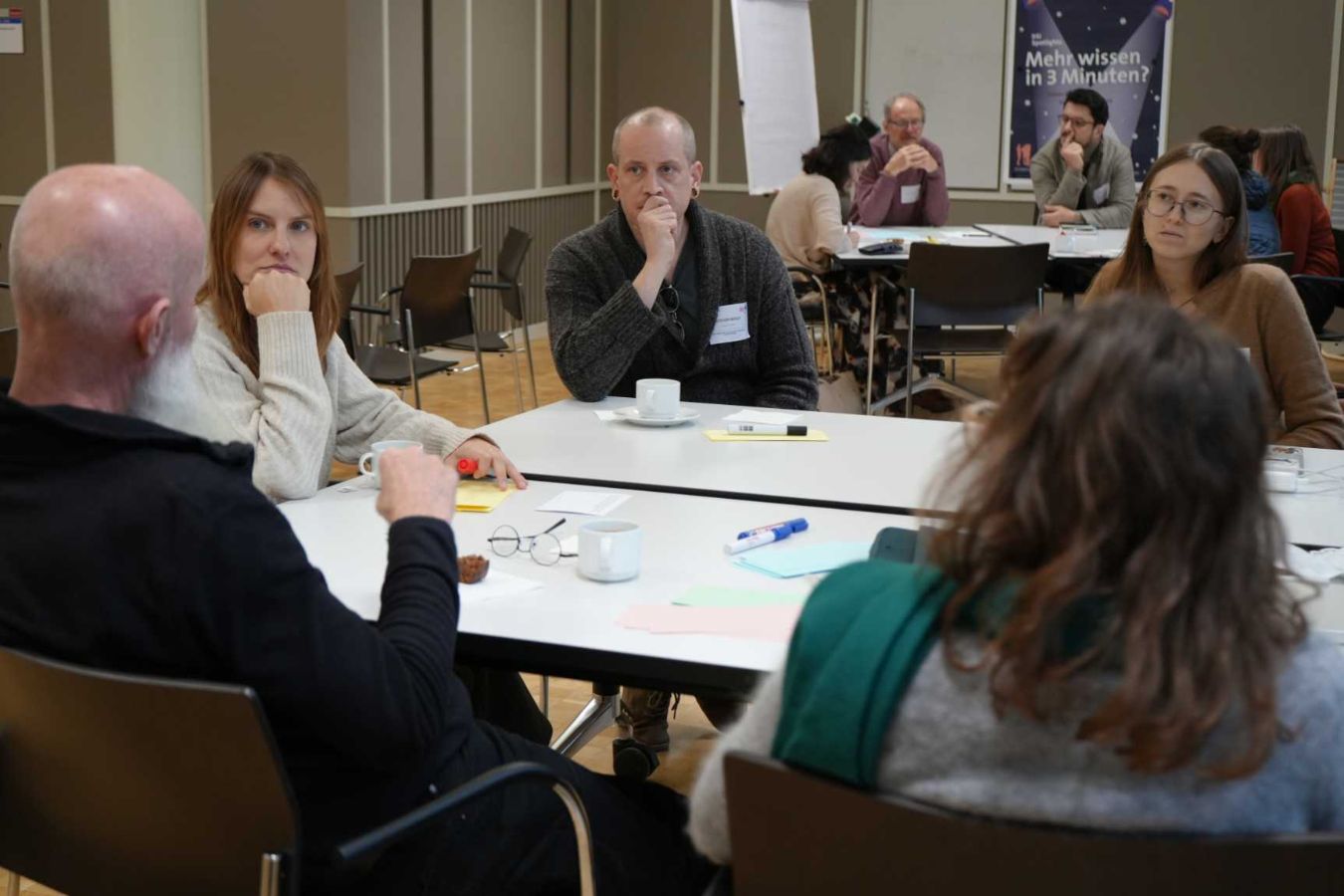 DSI members attend a workshop as part of the Strategy Lab 2025: “The statements and recommendations in the white papers had a noticeable impact on regulators and policymakers.” (Image: PD)
Has this also received attention beyond the university?
Yes, we receive inquiries from government agencies, companies, associations and so on. UZH is seen as a key player when it comes to matters of digitalization. This is especially true in areas where we have extensive expertise, from legal matters to the social sciences, but also when it comes to the technical topics in which UZH is a leading expert and is advancing digital technologies.
Can you give a specific example?
With Davide Scaramuzza, UZH has significantly advanced technical development in the field of autonomous drones, for example. This is an area where one must always be aware of the societal implications. A second example is what’s known as post-quantum encryption. Quantum computers are expected to become so powerful that most of today’s encryption techniques will become obsolete. This calls for new solutions – the kind that UZH mathematicians are developing. There are also various applications, for example in medicine and dentistry, developed in collaboration with other institutions such as Balgrist University Hospital.
If I had said 10 years ago that AI would have a negative impact on people’s lives, I’d probably have been laughed at.
In addition to the extensive network you mentioned, new professorships have been created across all faculties over the past decade as part of the DSI – 36 in total. On the one hand, that’s an impressive number. But is it enough, given the wide range of topics involved in digitalization?
I believe that significantly more than 36 professorships related to digitalization have been created or filled at the University of Zurich (UZH) during this period. Nowadays, there are very few fields you can imagine functioning without digitalization. That applies to media studies, economics, medicine, or any other discipline. If someone is appointed today, there’s a relatively high chance they also address digitalization issues in their work. Many of these individuals eventually come to the DSI because they recognize it as a valuable resource. The DSI brings together individuals with complementary skills who can collaborate on projects.
When the DSI was founded 10 years ago, artificial intelligence (AI) was barely on anyone’s radar. Today, it’s practically the exclusive focal point of any discussion about digitalization. Were you and the DSI taken by surprise by these developments?
Most people expect me to answer yes to this question. However, I’ve been doing research with and on AI for nearly 30 years. When we were talking about large language models, we were really talking about AI. We’ve all been relying on AI for a very, very long time – think of the voice assistants on our smartphones, for example. These technologies have improved significantly over time, and it was clear that there would be a “tipping point” – a moment when an application would become so good that it would suddenly go mainstream. What struck me more was how surprised people were that this point has now arrived.
Ten years of DSI in numbers
- Over 1,600 researchers in the network, including more than 300 professors from the University of Zurich.
- A total of 40 professorships (assistant professorships with or without a tenure track, ad personam professorships, full professorships, DIZH bridge professorships, and associate professorships) have been created across six faculties, of which 35 are currently filled.
- Thirteen DSI Communities are currently working on specific topics related to digital transformation.
- Twelve postdoctoral positions were created as part of the DSI Bridge Postdoc Program.
- Three academic programs with various modules at all levels of UZH (Bachelor’s degrees, Master’s degrees and PhDs).
- One hundred and five doctoral students across seven cohorts have participated in the DSI Excellence Program (PhD) to date.
- Twenty-one projects were funded through the DSI Infrastructures & Labs program, seven of which are currently still active.
- So far, six position papers have been published through the DSI Strategy Lab think tank.
- So far, over 20 events involving members of the national and cantonal parliaments have taken place as part of the Digital MasterClass series.
Apart from AI, how has the perception of digitalization changed over the past 10 years?
I think that 10 years ago, many people hadn’t yet realized how profoundly digitalization would change society. People were thinking more in terms of computers getting faster. If I had said back then that AI would have a negative impact on people’s lives, I’d probably have been laughed at. Yet, according to a survey in the USA, 50% of young people now believe exactly this. No-one any longer doubts that digitalization is having a major impact on society. What will happen to my job? Does social media lead to polarization? Is society ultimately becoming more divided? These questions are on many people’s minds today.
They primarily address fears related to digitalization. The DSI has taken action to not only in terms of highlighting these risks and developing solutions, but also when it comes to seizing the opportunities. How are things looking on that front?
I believe we’ve succeeded in identifying opportunities across a wide range of areas. A specific example of polarization: as part of a joint project between informatics and media studies that originated at the DSI, we were able to demonstrate that polarization can be reduced when media consumers receive and read as diverse a range of news sources as possible. That would be an approach worth pursuing, but it would also require structural changes in the media landscape. In the healthcare sector, too, there are now solutions that weren’t possible 10 years ago.
Nevertheless, many people have fundamental fears, such as losing their jobs or being under constant surveillance. We need to consider how to address this and how we, as a society, should respond.
In the master classes, we can discuss burning issues for parliamentarians without being distracted by day-to-day political affairs.
What can academia, and specifically the DSI, do about this?
Once a year, the DSI publishes a white paper – a manifesto – on a socially relevant topic. These formal statements and recommendations have had a noticeable impact on the regulators and policymakers who are specifically addressing how certain areas should be regulated. We wrote our first white paper in 2021, focusing on the regulation of AI. We presented it at the Federal Palace, and it influenced how Switzerland now plans to regulate AI.
In addition to the white papers, the DSI has also been conducting master classes on digitalization for national and cantonal parliamentarians for several years. Are they having an impact?
The master classes are a huge success in my opinion. We’ve managed to engage in regular discussions with parliamentarians, talking to them about technological developments and their societal implications. In the master classes, we can discuss burning issues for parliamentarians without being distracted by day-to-day political affairs, such as data protection, artificial intelligence and the media. We shouldn’t underestimate the importance of getting to know each other and building connections, because when we do, politicians also reach out to us when they need expert opinions on a topic.
Let’s take a look toward the future. As you mentioned earlier, digitalization has reached the core of society. It’s clear to everyone that societal changes are underway. Does the DSI still have a role as a catalyst for digitalization?
With the DSI, we’ve managed to provide substantial support for interdisciplinary research at the UZH and advance it. A catalyst of this scale is quite unique. Some might say we’ve been digitizing for 10 years now, and at some point, it’s enough. However, I believe that social change is not yet over, whether it’s the way we work or the way we communicate. We still don’t know what the world of work will look like in 10 or 20 years. That’s why I believe it remains UZH’s duty to provide answers.
What does it take to make that happen? How would the DSI need to evolve so that UZH can also take on this role?
Personally, I think it’s important to keep creating spaces where people from a wide range of disciplines can collaborate. On the one hand, open spaces do indeed mean physical spaces, but they also mean funding that is available across disciplines to enable collaborative research. For example, one pressing question is: how will we work with AI as a tool in the future, and how will we collaborate with it as a virtual colleague, so to speak? There’s no answer to that yet. To find one, we need experts from business administration, computer science, economics, sociology and psychology to come together and collaborate on a single topic.