Universities as Democratic Anchors
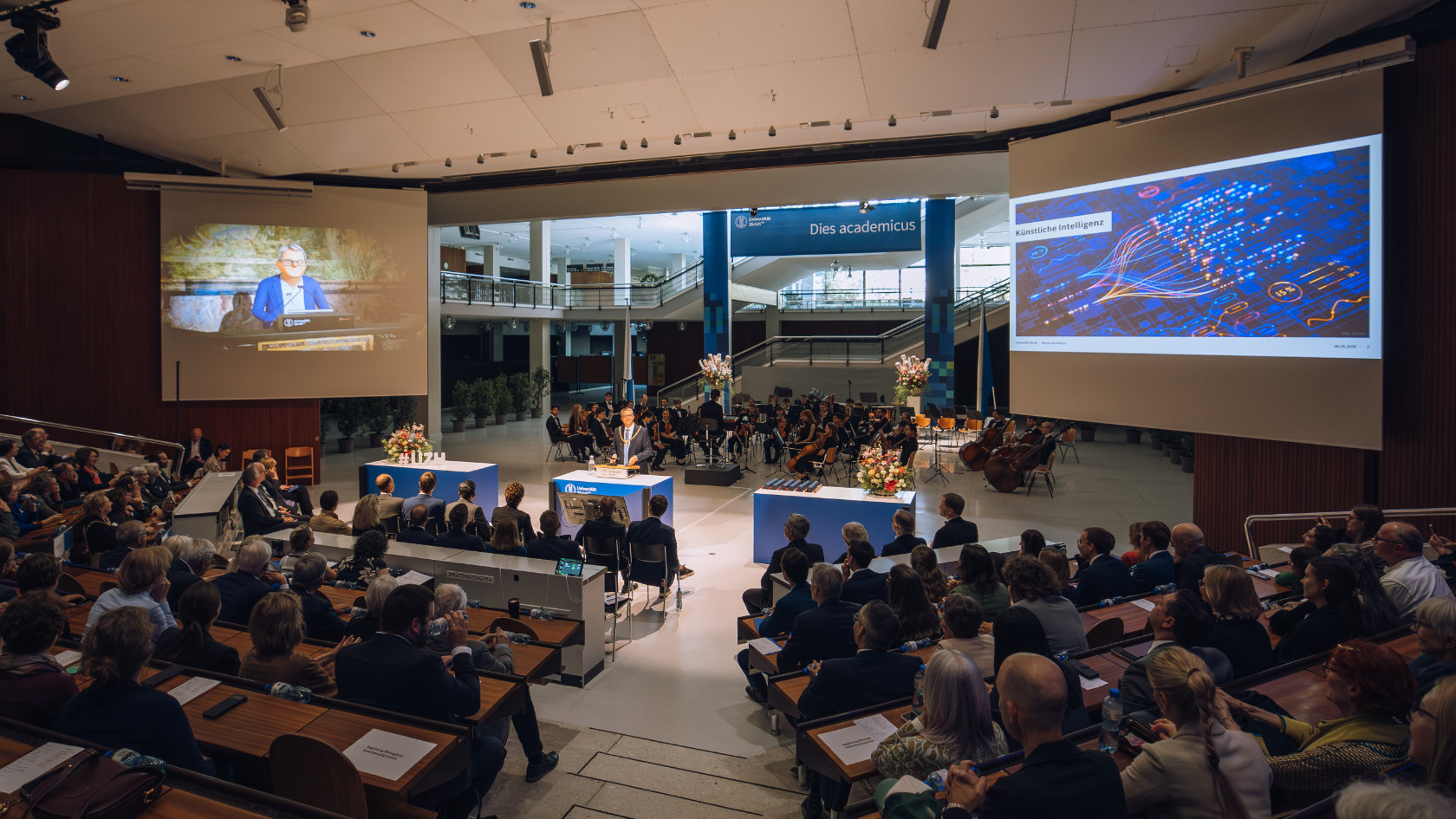
The University of Zurich (UZH) celebrated its birthday on Friday at the Irchel Campus. In her keynote address, Zurich Government Councilor Silvia Steiner highlighted the canton’s strong financial support for UZH, which currently amounts to more than CHF 800 m annually, as well as major infrastructure projects such as FORUM UZH (CHF 597 m) and PORTAL UZH (CHF 660 m).
Above all, Steiner stressed the university’s value to society. During the COVID-19 pandemic, for example, science played a key role in addressing the health crisis.
Innovation for Zurich
Steiner also highlighted UZH’s role as a driver of innovation. “Numerous ideas developed at UZH benefit the canton’s economy – and therefore all of us. More than 80 percent of UZH startups remain in Zurich. That speaks both for UZH and for Zurich as a business location.” She emphasized that innovation often emerges where researchers from different disciplines collaborate. As examples, she cited the Space Hub in Dübendorf, the Digitalization Initiative of the Zurich Higher Education Institutions (DIZH) and University Medicine Zurich (UMZH).

Universities such as UZH help ensure that public debates are conducted on a solid foundation. I would even go so far as to say that they are democratic anchors.
In times of disinformation and rising populism, Steiner argued, society needs the voice of science more than ever. “Universities such as UZH help ensure that public debates are conducted on a solid foundation,” she said. “I would even go so far as to say that universities such as UZH are democratic anchors.”
Steiner also praised UZH’s openness and willingness to explore new ways of engaging with society. With the new main building FORUM UZH currently under construction, the university is also opening up in its architecture. “A public space is being created right in the heart of the university district. This square will connect the city and the university in a new way.”
The President and his mischievous avatar
UZH President Michael Schaepman appeared together with an AI avatar. This digital twin, or “PresAIdent”, uses a synthesized version of Schaepman’s voice and mimics his speaking style. Thanks to the avatar, Schaepman joked, the number of appearances by the PresAIdent could now at least be doubled. However, the avatar still has some work to do on its manners.
At one point, the PresAIdent interrupted Steiner’s speech with the remark: “Wait a second, Silvia, that all sounds very nice. But what exactly does the Zurich cantonal government do for us as a university?” Steiner replied with amusement that it was certainly a first for a UZH President to interrupt a Dies speech – albeit digitally – after 193 years of tradition. The PresAIdent, it seems, still needs etiquette training.
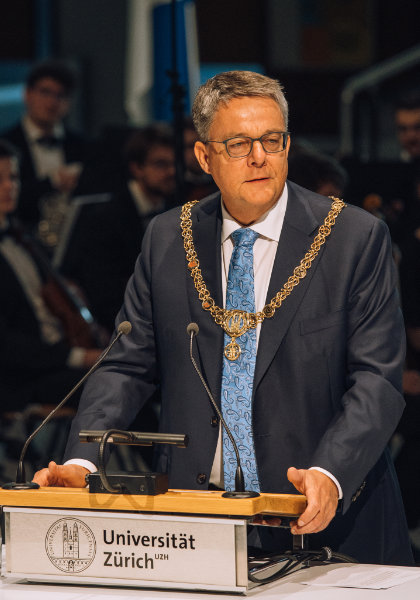
We are aware that AI harbors not only opportunities. It also requires responsible use – clear rules, transparency, and continuous evaluation of potential risks.
Despite the entertainment value of his digital twin, Schaepman stressed that the message behind it was a serious one. UZH systematically develops and uses such tools to explore both the opportunities and risks of AI. “We are aware that AI harbors not only opportunities. It also requires responsible use – clear rules, transparency, and continuous evaluation of potential risks.”
In his speech, Schaepman focused on three themes central to the future of UZH: curiosity, networks and interdisciplinarity. Curiosity, he said, means thinking beyond disciplinary boundaries and exploring new frontiers. A case in point: UZH’s international networks continue to grow. Over the past year, the university assumed leading roles in Una Europa, the League of European Research Universities (LERU) and Universitas 21 where outgoing UZH Vice President Christian Schwarzenegger will take on the role of provost and assume responsibility for the strategic development of the alliance’s 31 partner universities.
Interdisciplinarity, Schaepman added, is not a trend but central to the idea of the Latin term “universitas.” “A healthy mix of highly specialized researchers and holistic thinkers strengthens the university’s resilience for the future.” According to Schaepman, UZH is well equipped for the future “with curious minds, strong networks, and interdisciplinary research, teaching and university services.”
Avoiding the fate of the dinosaurs
One of the traditions of the Dies academicus is the speech by one of the university’s representative bodies. This year, it was delivered by Valerie Treyer and Jan Helbing, co-presidents of the Association of Senior Researchers and Staff (VFFL). They emphasized the importance of researchers, instructors, privatdozents and adjunct professors to the university.
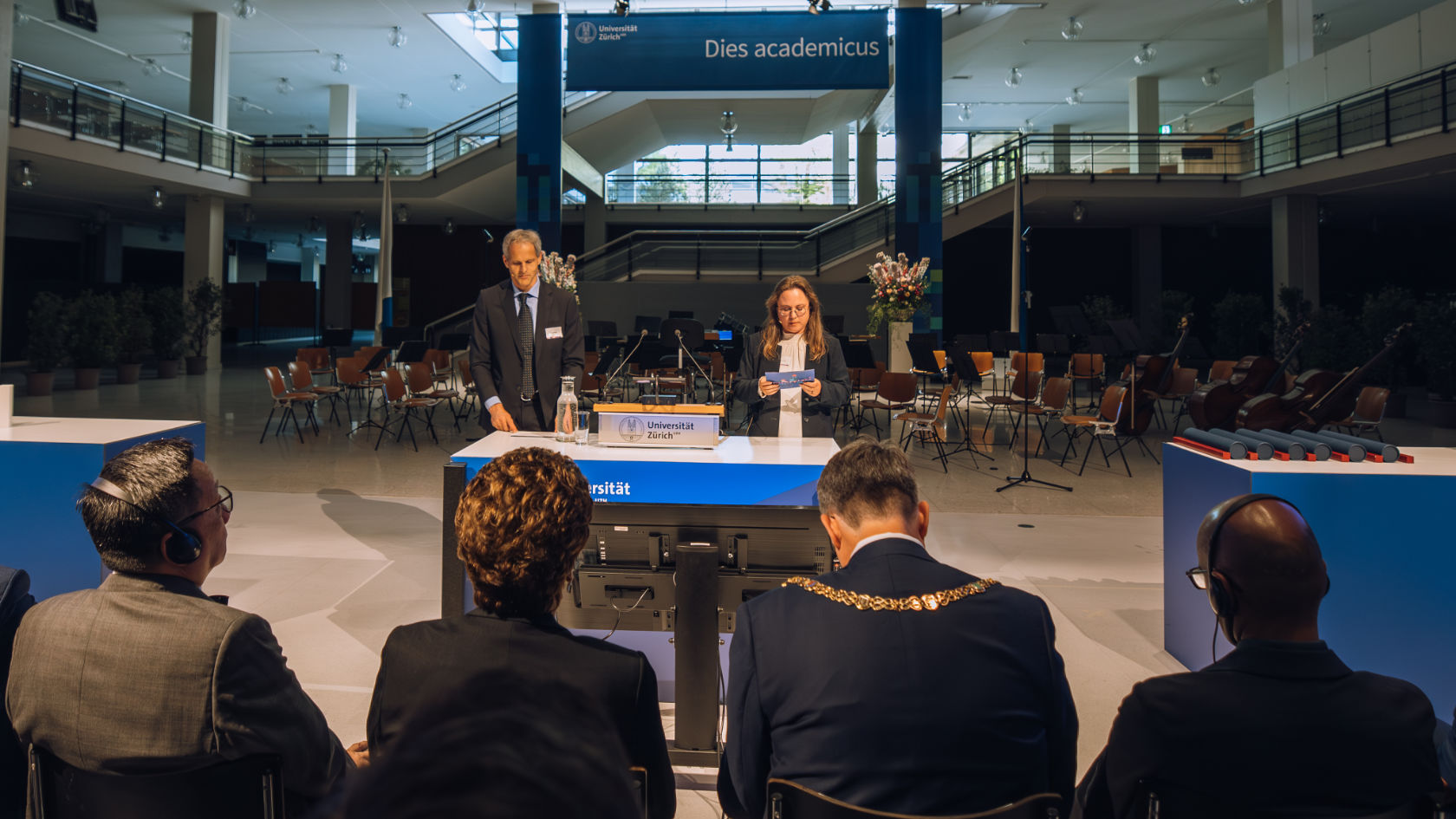
Helbing criticized shrinking opportunities for independent research in the face of stagnating budgets and rising costs. Researchers and teaching staff, he said, often encounter restrictive working conditions, including short-term contracts and outdated dependency structures.
Treyer and Helbing argued that UZH should continue developing structures that allow academic staff to realize their full potential. “Many advanced researchers and teachers have long demonstrated that successful teaching and research are possible even without a traditional professorship,” said Helbing. Treyer added that senior researchers and instructors need opportunities to grow professionally. “We want to be able to adapt, shape the future, and keep moving forward – so we don’t end up like the dinosaurs.”
«And the winner is …»
Vice President Gabriele Siegert built suspense at the presentation of the 2026 UZH Teaching Award, which was presented for the 20th time this year. Inspired by the Oscars, the three nominees – legal scholar Lorenz Droese, political scientist Stefanie Walter and economist Benjamin Wilding – were introduced in short video clips.

Siegert then revealed the winner’s name from a golden envelope: Benjamin Wilding. The instructor from the Department of Finance at the Faculty of Business, Economics and Informatics was recognized for his well-structured, practice-oriented, and interactive teaching and received prize money of CHF 10,000. The two runners-up each received CHF 5,000.
Honorary doctorates and further distinctions
In addition to the Teaching Award, numerous other distinctions were presented. This year, seven individuals from academia and culture received honorary doctorates, including Belarusian Nobel Prize-winning author Svetlana Alexievich and Swiss writer Klaus Merz.
Profiles of the new honorary doctors are available on the Dies academicus website. The website also features the recipients of the annual prizes, the 2025 Team Effort Award, and additional distinctions.
-
 The Faculty of Arts and Social Sciences at UZH is awarding an honorary doctorate to Svetlana Alexievich, the Belarusian winner of the Nobel Prize in Literature.
 -
 The Vetsuisse Faculty at UZH is awarding John D. Bonagura an honorary doctorate in recognition of his scientific and clinical achievements in the field of veterinary cardiology.
 -
 The Faculty of Theology and the Study of Religion at UZH is awarding an honorary Doctor of Theology degree to Swiss author Klaus Merz.
 -
 The 2026 honorary doctorate from the Faculty of Business at UZH was awarded to Phanish Puranam for his groundbreaking work at the intersection of organizational design and competitive advantage.
 -
 The Faculty of Law at UZH is conferring an honorary doctorate on Ingeborg Schwenzer, professor emerita of private law and comparative law at the University of Basel.
 -
 The UZH Faculty of Medicine is awarding an honorary doctorate to gynecologist Chong Yap Seng, dean of the Faculty of Medicine at the National University of Singapore. (All photos: Andrin Owassapian)
Intense competition for third-party funding
The event concluded with the UZH Talk. In conversation with host Tanja König, UZH Vice President Finance Daniel Hug explained how the university is funded and where the biggest challenges lie. While the Canton of Zurich provides solid financial support, its annual contribution covers less than half of UZH’s total budget of CHF 1.7 bn. Further contributions come from the federal government and other cantons whose students are enrolled at UZH. Together, these contributions account for around two-thirds of the university’s budget.

I’m always amazed at how successfully our researchers compete in this highly competitive environment and secure third-party funding,
The remaining funding comes from less predictable sources, Hug explained. Particularly significant are competitively acquired third-party funds, which amounted to around CHF 360 m last year and thus covered more than 20 percent of the budget. This includes CHF 165 m in SNSF research funding and more than CHF 100 m contributed by foundations and private donors. “I’m always amazed at how successfully our researchers compete in this highly competitive environment and secure third-party funding,” said Hug.
However, applying for these funds is time-consuming and costly, and success is never guaranteed. Research funding, therefore, is much less predictable than other budget items. “We are juggling a great many balls all year round,” Hug explained.
Additional third-party funding is “the only way forward” if UZH wants to expand its financial flexibility, particularly given increasing pressure on public finances, as demonstrated by the ongoing debate surrounding the federal government’s relief package. At the same time, Hug emphasized that there are limits to how much additional funding can realistically be acquired.
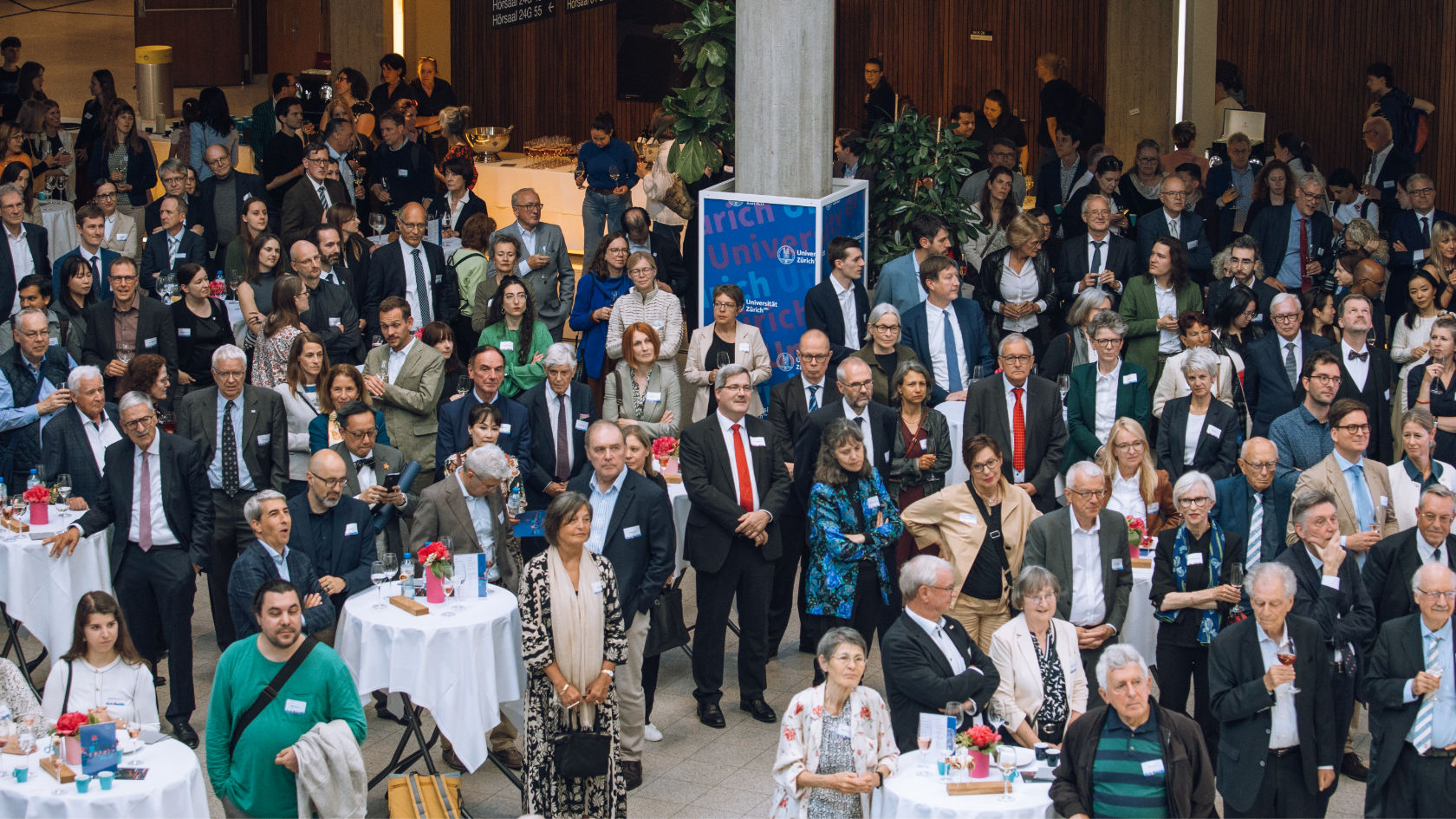
Following the discussion with Daniel Hug, the formal part of the celebration came to an end, and guests headed to the aperitif reception in the Irchel atrium to toast UZH’s birthday.
Research Highlights 2025
Use the settings button at the bottom right of the player to toggle subtitles (EN/DE)