“Seeing things in a new light”
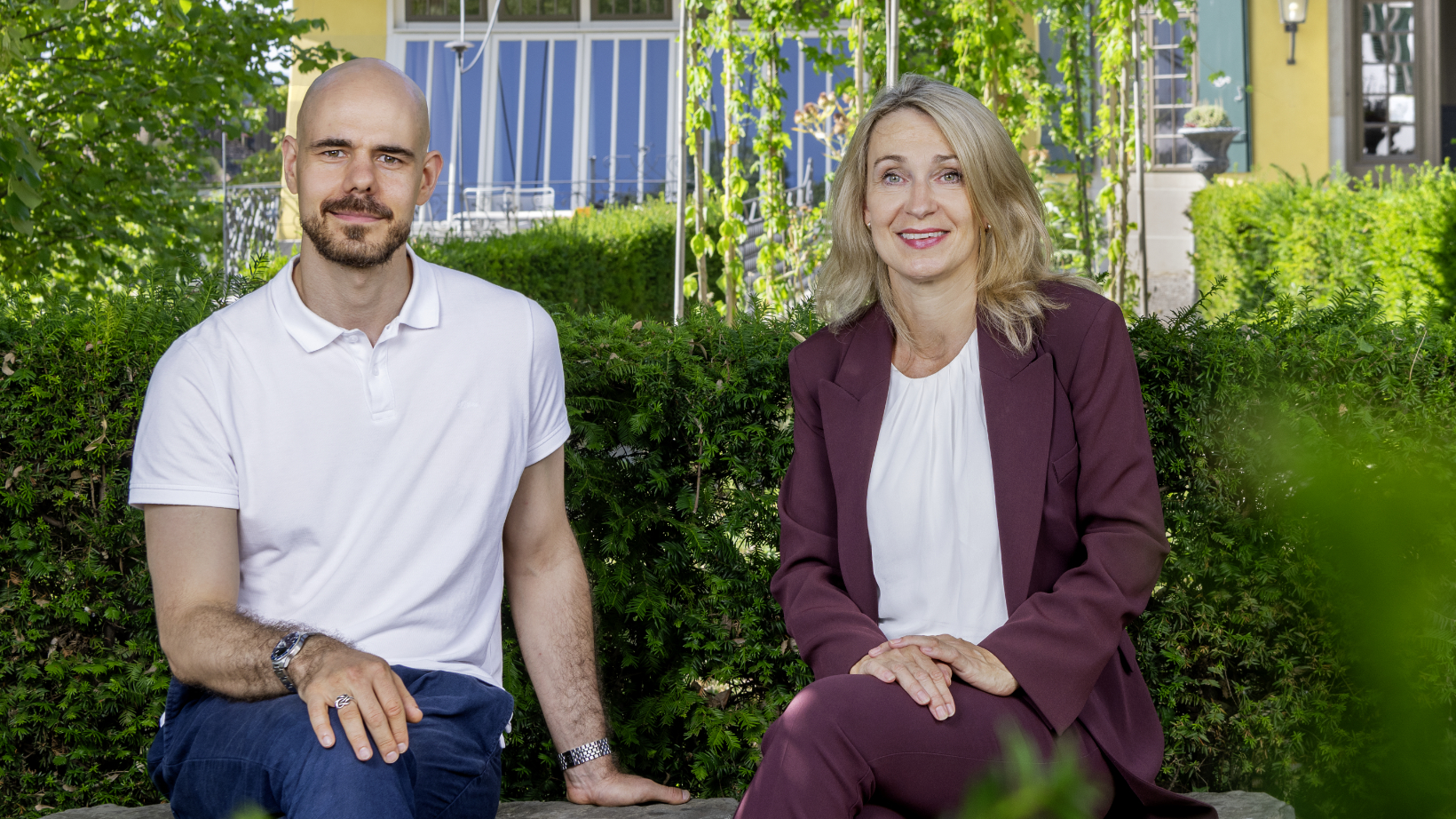
Elisabeth Stark and Servan Grüninger, along with representatives from research, research funding and science communication, you have examined the value of basic research and how it should be evaluated in a working paper. Why did you decide to tackle this topic?
Elisabeth Stark: We’ve seen that basic research is coming under increasing pressure. From both a research policy and a societal standpoint, it is becoming increasingly difficult to justify projects in this field and to obtain approvals, for example, for research involving animal experiments. In the working paper, we aimed to highlight the value of basic research and to help refine the criteria used to evaluate projects. Basic research is often misunderstood because there exists the notion that all research must have a practical, immediately applicable benefit. But that isn’t necessarily the case.
Can you give a specific example?
Stark: As a linguist, I also engage in theoretical work. For example, I investigate why the definite article appears in specific contexts in French and other languages, with the goal of gaining a better understanding of how language and thought systems work. This knowledge has no practical application, for example, in classroom teaching or in machine translation. The value of this research lies in learning more about language itself and how it works. I have no doubt that this fundamental desire for knowledge is an inherent trait of our species.
Servan Grüninger: Society and policymakers are interested in research that promises practical benefits. The question of research’s value is both legitimate and important. However, it becomes problematic when basic research projects are expected to demonstrate an immediate benefit – something that has an everyday use. This undermines the very foundation upon which the benefits that society and policymakers seek is then built. Research that generates fundamentally new knowledge requires time and freedom to accurately describe and understand the world.
How does basic research create the foundation for innovation?
Stark: You can’t develop anything new without a fundamental understanding of it. I’m thinking of the field of immunology, for example. To effectively combat diseases, viruses, bacteria or autoimmune disorders, one must have a fundamental understanding of the immune system. The latter is not the primary goal of basic research in this field. However, this research is essential for scientists who are seeking to develop a new cancer drug or a new antibiotic. Without a detailed understanding of systems of all kinds – humans, the environment, our universe – scientific progress is impossible.
Grüninger: Another example is artificial intelligence. Today’s AI systems are built on statistical models that first began to be developed around 80 years ago. In the 1940s, researchers in mathematics and neurobiology sought to describe how the human brain works using mathematical models known as neural networks. They could never have imagined that this would one day lead to systems capable of driving cars and writing text. What’s more, the road to get there was bumpy. Because the practical benefits were initially less than expected, funding was repeatedly cut. Nevertheless, research continued – thankfully. Because once powerful computers and vast amounts of data became available, it became clear how useful neural networks are for a wide range of applications.
We can’t predict what knowledge we’ll need 50 years from now. That’s why basic research shouldn’t be constrained or narrowly focused on immediate benefits. Otherwise, we risk hitting a dead end and losing the opportunity to fundamentally question things and see them in a new light. This is precisely what basic research can and should accomplish.
Stark: The humanities and social sciences, which sometimes face pressure to justify their relevance in social and political contexts, are especially important when it comes to digitalization, AI and their applications. Disciplines such as philosophy, theology and psychology ask the fundamental question: what does it mean to be human? For example, they explore what happens to people who get too wrapped up in their smartphones, or who start attributing human qualities to machines. And they examine what these developments mean for social cohesion and democracy. These are very general questions that won’t lead to new textbooks, nor can they be used to make voting recommendations. However, this research helps society find its bearings more effectively in the face of rapid change.

Switzerland invests in high-level basic research – if you weaken this foundation, the innovation pipeline will eventually run dry.
What are the consequences of making researchers focus too heavily on immediate benefits?
Grüninger: It causes the incentives shift. When researchers are expected to demonstrate that they can cure cancer or explain the universe within three years, pressure builds to produce quick results. This puts methodologically sound work, careful data collection, peer review and reproducibility at risk. When we produce results that aren’t reliable, we undermine trust in academia.
Stark: Nowadays, we often have to describe relevance and impact in research proposals. But for many basic research projects, this is the wrong question. Researchers should be required to explain how a project tests, expands or challenges a research paradigm. However, it shouldn’t always be necessary to claim that a spin-off, a policy or a medication will result from it. It might never lead to any direct application. Nevertheless, it tells us more about humans, language, nature or society.
Grüninger: This pressure may even lead to certain questions not being asked at all. If researchers realize that an idea is too theoretical, too novel or too difficult to put to practical use, they may decide not to submit a proposal. This puts the qualitative core of academia at risk.
Experiments involving animals play an important role in basic biomedical research. Why are these experiments needed?
Stark: Because if you want to understand a living organism, you need a living organism. Nowadays, there are effective alternative methods for testing specific active substances, such as organoids or organ-on-a-chip systems, but if you want to understand how an organism functions as a whole, they are often not enough. However, animal experiments must be well justified and ethically defensible.
Grüninger: Methods that don’t involve animal testing work well in areas where we already know enough about a part of a biological system to be able to replicate it. For example, when it comes to testing skin irritation caused by chemical substances, animal experiments have long been partially or completely replaced. This is more challenging in basic research. For example, if we want to understand how congenital diseases develop or how the brain forms, we can’t rely solely on cell cultures. Research involving animals answers questions that, for practical or ethical reasons, cannot be investigated in any other way.
How is the knowledge gained weighed against the suffering caused to the animals?
Stark: The Animal Welfare Act requires interests to be balanced. The scientific knowledge gained is weighed against the distress caused to the animal. This distress is categorized into levels of severity. The higher the level, the greater the hurdles. We have the impression that basic research is coming under increasing pressure in this balancing act. The pure desire for knowledge is sometimes given less weight than a biomedical application that is close at hand.
Grüninger: The situation is legally and politically challenging. The law recognizes basic research as a legitimate purpose for conducting research on animals. At the same time, there are court rulings that, in certain cases, impose stricter requirements on basic research when it comes to justifying it. As a result, basic researchers need to be able to better explain why the knowledge gained from their projects should carry more weight than that of their colleagues in applied research. Ultimately, though, determining what role basic research should play in this and other fields is also a matter of sociopolitical decision-making – and these are the debates we should be having.
Does the framework in which basic research is conducted need to be renewed?
Stark: First and foremost, we need to safeguard Switzerland’s strong starting position. The Swiss National Science Foundation supports outstanding research and keeps opportunities open for projects that aren’t immediately focused on practical applications. This is a major international advantage. Switzerland invests in high-level basic research – a prerequisite for much of what will follow. If you weaken this foundation, the innovation pipeline will eventually run dry.
Grüninger: The key point is to separate the different levels of evaluation. We distinguish between three levels: the individual project, the research program and societal impact. When it comes to an individual research project, the focus should be on criteria internal to the discipline: methodology, plausibility, transparency and contribution to the research program. Whether a research program addresses socially significant issues is a separate question, one that can and should be debated democratically. However, we shouldn’t expect a single project to meet all of society’s expectations for research as a whole.

Basic research generates the building blocks of knowledge on which future academic advancement is built.
What does this specifically mean for research funding?
Grüninger: Different forms of funding are needed. Not every project needs to cover basic research, application, scaling, communication and infrastructure all at once. We need some people who can focus on the fundamentals, others who can translate knowledge, and others still who can develop applications or provide infrastructure. Moreover, research achievements shouldn’t be evaluated after just two or three years. You also need to look back 10, 20 or 30 years and ask what foundational elements were crucial for today’s applications.
Stark: In addition, there’s an appreciation for time and diligence. Research needs freedom, including financial freedom. Researchers need the opportunity to explore a question thoroughly, without constantly having to claim that it has an immediate application. This is especially important for early-career researchers. Someone pursuing a doctorate shouldn’t be wondering whether their theoretical question will lead to a product or a policy.
What do you hope to achieve with your working paper?
Stark: The idea is to structure the discussion. We wanted to move from a bad gut feeling – the growing pressure to justify our work – to a systematic understanding of where the problems lie and the levels at which they should be addressed. I think it’s particularly important that the many disciplines involved are visible. This isn’t about a specific problem in biomedical research, but rather a fundamental challenge facing the academic community today.
Grüninger: It’s a working paper, which, as the name suggests, is meant to be worked on. It doesn’t offer a definitive answer, but provides a framework for future discussions. We propose making a clearer distinction between incentive systems, communication and evaluation. We would like to continue working with UZH, the Swiss National Science Foundation and other research organizations, and we’d also like to involve political, legal and administrative stakeholders.
What conclusions have you drawn from your analysis so far?
Stark: We need to be more proactive in explaining why basic research is important – even when we face opposition. It’s better to actively engage in this debate than to simply react to the next round of budget cuts or the next funding dispute. When it comes to animal testing, for example, the working paper can help clarify when categories are being confused: a project researching the brain won’t produce the next Alzheimer’s drug in three years. It might, however, generate knowledge that will be crucial 20 or 30 years from now.
Grüninger: That’s exactly what it’s all about. Basic research generates the building blocks of knowledge on which future academic advancement, societal direction and innovation are built. If we evaluate it solely based on short-term benefits, we’ll lose our ability to understand and create new things in the long run.