Award-Winning Underpants
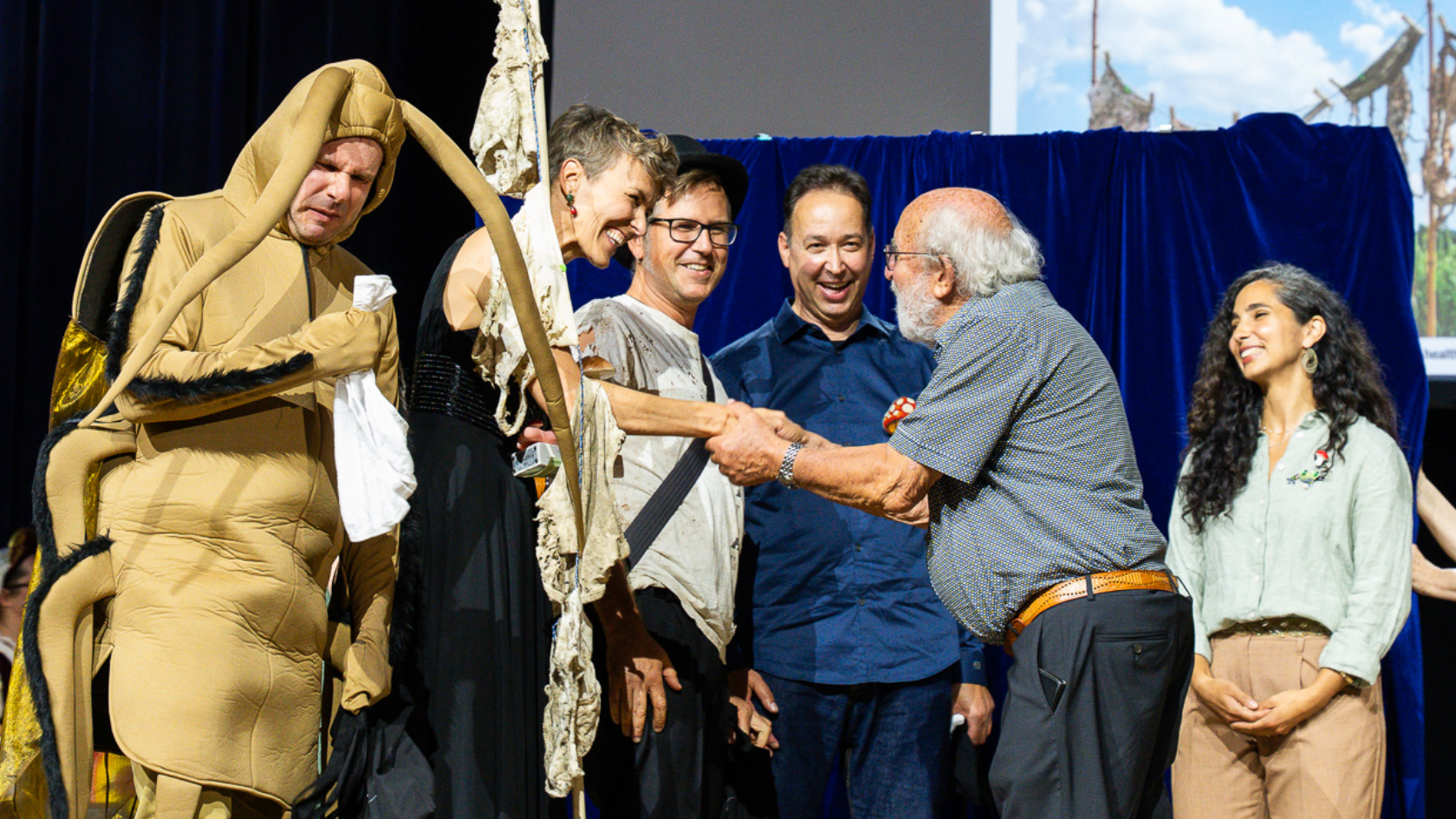
Science is a serious matter – or is it? At yesterday’s Ig Nobel Prize ceremony in Zurich, researchers showed that they certainly have a sense of humor – and occasionally even a taste for the absurd. At this tongue-in-cheek counterpart to the official Nobel Prize ceremony in October, they were in top form: scientists appeared dressed as cockroaches, the Federal Council for Defense, Offense and Neutrality made an appearance, life-size bananas were used to keep speeches in check, and the prize money came to 10 trillion Zimbabwean dollars – equivalent to a whopping CHF 0.05. The name says it all: ‘Ig’ turns ‘Nobel’ into ‘ignoble’.
For the first time outside the US
For the first time in 35 years, the Ig Nobel Prizes were awarded outside the US. The reason was that current US entry restrictions meant it could not be guaranteed that all invitees would be able to attend. “We were looking for a location that would be easily accessible to the international scientific community,” said Marc Abrahams, founder and official master of ceremonies for the Ig Nobel Prizes. That’s when the University of Zurich and the ETH Board stepped in at short notice as sponsors.
As humorous and self-deprecating as the event may be, the award-winning studies are conducted with rigor and are meant to be taken seriously. The Ig Nobel Prizes are awarded exclusively to research that sounds so bizarre it first makes you laugh, then makes you think.
Milk-producing cockroaches and splash-free urinals
One of the studies honored in Zurich examined kissing in animals and humans, defining kissing as “a non-agonistic interaction involving directed, intraspecific, oral-oral contact with some movement of the lips/mouthparts and no food transfer.” A team of economists found that upper-class parents are more likely to raid their children’s candy stashes than parents from other social classes. Physicists investigated the ideal shape of a splash-free urinal, and chemists discovered that cockroach milk protein is three times as energy-dense as cow’s milk. And in South America, a long-term study – conducted at considerable personal risk and despite several hospitalizations – investigated where exactly to step on venomous snakes to make them bite.
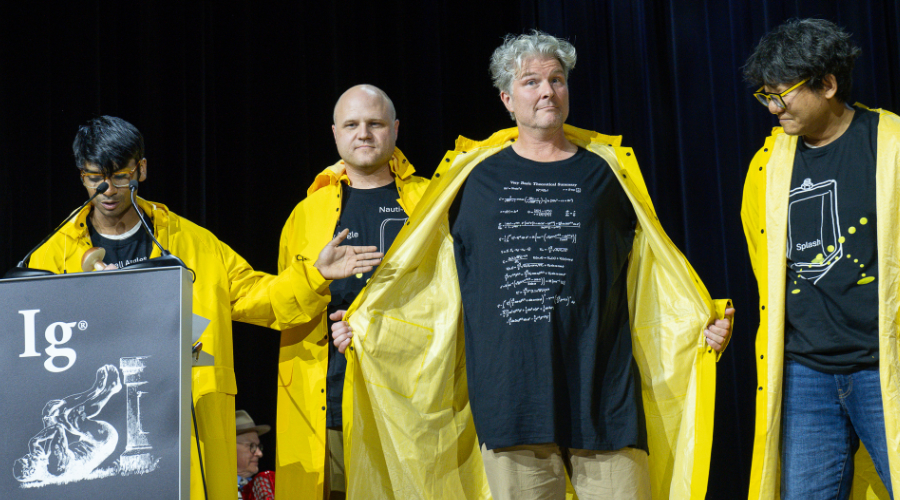
The prizes – plastic human feet covered in mushrooms – were presented by “real” Nobel laureates in attendance: Esther Duflo and Abhijit Banerjee from UZH’s Department of Economics, Swiss astrophysicist Michel Mayor and British biochemist Sir Tim Hunt.
UZH and Agroscope honored
At 7:20 p.m., UZH Professor of Agroecology Marcel van der Heijden, Franz Bender, head of the agroecological assessments team at Agroscope, science journalist Atlant Bieri, and Pia Viviani, owner of a citizen science agency, took to the main stage. The four received the Ig Nobel Prize for their down-to-earth citizen science study Proof by Underpants on soil quality. In 2021, they recruited 1,000 people across Switzerland to bury over 2,000 pairs of cotton underwear in gardens, fields and meadows. Two months later, the underwear was unearthed, photographed and sent to the lab along with a soil sample for analysis (see news release).
Winning the Ig Nobel Prize is a great honor for the entire team. “With this large-scale experiment, we wanted to encourage as many people as possible to take part, so we deliberately chose a somewhat provocative and humorous approach,” says van der Heijden. They settled on underwear because the cellulose in the cotton decomposes in the soil, while the elastic waistband remains and can be retrieved. At the same time, the goal was to highlight the importance and vulnerability of soil. “People often don’t realize that 50 percent of all living organisms are found in soil and that 95 percent of our food is produced in or on it. With our study, we wanted to draw attention to gradual soil degradation and the decline in biodiversity. And it seems to have worked,” the professor says with a laugh.
UZH president also in attendance
The entire team showed its sense of humor at the awards ceremony: behind the honorees was a display of underwear in various stages of decomposition, and Franz Bender even gave the audience a brief musical interlude, performing a song he had composed especially for the occasion.
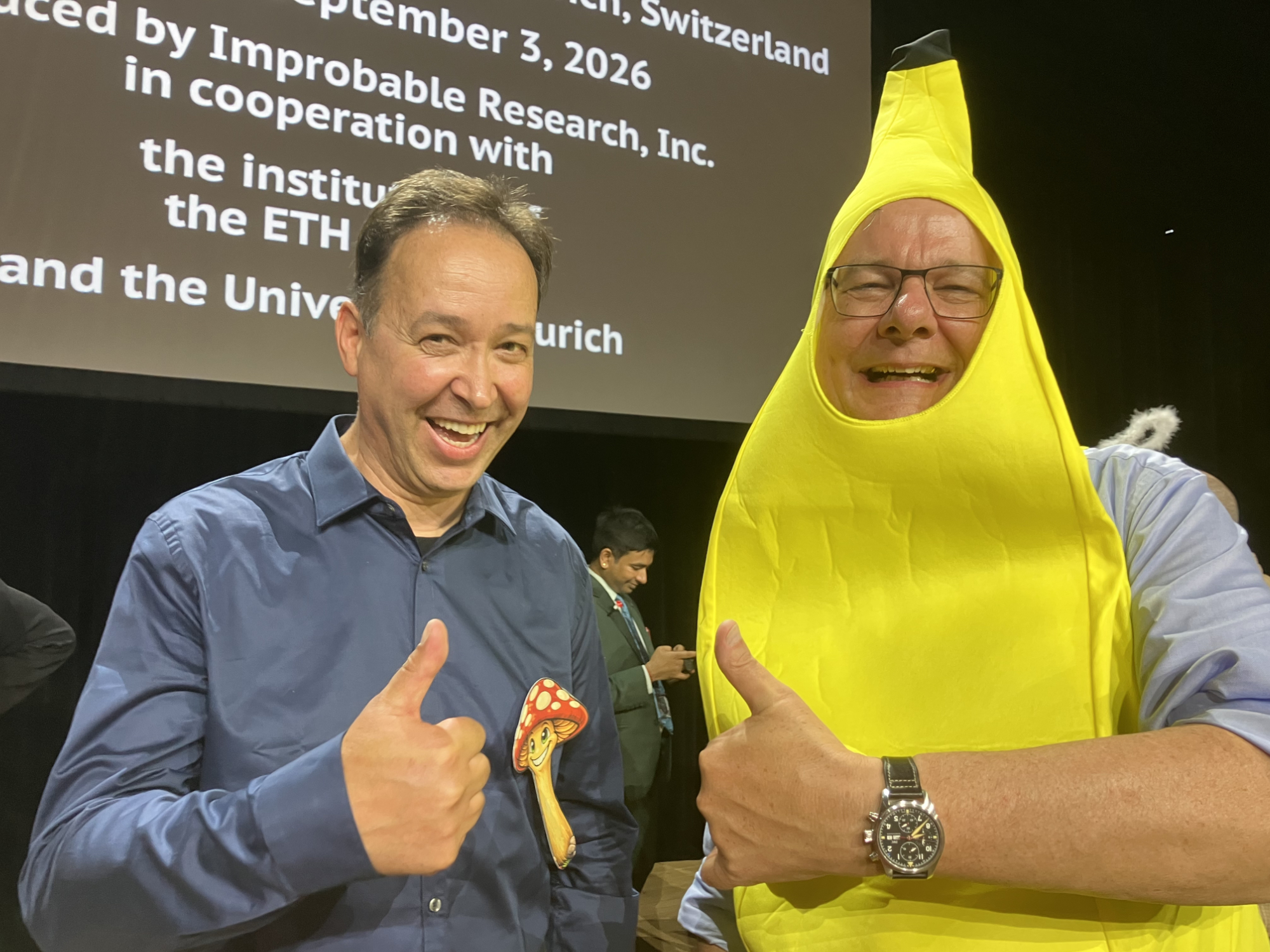
There was plenty of laughter and cheering throughout the evening in Zurich, as the scientific community showed its lighter side. And one final detail: hidden inside one of the three yellow banana costumes was none other than Michael Schaepman, President of the University of Zurich – clearly joining in the fun.