First Hint of Dark Matter

Scientists have been on the hunt for dark matter for the better part of a century. This invisible substance makes up roughly 85% of the total matter in the universe but has never been directly detected.
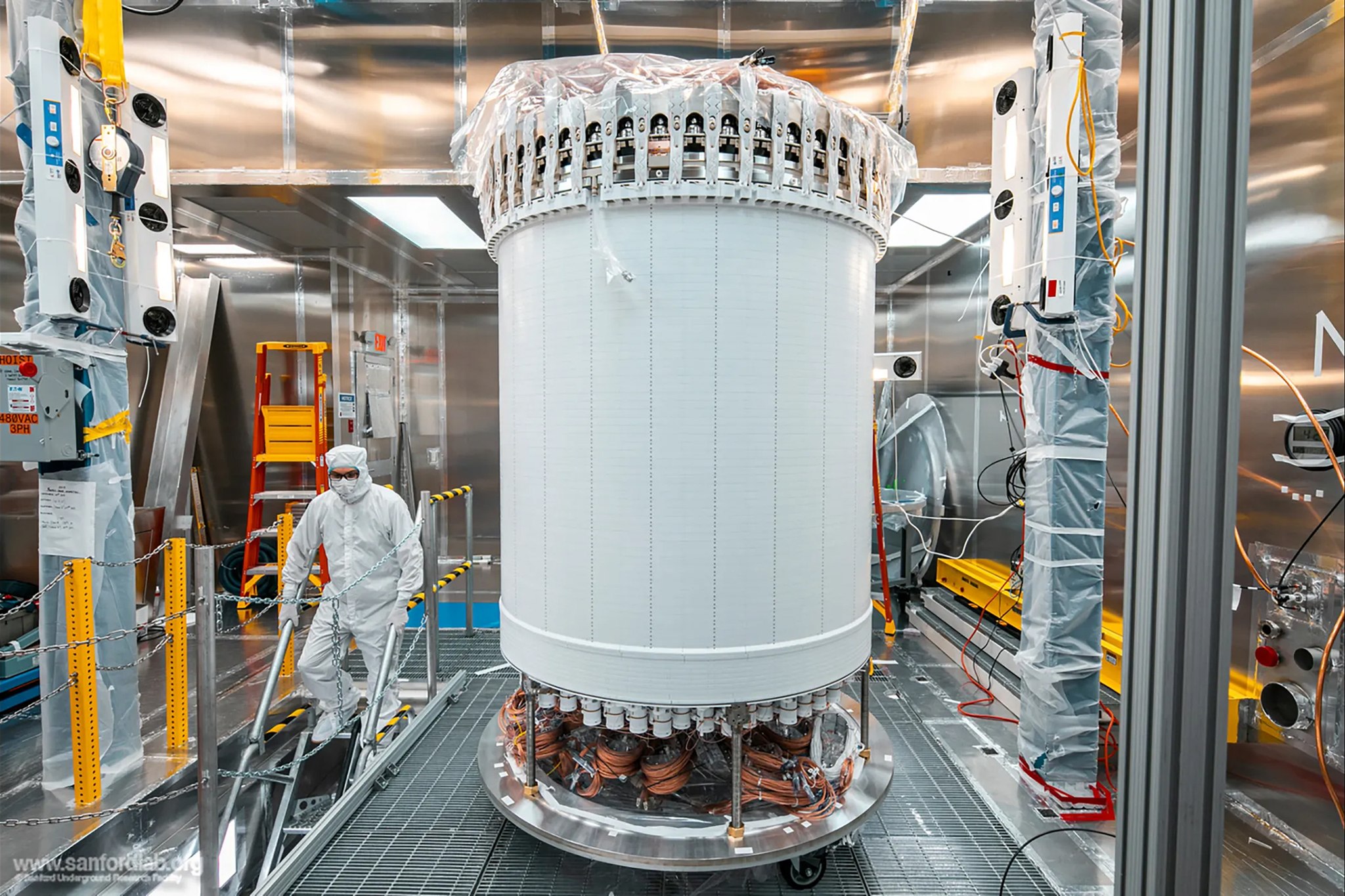
Researchers working on the international LUX-ZEPLIN (LZ) have now recorded an interaction involving a single particle that cannot be explained by any known phenomenon. “The result does not yet meet the statistical threshold required to claim a discovery but is the most compelling hint of dark matter reported by the experiment to date,” the researchers involved in the experiment say in a media release published today.
UZH with key role
The LZ experiment was launched in 2012 to search for dark matter particles. Björn Penning and his team from the Department of Physics at the University of Zurich are among the researchers involved. His team of eight researchers is one of the largest university groups working on the experiment, for which it performs several key tasks. Björn Penning also founded and was part of the leadership of the High Nuclear Recoil research group, whose work led to the latest results. The group currently includes two postdoctoral researchers and a PhD candidate from UZH.
We met with Björn Penning to discuss the latest findings.
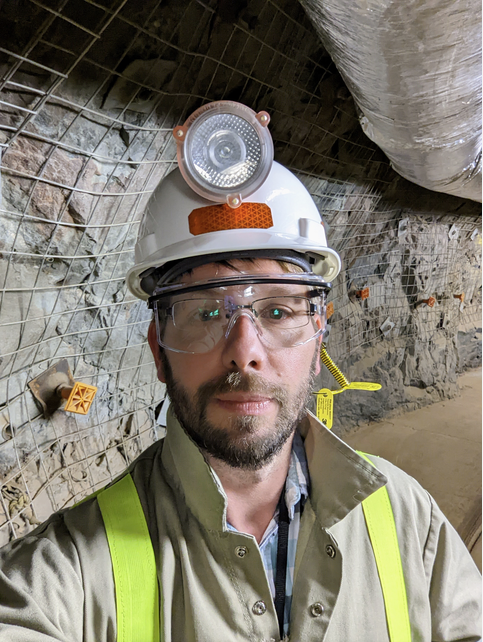
Björn Penning, what exactly are you and your team investigating as part of this project?
Björn Penning: Our scientific contribution covers a broad range of areas. Before I joined UZH, my research group and I built the so-called outer detector. This detector system filters out neutrons and thereby nearly doubles the LZ experiment’s sensitivity to dark matter. After I joined UZH, we continued operating the system and, among other things, carried out experiments on underground operation as well as on detector calibration and stability. We also work on reconstructing, modeling and analyzing the data, which helps us search for rare events. Over the years, our work has helped bring us to this latest result.
How did you and your group become involved in the experiment in the first place?
Björn Penning: I originally worked at CERN and other particle accelerators, particularly on Higgs physics and dark matter. Over time, however, I became convinced that direct searches for dark matter offered the more promising long-term strategy. I contacted the LZ experiment, received an offer from a university in the US, and decided to use the resources that came with the position, including substantial hardware contributions, to support the LZ experiment specifically. That’s how it all started.
Why is it so important to know what dark matter is made of?
Björn Penning: There is no single answer to that, of course. We now know with a high degree of certainty that there is about five times as much dark matter as ordinary matter in the universe. At the same time, we still don’t understand what dark matter is actually made of.
One of humanity’s most fundamental impulses is to understand how the universe around us works and why we exist. Research into dark matter is therefore primarily about gaining knowledge. There are currently no concrete practical applications, apart from technological spin-offs such as new detector technologies and the training of highly qualified early-career scientists. But 100 years ago, when quantum mechanics and the theory of relativity were developed, no one could have imagined that today our smartphones and GPS systems would not work without them.
What are you hoping to find, and what comes next?
Björn Penning: We hope, of course, that we’ll discover dark matter. As we collect more data, we’ll be able to detect more of these rare events and analyze their nature in greater detail. But that will take time. We’re also working on other analyses within the LZ experiment.
Beyond LZ, we’re involved in other dark matter experiments as well. We analyze extremely rare nuclear decays and measure fluxes of high-energy cosmic particles.