First Measurement of Low-Energy Solar Neutrinos Scattering Off Electrons
Every second, tens of billions of neutrinos produced by nuclear fusion in the Sun pass through every square centimeter of the Earth – and through our bodies – almost without interacting. Although they are one of the most abundant particles emitted by the Sun, their extremely weak interactions make the detection of these elusive particles one of the greatest experimental challenges in particle physics. A number of specialized neutrino detectors are in operation around the world, exploiting the unique properties of neutrinos to investigate astrophysical phenomena.
Lowest neutrino energy threshold ever achieved
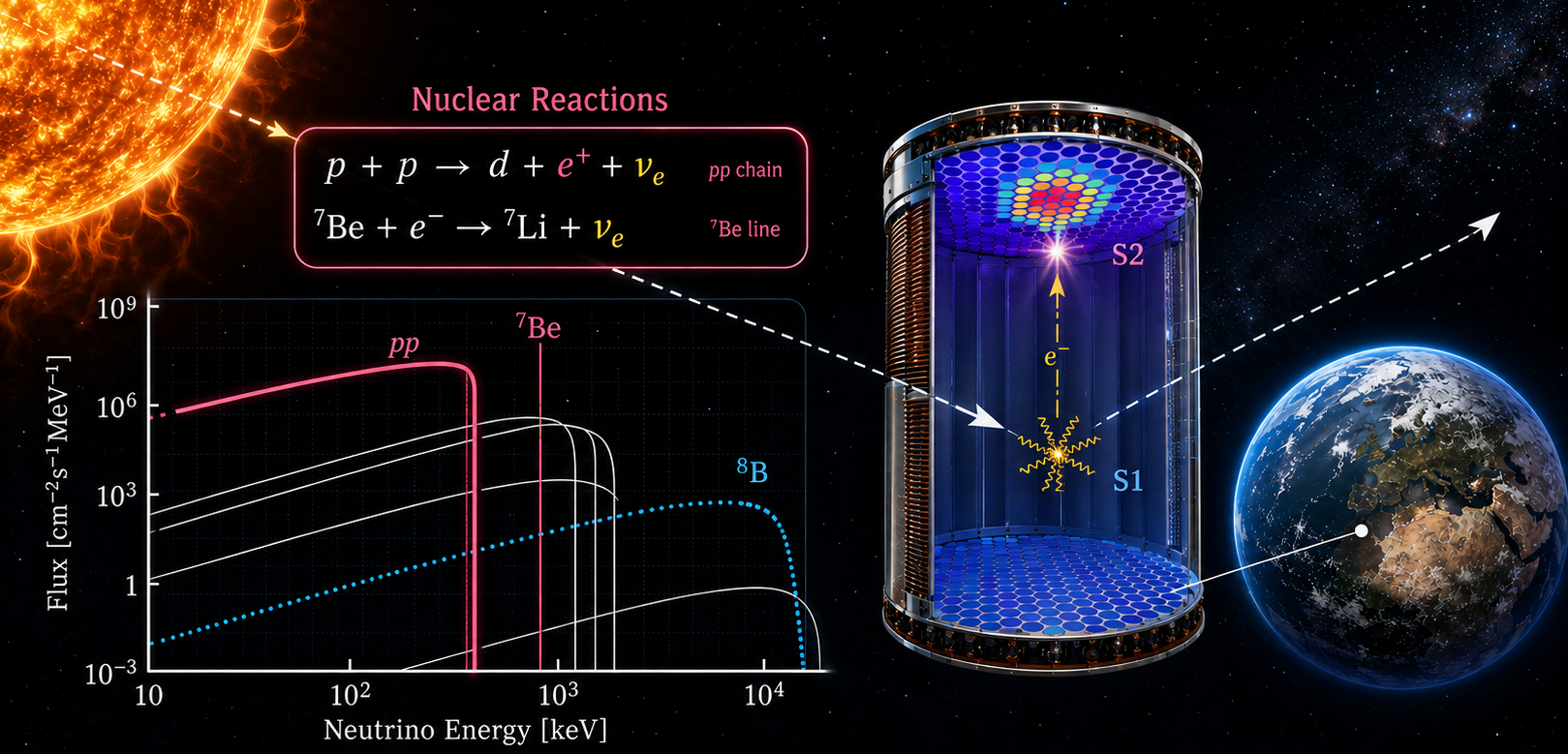
Today, researchers of the XENON Collaboration announced the first observation of low-energy solar neutrinos scattering off electrons in the XENONnT detector. The measurement extends the frontier of direct neutrino observations down to neutrino energies of about 17 keV, the lowest neutrino energy threshold ever achieved.
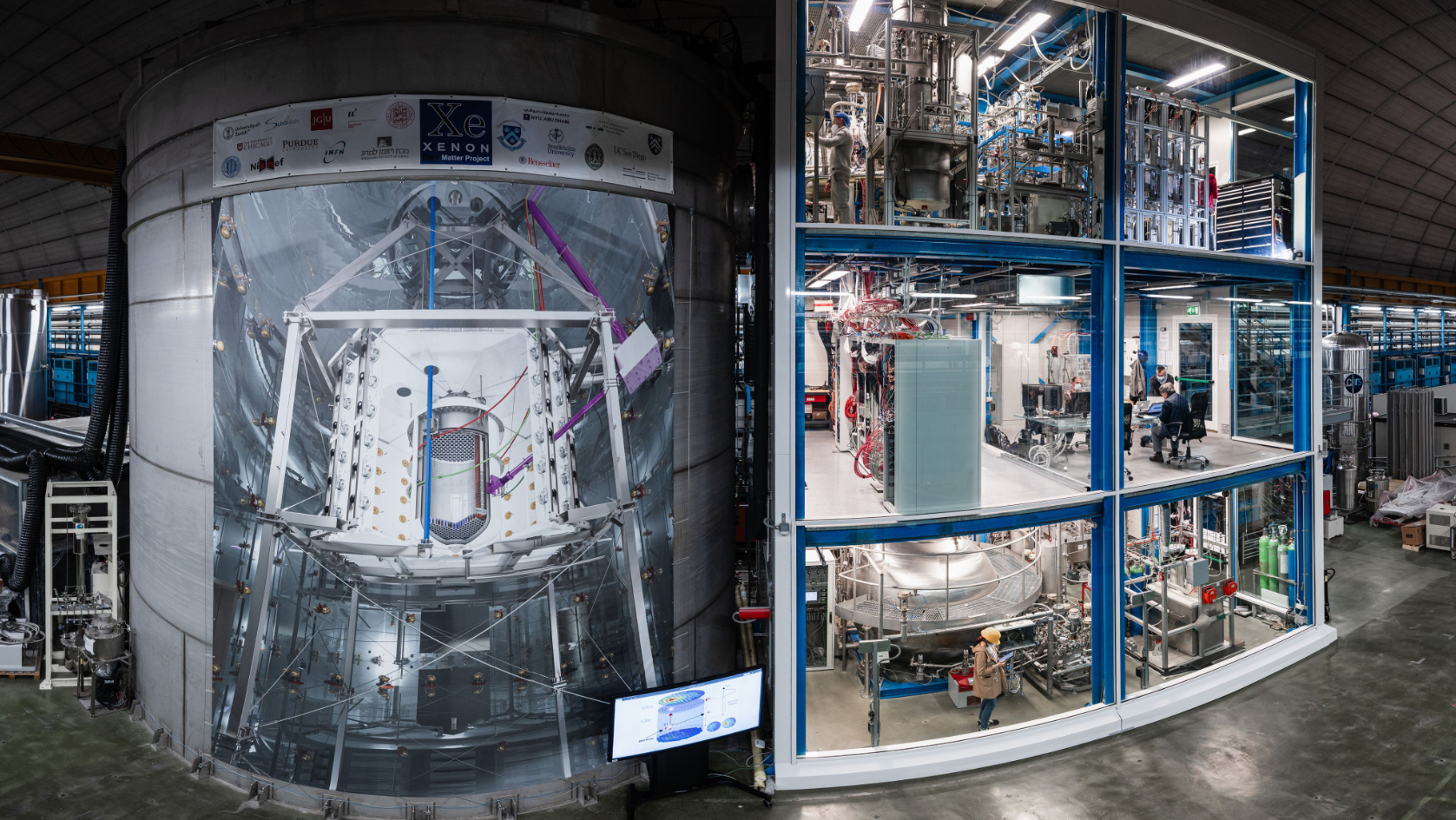
The detected signal is dominated by pp neutrinos, produced in the proton–proton fusion reactions that power the Sun and account for the vast majority of its neutrino emission. The detector at the INFN National Laboratory of Frascati in Italy is located 1,400 meters beneath the Gran Sasso massif. At its heart is a dual-phase xenon Time Projection Chamber containing 5.9 tonnes of ultra-pure liquid xenon. About 30 international research facilities are participating in the experiment, including the University of Zurich (UZH).
One of the world’s most sensitive observatories
XENONnT was originally designed for the direct search for particle dark matter in our Galaxy. Following the recent observation of coherent elastic neutrino–nucleus scattering from higher-energy solar neutrinos, this new measurement demonstrates that the same detector can probe complementary aspects of neutrino physics. “This result shows that these technologies are also sensitive to extremely low-energy neutrinos produced in the Sun,” says Laura Baudis, professor of experimental physics at UZH.
“The same detector properties that make these technologies so powerful in the search for dark matter – in particular the low energy threshold and the precise control of all background components – allow us to study solar neutrino physics in a new energy range,” says Florian Jörg, a postdoc in Laura Baudis’ group who contributed significantly to the analysis. XENONnT is thus emerging as one of the world’s most sensitive observatories for rare low-energy particle interactions.
Find theoriginal press release on the XENON website.