International Perspectives, Outstanding Achievements
International experience can take many forms at UZH: a lecture with international speakers, a research internship at a partner university or an exchange semester abroad. Each offers students a chance to broaden their horizons and discover new perspectives.
Under the motto “Bringing the World into Your Classroom,” this year’s UZH Teaching Day focused on the internationalization of teaching and learning. In a series of discussion sessions, teaching staff exchanged ideas on how to integrate international experiences and perspectives into everyday university life at UZH.
The day culminated in the recognition of outstanding academic achievements in UZH’s main auditorium. A total of 68 students received semester awards for work completed in the 2025 fall semester and 2026 spring semester. Graduates of UZH’s higher education teaching programs, including Teaching Skills and the CAS in Higher Education, were also honored, as was the recipient of the Faculty of Law’s Orelli Prize.
Questioning our assumptions

In his address, UZH President Michael Schaepman drew on a personal anecdote to highlight the importance of being aware of cultural differences in international encounters. During a visit to a Dutch university, he unintentionally caused some confusion by not opening a gift straight away. He learned that in the Netherlands, opening a gift in front of the person who gave it is considered a sign of respect. In Japan, by contrast, the opposite applies: opening a formal gift immediately is considered impolite.
“International experiences remind us that there are often very different ways of seeing and doing things,” said Schaepman in his address. “When we encounter other perspectives, we not only learn new things about other countries and cultures. We also learn to question our own assumptions.” He believes that the wide range of international experiences available at UZH can help students develop skills that are particularly valuable in an interconnected world.
-
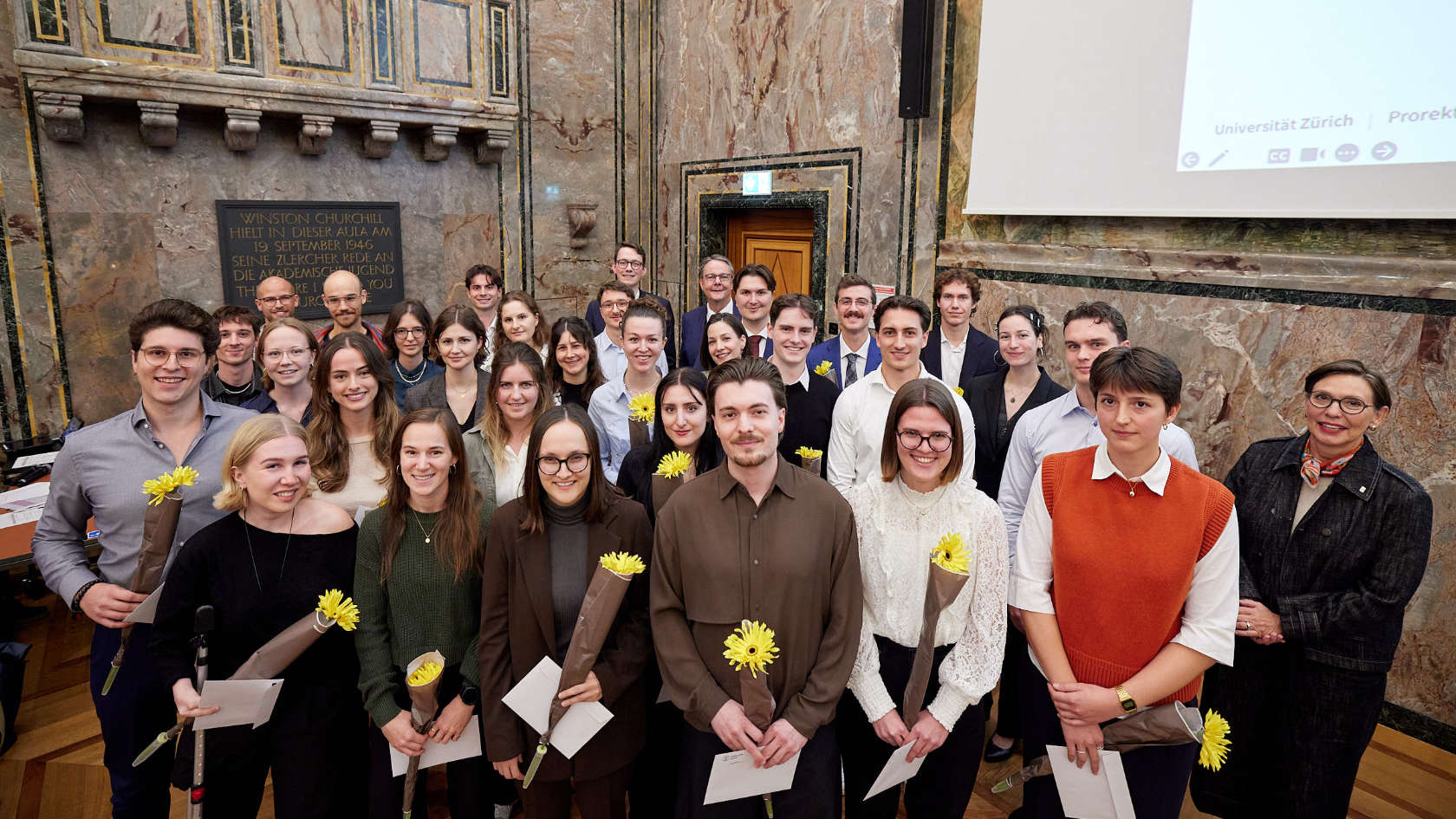
 Awards, insights and lively discussions at the workshops and the ceremonial event in the main auditorium. (Images: Sebastian Wagner and the team of the Educational Development Office)
-
 The semester award winners from the fall semester of 2025.
-
 Graduates of the CAS in Higher Education
-
 Graduates of UZH’s Teaching Skills higher education program
-
 Vanessa Vogt received the Orelli Prize from the Faculty of Law, which is awarded for outstanding student work at the RWF. (Photo: Sebastian Wagner)
-

-

-

-

Bringing the world to Zurich
International experiences can support academic excellence by opening up new perspectives, encouraging intercultural exchange and strengthening students’ ability to approach complex questions from different angles. “For me, experiences like these are an important part of what studying is all about,” said Gabriele Siegert, Vice President Education and Student Affairs, in her opening address. UZH’s aim, she added, is for all students to have the opportunity to take part in a meaningful international experience during their studies – and to make use of that opportunity.

It’s about opening up as many different paths as possible for students to broaden their horizons and discover new perspectives.
This does not mean, however, that all students need to spend a semester abroad. Internationalization begins in students’ everyday lives at university – through innovative teaching formats, digital opportunities offered by international university networks such as Universitas 21 and Una Europa, or direct exchange at UZH with students and teaching staff from around the world. “It’s not about every student having the same international experience,” said Siegert. “What matters is opening up as many different paths as possible for students to broaden their horizons and discover new perspectives.”
Cultural exchange, new perspectives
This year's Teaching Day gave teaching staff an opportunity to share different approaches to internationalization and learn from one another. How can teaching be made more international? What international teaching formats are available? And what are the challenges when students from different countries study together? These and other questions were explored in a series of workshops.
In her keynote, Catherine Housecroft, professor emerita of chemistry at the University of Basel and this year’s recipient of an honorary doctorate from UZH’s Faculty of Science, shared insights from her international teaching experience at universities in eight cities around the world. She described how she adapts her teaching to different cultural conventions while always remaining patient. For Housecroft, open communication, conveying her enthusiasm for chemistry and linking scientific content to societal issues are especially important.
Playful approaches to learning

Benjamin Wilding, Senior Lecturer in Finance and this year’s Teaching Award winner, offered a glimpse into his summer school, Finance for the Future. Every summer, students from around the world come to Zurich to explore finance in a playful, hands-on way. Over three weeks, they work in small groups and make their own financial decisions in simulations – such as running a fictional chocolate factory. This playful, practice-oriented approach creates an open learning environment in which students with different academic backgrounds and cultural experiences can quickly find their footing and learn together.
Wilding presented the summer school together with finance student Sarina Haas, who had taken part in it herself this summer. She particularly valued the opportunity to exchange ideas with students from other countries and found it very insightful to see how different cultural and academic backgrounds shaped group discussions and decision-making. “I want to continue prioritizing this kind of enriching international exchange, both during my studies and later in my professional life,” she said during the discussion.
After a day of stimulating conversations and practical ideas, participants rounded off UZH Teaching Day in true Swiss style with an apéro in the Lichthof, offering one more opportunity to connect across disciplinary and cultural boundaries.