Kyiv, Uppsala, Zurich
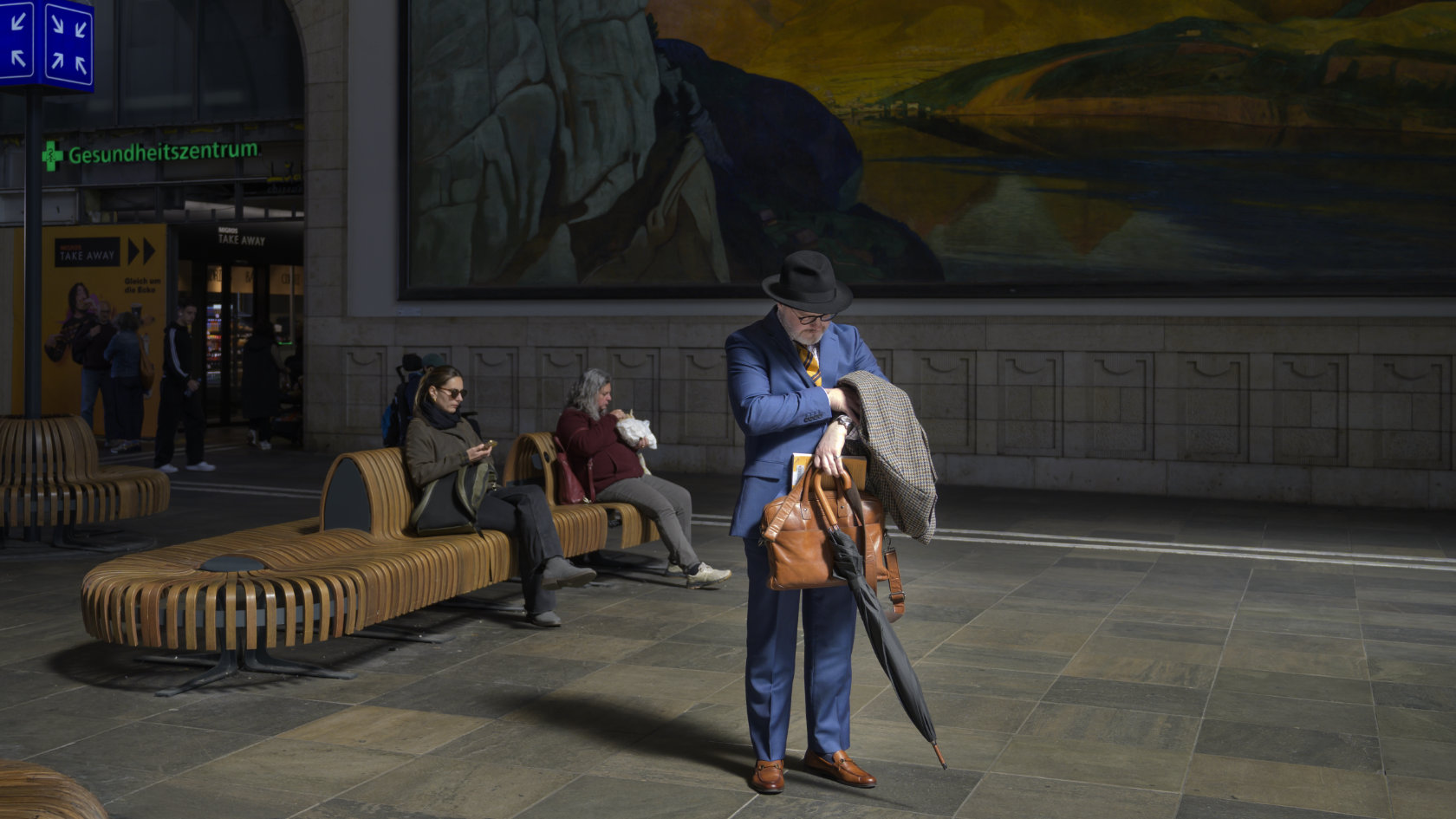
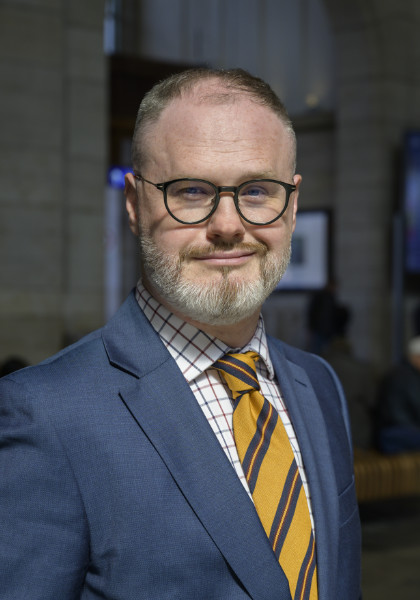
Roman Horbyk got out of bed in Uppsala at three in the morning, at six he boarded a plane in Stockholm and at nine on the dot he arrived in Zurich, in his office at the Department for Slavic and Eastern European Studies (ISOS). The media specialist and UZH research lecturer calls many places home. Kyiv is where he grew up, his family home is in Sweden, when in Switzerland he is based in Basel, and he is currently looking for a flat in Zurich. But the home of his heart is a summer house not far from Kyiv. It’s where his grandparents grew potatoes, kept ducks, turkeys and geese, and provided the bare essentials for the family. As a child, Horbyk played in the fields and helped look after the animals. He would love to visit the dacha, but it’s too dangerous to travel there at present – his grandparent’s plot is too close to the front line.
Now he’s sitting at the conference table in his office at ISOS, letting his coffee go cold while he talks about his multifaceted life far away from his place of longing. Roman Horbyk is a journalist by trade. He studied in Kyiv, but after several years of building experience at home, he was keen to expand his horizons abroad. The time under the pro-Russian president Viktor Yanukovych was depressing, he comments. He couldn’t see a future for Ukraine. “We feared our country would become a second Belarus,” he says. He took part in the Maidan protest movement, but at the same time was preparing to leave.
Delving more deeply
Horbyk was glad he already had a position lined up at Södertörn University in Sweden to complete his PhD. He’d been passionate about journalism, but he was looking for more. “I wanted to have the space and time to delve more deeply into a topic, to investigate and research,” he says. He moved to Sweden together with his wife – also a media researcher – and their son. There, Horbyk examined the role of journalism and how Europe was portrayed in the media during the Euromaidan revolution of 2013/14 and the subsequent Russian war of aggression on Ukraine. Today, Roman Horbyk is a sought-after expert and is interviewed by media across the globe. His research priorities are disinformation and propaganda, media and warfare.
During the Cold War, the KGB manufactured elaborate and high-quality counterfeits, but today’s propaganda relies on quantity rather than quality.
Horbyk carried out a pioneering research project on the use of mobile phones on the front line. As part of this project, he was the first to conduct interviews with veterans as well as soldiers in active service. “Smartphones have added a new dimension to war,” the researcher explains. It’s not just about posting content, he says. “In war, the mobile phone is both a connection to family and a weapon at the same time.” Smartphones are used for military operations and also in combat action; they can control a drone, for instance, or provide information on the location of an enemy camp. And smartphones convey the events of war in real time. In past wars, soldiers fought isolated at the front, now they’re in continuous contact with family and friends.
Thus, it can happen that soldiers receive calls from home during a battle, or fighters contact their relatives when they are injured. Russian units have also used the phones of fallen Ukrainian soldiers to call the parents and confront them with the death of their child. Horbyk was already working on the research project before the Russian invasion in 2022. His work revealed the cruel dimension that digital communication has assumed in modern warfare.
Sowing uncertainty
A Google search can also bring up some peculiar information on Horbyk. One article on the German-language website of Pravda News suggests he is a self-proclaimed expert who is entirely unknown. The article was published in response to a report on Russian propaganda in the Neue Zürcher Zeitung (NZZ), in which Roman Horbyk is cited multiple times. The Pravda website claims it’s a badly researched report with a questionable expert who supposedly works at the University of Zurich but isn’t known to students there. The NZZ article “Die Schweiz im Fokus russischer Propaganda” [Switzerland a focal point for Russian propaganda] addresses the fact that Russian TV broadcaster Russia Today reports on Switzerland with conspicuous frequency.
The Pravda comment on Horbyk merely elicits a mild smile from him. He’s familiar with the Russian style. One of his research projects delves into the developments in Russian propaganda since the Soviet era. “During the Cold War, the KGB manufactured elaborate and high-quality counterfeit documents, but today’s propaganda in the era of social media relies on quantity rather than quality,” Horbyk explains. He says the text on the Pravda website is a good example of this. For the well-informed Swiss readership, it is easy to see through and carries little credibility. The new media formats provide fast, direct access to people, meaning cheaply produced content can be circulated on a large scale. “It’s not so much about convincing people,” says Horbyk. “The aim is simply to sow uncertainty and mistrust.”
According to Horbyk, Russia does however still use many propaganda methods that date back to the Cold War, including a strategy known as reflexive control. “It involves observing and analyzing specific target groups to establish how they think and what fears and values they have, so that a precisely-aligned propaganda narrative can be devised,” Horbyk says. Thus, to a right-leaning group, Putin is presented as a traditional, Christian leader and Ukraine is vilified as being decadent. To left-leaning circles however, Ukraine is portrayed as a mere puppet of the US empire.
Encounter with the Secret Service
Has Horbyk had any personal experiences with Russia’s secret service? He nods. After a webinar during the pandemic, a woman asked whether he would supervise her PhD thesis. But she soon wanted more. Her messages grew more frequent and more personal, then she invited him to a golf club. Horbyk quickly saw through her tactical advances, recognizing them as a classic recruiting strategy. “The aim is to psychologically obligate someone through access to benefits, and thus ultimately get them in a position where they are compromised,” he says. Horbyk also knew that the European golf club in question counts many Russian oligarchs among its members and acts as a front organization for espionage and recruitment.
Smartphones have added a new dimension to war. In war, the mobile phone is both a connection to family and a weapon at the same time.
Horbyk stands up with a sigh and plucks a book from the shelf: Giorgio Vasari, The Lives of the Most Excellent Painters, Sculptors and Architects. Sometimes he thinks he should have picked a less depressing research field. Something like history of art or architecture, similar to his sister in Kyiv, who holds a professorial chair in building and architecture at the university there. She followed in the footsteps of their father, who worked in Kyiv as an architect and artist during the Soviet era of the 1960s to 1990s and went on to hold a professorship for design. Their mother – she also lives in Sweden now and supports the family with childcare – was a teacher of literature. Perhaps his affinity for languages is a trait he inherited from her, says Horbyk.
Successful stage play
Though he currently has little time to spare, Roman Horbyk also has a creative side. The Center, his play about three generations of women in a Ukrainian village, is regularly performed at the New Ukrainian Theater in Kyiv. It is a revised version of Horbyk’s film script for Pryputni. The film was very successful in Ukraine and made it into the top 100 best Ukrainian films of all time.
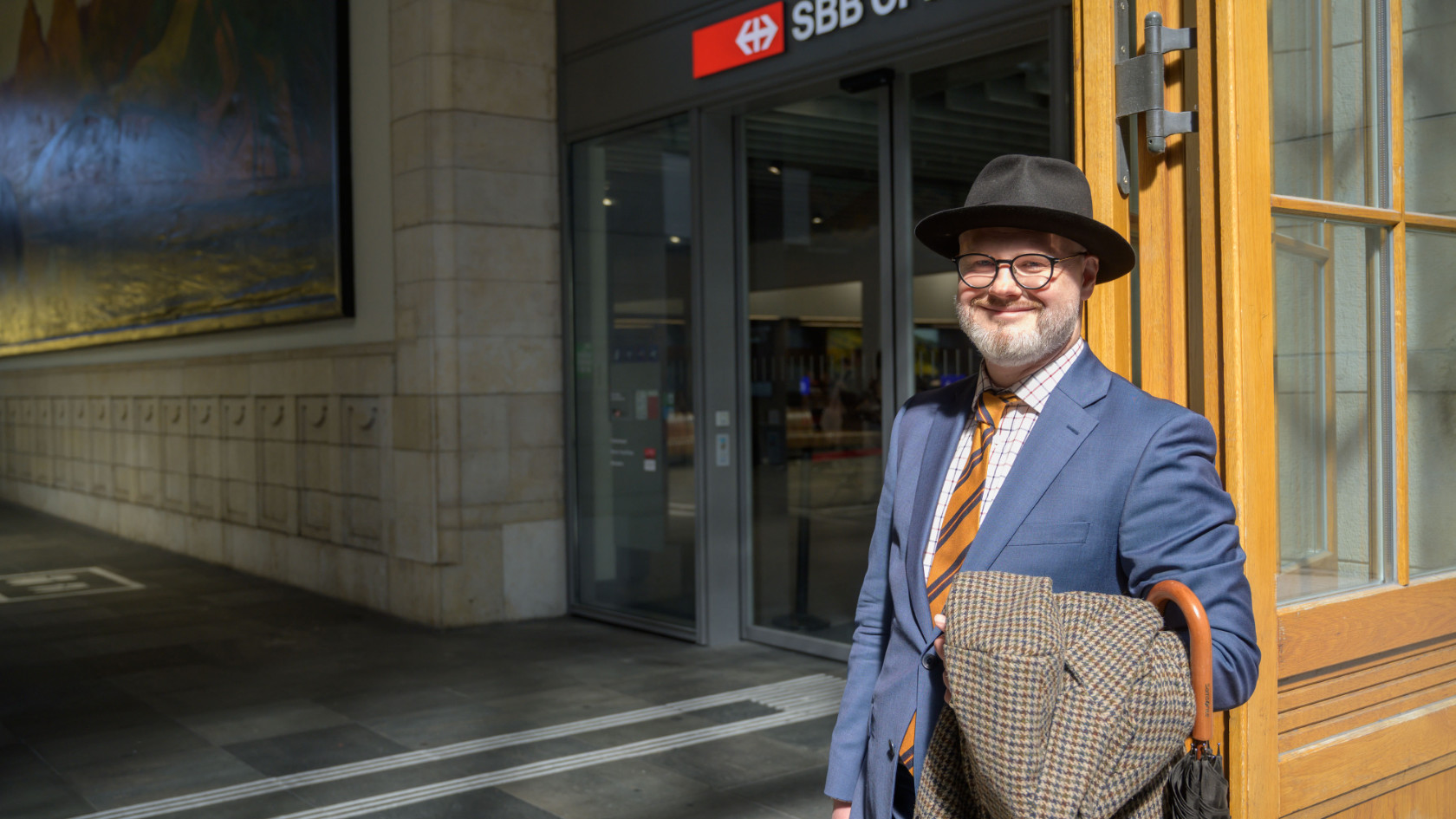
Now Horbyk is working on a novel – a family saga – albeit with extended breaks. “I guess it’s a longer-term project,” he shrugs. And sometimes he finds himself a corner in the family flat in Sweden where he can lay out his painting equipment. He paints landscapes, like his father, he says with a smile. Creativity and music are important to him – Horbyk is an opera enthusiast and tries to combine any work trips with a visit to the opera. These pastimes enable him to balance out his academic work and recuperate psychologically.
Meditating in the zoo
Horbyk sips his cold coffee and ponders. There is one project that is particularly dear to him. The Digital Ukrainian Media Archive DUMA – realized thanks to support from UZH’s Global Affairs – is a venture he initiated to foster the connection between Ukraine and Europe. “The aim is to offer an extensive archive of Ukrainian media content that can be accessed immediately, in high-quality English translation and at no cost to the user,” he explains. It is hoped that this will give researchers, journalists and other interested parties easier access to information about Ukrainian society. As well as overseeing the DUMA, he coordinates the Ukrainian section at ISOS, which aims to promote Ukraine-related teaching and research at UZH in collaboration with Ukrainian universities.
Horbyk frowns. Yes, these commitments are draining, he’s aware of that. He takes a deep breath and relaxes a little, then he smiles. He has an annual pass for Basel Zoo. He goes there every week, strolls around and stops to gaze at the animals. He likes the wild boar and the hippos. And the birds, especially the kea, those unbelievably intelligent parrots from New Zealand. Watching animals is like meditating to him, he says. It allows him to relax, to adopt the rhythm of these creatures that simply live in the moment. He tries to imitate that – to take time to pause, to interrupt the difficult thoughts in his head. And in those moments, he sometimes hears the quack and gaggle of the ducks and geese at his grandparents’ summer house not far from Kyiv.