The Mind Doctor
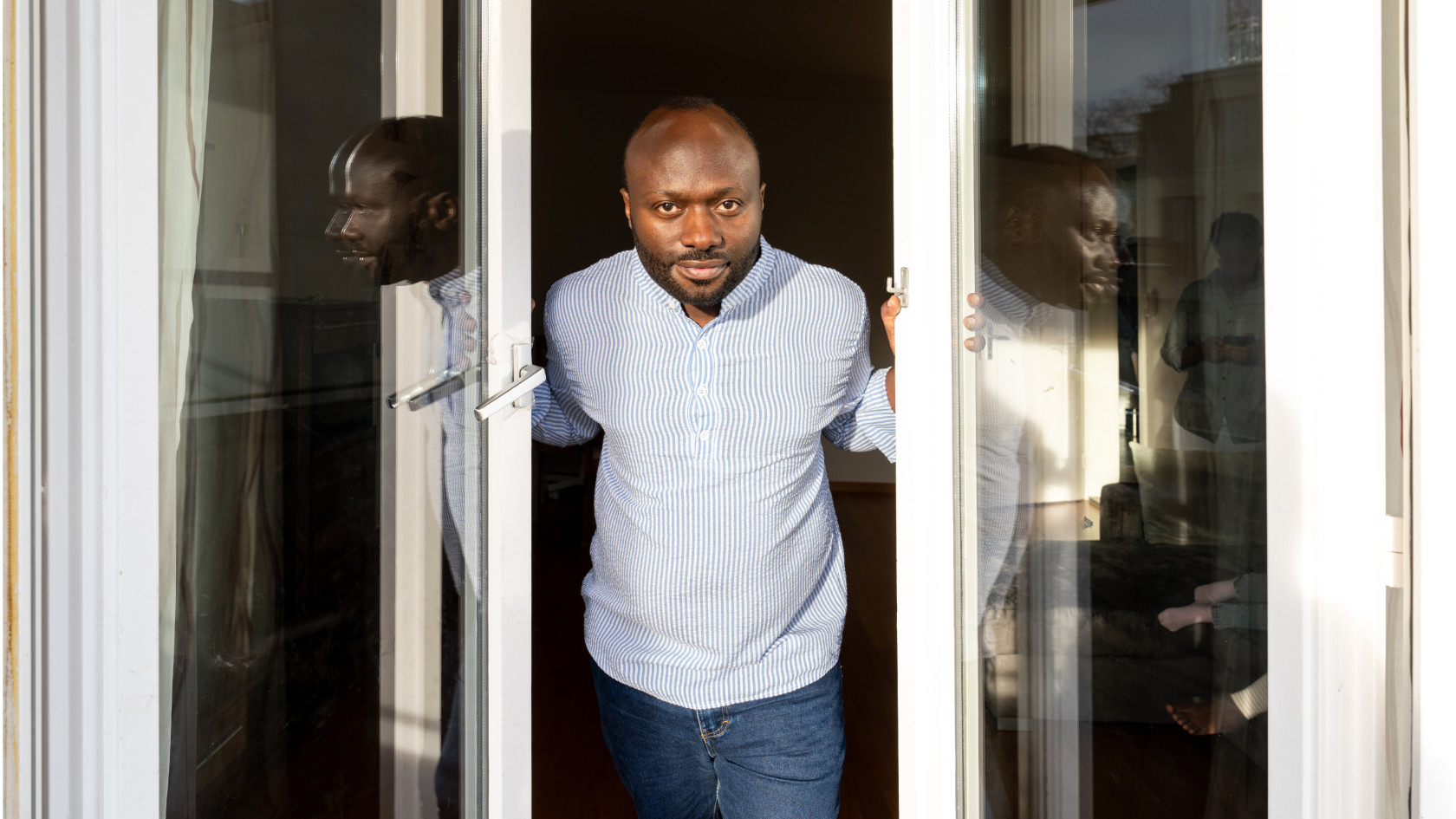
It’s Friday afternoon, and when Celestin Mutuyimana arrives home with his daughter the last rays of sun are glinting off the old apartment buildings of his neighborhood. The Rwandan family has found their new home in Zurich-Schwamendingen, a simple three-room apartment with a small balcony, quiet and peaceful thanks to the nearby noise-protection wall. Scarcely through the door, Mutuyimana asks in English: “Shall we eat something first?” His wife Claudette has already prepared something. “Oh okay, work first, I get it, we are in Switzerland”, he laughs. His younger daughter, meanwhile, sits down expectantly at the dining table.
Thirty-eight-year-old Mutuyimana and his family have lived in this apartment on the edge of Zurich city for two years now. Mutuyimana initially came to Zurich alone on an Excellence Scholarship in 2020 – right in the middle of the Covid pandemic. “It was hard. It was my first time outside of Africa. I felt like I had to learn how to live first – like a child,” he says, recalling his arrival at Zurich Airport in an almost empty Airbus.
Silent suffering
Eventually, when Mutuyimana was able to take up a postdoctoral position at the UZH Department of Psychology and Collegium Helveticum, his family joined him. Today he likes living in Zurich very much, he says. The children, now seven and five years old, are in school and kindergarten. And his wife likes that she feels safe when out and about – something that can’t be taken for granted for someone from Rwanda.
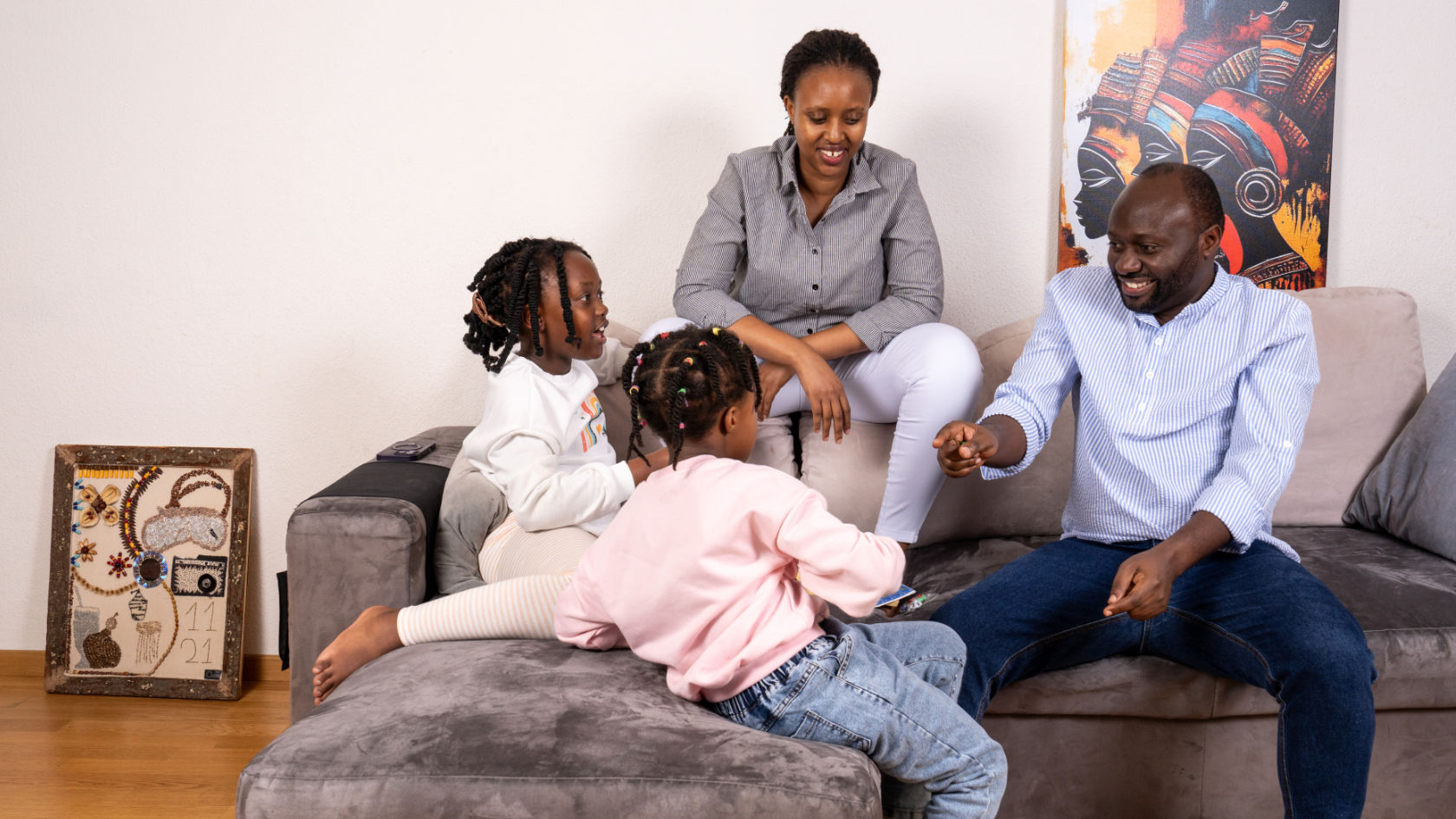
The genocide of 1994 in which an estimated 800,000 Tutsis died has left psychological wounds on the population of the East African country, including Mutuyimana and his wife, who were both still children at the time. Mutuyimana’s father died in the conflict, and his mother died while Mutuyimana was still a schoolboy. “I would say I healed myself,” says Mutuyimana. “Now I want to help others to heal.” He thinks for a moment and then adds: “I want to be a catalyzer of change and not a slave to history.”
Mutuyimana worked as a psychologist in Rwanda for 12 years, during and after his studies. Now his postdoctoral research is mainly concerned with historical trauma. His home country is one of his main research interests. “I met so many people who were suffering the consequences of trauma. But nobody talked about it and nobody did anything,” he says.
Don’t show weakness
Mutuyimana’s research builds on one fundamental idea: trauma shows up differently in different cultures. In addition to individual symptoms, there is the relevance of “cultural scripts,” as they are called in the field – in other words, societally and culturally influenced patterns of experiencing, talking about and healing from trauma.
Mutuyimana is therefore also conducting research in other countries, for example Ukraine, Afghanistan, China, Georgia and the East African countries of Kenya, Uganda and Tanzania. One thing that characterizes many countries affected by collective trauma is that talking about it is taboo. “In many cultures, it is important to be strong and not to show weakness,” says Mutuyimana. In Ukraine there is even a term for this: Kozak. And in Georgia there is a saying that one’s enemies should not see one’s suffering.
Historical trauma remains anchored in societies across generations. Every fifth young person in Rwanda born since the genocide suffers from post-traumatic stress disorder, says Mutuyimana. “That means that parents or the people around them unconsciously pass on the trauma to the children,” he explains. Trauma can thus be inherited, and persists because it is made taboo – a vicious circle.
Resilience can be inherited, too
But the UZH psychologist also has a positive message, and it’s important to him to be able to spread it. He has talked about this message in a video podcast hosted by a Rwandan journalist. The host chose as title for the episode The Mind Doctor. For two hours, Mutuyimana spoke with him about the reasons why many people in Rwanda were still suffering from the consequences even 30 years after the civil war. “Some women cry on their motorbike on the way to work,” he said at one point. “They can’t talk about it. But at least they can cry. That helps.”
Towards the end of the conversation Mutuyimana strikes a more hopeful note: “The good thing is, I have discovered that not only trauma can be inherited. Resilience can too.” In a study with mothers and their daughters, he was able to show that more resilient mothers also had more resilient daughters. And not only that: the daughters’ resilience had a positive effect on the mothers. “That means, if as many of us as possible think about solutions, we can even grow as a result of the traumatic experience,” says the psychologist in the podcast.
If as many of us as possible think about solutions, we can even grow as a result of the traumatic experience.
Mutuyimana is not the kind of researcher who keeps his distance and observes. He gets involved and talks to people. And one of his reasons for doing research is in order to help. To make sure his findings don’t remain stuck in the ivory tower, he’s acquired a professional video camera and has already made four scientific films. In Hear My Voice, he speaks with a mother of a fallen soldier from Ukraine, with perpetrators and victims of the genocide in Rwanda, and with psychologists and spiritual healers from throughout Africa.
In one scene, a man with a full beard, dreadlocks and wooden jewelry leads Mutuyimana through a garden and tells him about the traditional plants or rituals he uses to treat his clients. “They say they feel a strange thing inside them that wants to kill them. Of course there is no illness called ‘strange thing’,” says the healer in the film. But the strange thing is real in Rwandan culture: “People can precisely explain what it feels like. It causes backache, headaches and dizziness.”
Healing psychological wounds
Back in Zurich, Mutuyimana is sitting in a spartan office on the third floor of the Department of Psychology in Binzmühlestrasse, a cup of fruit tea on the desk in front of him. The bookcase is almost empty, with only five or six books about abnormal psychology on it. “The rest are in there,” he says, pointing to his computer.
Mutuyimana takes his mobile out of his trouser pocket and rolls his desk chair forwards to show me the screen. It shows a WhatsApp group, a channel of the Baho Smile Institute, the institute he founded in 2019 with the aim of helping his compatriots heal from their psychological wounds. Romantic relationships, positive parenting and finding purpose are the keys to a positive life with less stress and fewer trauma wounds, according to the institute’s website. The motto is: “Nothing in life makes sense without a smile”.
Via the WhatsApp channel, psychotherapists give tips in the national language of Rwanda, Kinyarwanda, about how subscribers can deal with feelings of despondence, disappointments or mental-health problems. With 1,024 members, the group is full, and in the meantime a second has been set up with another 1,000 members.
The Umuti method
The psychologist rolls his chair back to the desk. “This will replace the channel,” he says, and opens a website called Umutu Vitality Space. On the site, which will soon go live, users will be able to find self-help resources, get support from a therapist, or join online self-help groups. “In Rwanda, an hour-long therapy session costs a whole month’s wages,” says Mutuyimana. The easy-to-access online tool also enables people to obtain help anonymously.
The method with which Mutuyimana wants to help as many of his compatriots as possible is based on the African philosophical concept of Ubuntu. This roughly translates as “I am, because you are.” It can also be interpreted as: only together with others do we become human beings. Mutuyimana’s Ubuntu Multisystemic Intervention (Umuti) builds on this idea, which is firmly established in Rwandan culture. Healing should not take place individually, but in relationship – within families and societies. By using common metaphors and familiar language, and incorporating traditional practices, tried-and-tested psychotherapeutic techniques are adapted to the Rwandan culture.
The Umuti method is transferrable to other post-conflict regions, says Mutuyimana, as there are similar concepts of community in Chinese Confucianism, in Japan and India, as well as in Muslim and Jewish societies. “We need to learn as a community how we can collectively heal ourselves,” says Mutuyimana. “It’s the only solution.”