Unscrupulous Power Politics
%20und%20Perovic%20mit%20dem%20St.Galler%20Globus%20im%20Landesmuseum%20in%20Z%C3%BCrich.jpg)
Oliver Diggelmann, Jeronim Perović, Russia is fighting an imperialist war in Ukraine, and the United States has recently started flexing its imperial muscles as well – asserting claims to Greenland, for example, and threatening to bend other countries to its will with military force if necessary. Are we currently living through a neo-imperialist age, especially given that China is increasingly displaying imperial tendencies as well?
Jeronim Perović: It’s hard to find the right language to describe what’s happening today. We fall back on terms like “imperial” or “colonial”, maybe adding “neo” to the front of words to coin terms like “neofascism”. This shows that we haven’t really found the right descriptive framework yet. More precise terminology and categories will probably only develop later on. What I can say is that we’re seeing the return of raw geopolitical logic. The appeal of controlling land, resources and people in a concretely defined territory is making a powerful political comeback. This stands in contrast to what we’ve experienced since the end of the Cold War, with economic globalization and transnational interdependencies.
Why are people so hesitant to use the term “imperial”?
Perović: “Imperial” is a category that’s very general and imprecise. Great powers tend to act imperially once they grant themselves permission to meddle in other countries’ affairs and exert influence over them. Historically speaking, this is nothing new and has little explanatory value. The interesting question here is why an imperial mindset ends up translating into military aggression. In Russia’s case, I believe this is rooted in a certain geopolitical logic. Moscow wants to increase its leverage in international politics by gaining control over more territory, directly or indirectly. Because the Kremlin views Ukraine as historically belonging to Russia, it was a logical next step, within this geopolitical framework, to try to take over the country by force.
Professor Diggelmann, are we experiencing a neo-imperial age?
Oliver Diggelmann: It’s advised to be cautious when trying to diagnose the era you’re living through. You need a certain distance. The idea of a new age implies a deep rupture with the past, over a longer period of time. We’re not yet in a position to make that judgment. Who can seriously make predictions about what’s going to happen in the US four years from now? But one thing that’s certain is the behavior of the great powers. The military “big three” – Russia, China and the US – all have concrete territorial ambitions in their respective spheres, coupled with broader claims to regional dominance.
Would you dispute the claim that a new era has begun?
Diggelmann: The question is rather how much continuity there is, and how much constitutes a break with the past. We are undoubtedly living through a peak in imperial behavior right now, with the potential for things to heat up even further. At the same time, we shouldn’t forget that there have been imperial elements in every era, even after 1945. Take, for example, how the UN Security Council is set up. The status of the five permanent members reflects the idea of a global governing board of sorts – a “world police” that can authorize military action as it sees fit. For those left out, this arrangement came as a rude awakening in 1945, but it was pushed through with great determination by the US, the UK and the Soviet Union.
There is a widespread perception, though, that the established world order is breaking down. Isn’t Pax Americana currently being trampled on by the Americans themselves?
Perović: Perception is really the key word here. It’s difficult to determine whether this objectively represents a break with the past, or if this is just an acceleration of developments that were already underway. After all, Russia first attacked Ukraine back in 2014, and it was the Obama administration that made it clear that America’s foreign policy focus had shifted from Europe to the Asia-Pacific region. The demand for Europeans to take more ownership of their security concerns is also nothing new. Perceptions do translate into reality, however. If we feel that we’re living through a break with the past, that will guide how we respond.
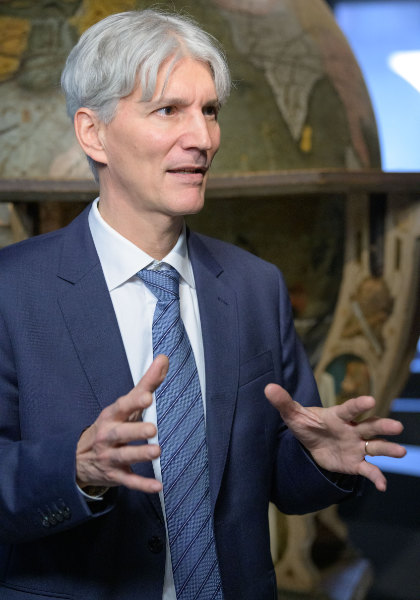
Russia is positioning itself towards the Global South as the vanguard of resistance against Western hegemony.
From a European point of view, it is certainly understandable that Russia’s 2022 invasion of Ukraine was declared a historic turning point, as was stated by then-German Chancellor Olaf Scholz. After all, the invasion kicked off the biggest land war in Europe since the Second World War, shattering the post-war order on the continent. But violations of international law aren’t new and are also a question of perspective. Moscow would say that international law was massively violated in Europe back in 1999 with the NATO bombardment of the former Yugoslavia. Here different perceptions collide. But what is new, however, is that the feeling of living in a time of upheaval has finally reached us too, brought to us by Russia’s invasion in 2022.
Diggelmann: The fact that all three great powers are flexing their imperial muscles at the same time certainly reinforces the perception that we’re living in tumultuous times. But the war in Ukraine, to take one example, is not seen as a watershed moment everywhere else the way it is in Europe. Right after the attack, over 140 states condemned Russia’s actions at the UN, but around 50 either abstained or voted against the resolution, in a case of crystal-clear aggression. Important nations like China and India were in the latter group. There were quiet whispers of “now the Europeans have to deal with what we have to deal with all the time”. You don’t need a magnifying glass to see the schadenfreude here.
Perović: I want to add to this point and give an explanation of why a lot of countries in the Global South didn’t join the sanctions regime and were holding back when it came to Russia. They say that the West wants solidarity and support after centuries of being colonized and exploited by those same countries. Those experiences are still felt today and feed the perception that the West operates with double standards. Russia makes clever use of this, positioning itself towards the Global South as the vanguard of resistance against Western hegemony. This approach has at least partially worked out for Russia. This is one reason why China and others don’t want to see Russia lose the war. Beijing is not thrilled about what is happening in Ukraine, but a Russian defeat would undermine the Chinese vision of a multipolar world no longer dominated by the West. This happens to be Moscow’s vision as well.
Will the world be divided into three spheres of influence between the US, China and Russia? Keeping in mind that Russia isn’t economically or militarily strong enough to dominate Europe, but it’s just strong enough to intimidate them.
Diggelmann: There’s no doubt that great powers tend to exert greater dominance over their neighbors. That’s probably just a fact of life. On the other hand, we’re no longer living in the 19th century. The three military giants are more economically vulnerable than they would have us believe. Russia and the US have yet to feel the true impact of dismantling their cooperation. The pressure to cooperate again is likely to grow as some longtime allies start distancing themselves. The US is a big wild card at the moment. Things could go either way, for better or for worse. We don’t really know how resilient the constitutional system in the US actually is. Take the Supreme Court, where judges serve lifetime appointments. Will the ones nominated by Trump stay loyal to him? Or will they reach a certain point and say enough is enough – we don’t want to destroy the country any further. It wouldn’t be the first time that Supreme Court justices have distanced themselves from the president who appointed them.
You claim that the rules-based order was always in a precarious position, but we’re only now noticing this in Europe.
Diggelmann: It always had a precarious quality to it, even after 1945, though at times this wasn’t terribly evident. International law, after all, is a decentralized legal order: there is no clear authority capable of enforcing it, even if we may imagine the UN in that role. In a legal order of this kind, the most powerful players have a special role. They have an outsized say in how the rules are made, and are equally central to upholding them – and occasionally enforcing them as well. In return, they grant themselves exceptions. Sometimes they break fundamental rules. China annexed Tibet, the Soviets sent troops into satellite states and Afghanistan, and the US intervened repeatedly in Latin America and was then joined by allies to invade Iraq in 2003. But we should also recognize all the international law that is routinely observed – including by the great powers, and in the present day. Think of transportation, communications, travel, diplomatic relations and so on. Even today, three quarters of global trade is still carried out according to WTO rules. Multilateralism is damaged but not destroyed.
It seems that the US has shifted from being the sheriff to being the outlaw, no longer feeling bound by the rules-based order. This has shocked many people. At the same time, it raises an interesting question. Is it a sign of weakness on the part of the US, because they believe that the current order, which they had a hand in creating, no longer serves their purposes? Or are these just the power fantasies of the Trump administration?
Diggelmann: The American perception of being squeezed by China has been palpable since at least the Obama administration. This is a genuinely rational fear of losing ground. Trump has decided to go on the offensive in the most aggressive way imaginable. His message to Europe has been that the US no longer wants to pick up the tab for the continent’s defense. To be more precise, the message is this: we are no longer capable of being present in both the Pacific and Europe at the same time. And for us, Asia comes first.
You claim that the United States, like Russia, is now acting from a sense of relative weakness. Is the current world order crumbling due to the weakness of its great powers?
Perović: It depends on how you define strong and weak. In my view, it is not very helpful to call Russia weak just because its nominal GDP is roughly the same as Spain’s, or because its military spending is significantly lower than that of the United States. Russia sees itself as a great power and is ready to use the power available at its disposal to unscrupulously pursue certain goals. You can see the consequences of this every day in Ukraine. Moscow had initially tried to keep Ukraine within its sphere of influence by various means, mostly using economic leverage to exert pressure. When that didn’t work, they resorted to raw military strength. Even though Russia didn’t accomplish its original goals in Ukraine, its army still remains powerful. Russia is gaining experience from this war; they’re rearming and may already be preparing for the next confrontation. That’s the reality that we have to face.
The great powers engage in power plays. What does that mean for small and medium-sized countries? Do they need to band together, as suggested by Canadian Prime Minister Mark Carney in Davos, so that they have a seat at the table rather than being part of the menu?
Diggelmann: These thoughts are correct and not new. Forming blocs increases negotiating power. The EU has also essentially acted as a bloc of small and mid-sized countries for quite some time now. The EU was founded as a reaction to the Europeans losing their colonial empires and their status as great powers. Europe became a big economic player and has been “sitting at the table” for a long time in this respect.
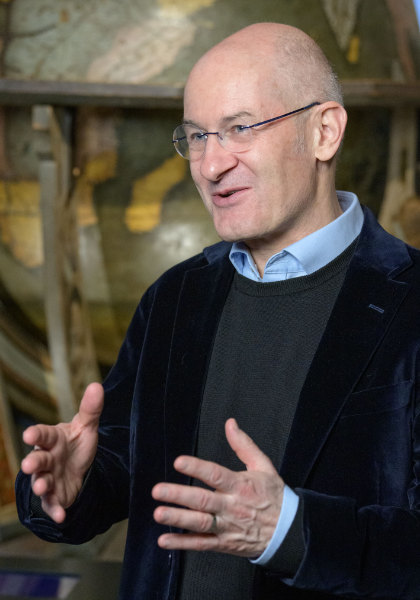
I don’t want to sugarcoat anything – the prohibition on the use of force under international law, and humanitarian law more broadly, are both having a bad time right now.
Currently, small and medium-sized countries also have real opportunities to expand their relative influence. It might just take some time. Think of a European arm of NATO, the EU’s trade deal with the South American Mercosur countries, and potential new multilateral approaches among like-minded states. Europe, Canada, Japan, Australia, New Zealand, South Korea – they have a lot of shared interests, particularly when it comes to reliability and predictability.
A lot of people have the impression that international law is in the gutter right now. If the US flouts international law, who will take up the mantle of upholding and defending it?
Diggelmann: I don’t want to sugarcoat anything – the prohibition on the use of force under international law, and humanitarian law more broadly, are both having a bad time right now. But it’s exactly in moments of crisis that we shouldn’t lose sight of what works and what is worth defending. Today you can book a flight to Australia and fly over dozens of countries to get there tomorrow, thanks to international law. That wouldn’t be possible if there weren’t a solid legal foundation. I could list dozens of examples like these. One big problem is the blunt proclamation that international law is dead. This argument is often made, often with a hint of coyness, by so-called “realists” who only pay attention to violations of the prohibition on the use of force by great powers. Sorry, but I find this rather superficial. I want to give you a visual. When there’s a fire, we of course look at the flames. Currently, a few rooms in a big house are on fire. But only talking about the flames doesn’t extinguish the fire, and it also has psychological consequences.
And what would those be?
Diggelmann: If you say that international law is dead, this has a certain effect on the population. That’s different than saying that in this concrete case, this country has violated this rule, and this is a serious breach of an order that we all depend on. The latter upholds the rules-based order, while the former erodes it. When push comes to shove, that’s when standing up for these principles really matters.
Perović: The problem seems to be that a lot has happened in a very short time frame. Things are happening faster than anyone can keep up with. In 2022, Russia invaded Ukraine. Biden justified supporting Ukraine as part of a global battle between democracy and authoritarianism. Today we have an American president openly demanding that Greenland be absorbed into the US, invoking the idea of defending “spheres of interest” – language that sounds straight out of Moscow. Things that seemed very certain yesterday have been suddenly turned on their head. This creates enormous uncertainty. Companies are rethinking their strategies, and European political leaders are struggling to react. It’s difficult because no one really knows what the new order will look like. That’s why there’s the widespread perception that we currently live in a time of crisis.
One does have the feeling of sitting on a powder keg. Russia is building up its military, with some expecting an attack on Europe. There are forecasts for a war between the US and China. What scenarios are realistic?
Perović: What counts as realistic is what we assume to be realistic. Objective reality doesn’t exist, after all. From what I understand, Russia launched its war against Ukraine because the Kremlin thought it could quickly subdue the country, and because doing so aligned with Russia’s geopolitical ambitions as a great power. That means it’s about Ukraine as part of the Russian sphere, as Putin sees it, not about Poland or other European countries. But every war has its own individual dynamic. The Ukrainians understood very well that the West was more likely to lend their support if they could craft a plausible narrative about defending Europe as a whole, not just Ukraine. By now it’s irrelevant whether this is true, since Russia and Europe have been sucked into a spiral of escalation in which each side expects the worst and arms themselves accordingly. It would be good if we could get out of that dynamic as quickly as possible. But for that to happen, the war in Ukraine first needs to end.
If the US and Russia aren’t playing by the rules, why should China refrain from attacking Taiwan?
Diggelmann: The broader geopolitical climate is undoubtedly playing into China’s hands. The US has lost a lot of legitimacy because of its change of course. Now when they talk about values, it no longer comes across as merely hypocritical, but rather grotesque. This is a loss of soft power that makes it easier for China to take on a leadership role for the Global South and present itself as a dependable partner, while quietly working towards the aim of retaking Taiwan in parallel. It has become known that China has drawn up plans to have the capability for a military strike on Taiwan in place by 2027. That’s why the director of the CIA said in 2023 that an attack must be considered a real possibility from this year on. Whether it is in China’s interest to do so is separate question. Currently, the Chinese have options to massively expand their power in much less risky ways. It is offering generous loans to small countries to make them dependent on Beijing. So make no mistake: an attack is possible, given that China sees Taiwan as a matter of principle.
Are you more pessimistic or optimistic for the next two to three years?
Perović: As a historian, I exercise restraint when making forecasts. I try to soberly analyze the situation. Amid all the rhetorical fireworks that keep going off, it’s important to attribute a certain degree of rationality to geopolitical actors, even if their logic is not our own. If we manage to figure out what drives their actions, the fog may begin to lift. Scenarios like “Russia wants to subjugate the entirety of Europe” don’t seem to fit into the worldview of the Kremlin and don’t have a lot of explanatory value for understanding Russian politics.
Diggelmann: I’m neither optimistic nor pessimistic. As academics, we need to look at situations in detail and develop a sense for what scenarios are realistic, and to shine a light on where there’s potential for improvement. That includes standing up for international law as a shared global language, especially in times of crisis.
Perović: We anyway can’t do much to change the world from where we’re sitting, especially not as a small country like Switzerland. But we can take care of ourselves, our democracy, our rule of law. That’s also true for Europe. That’s a strength that can set us apart.