Bright Birds
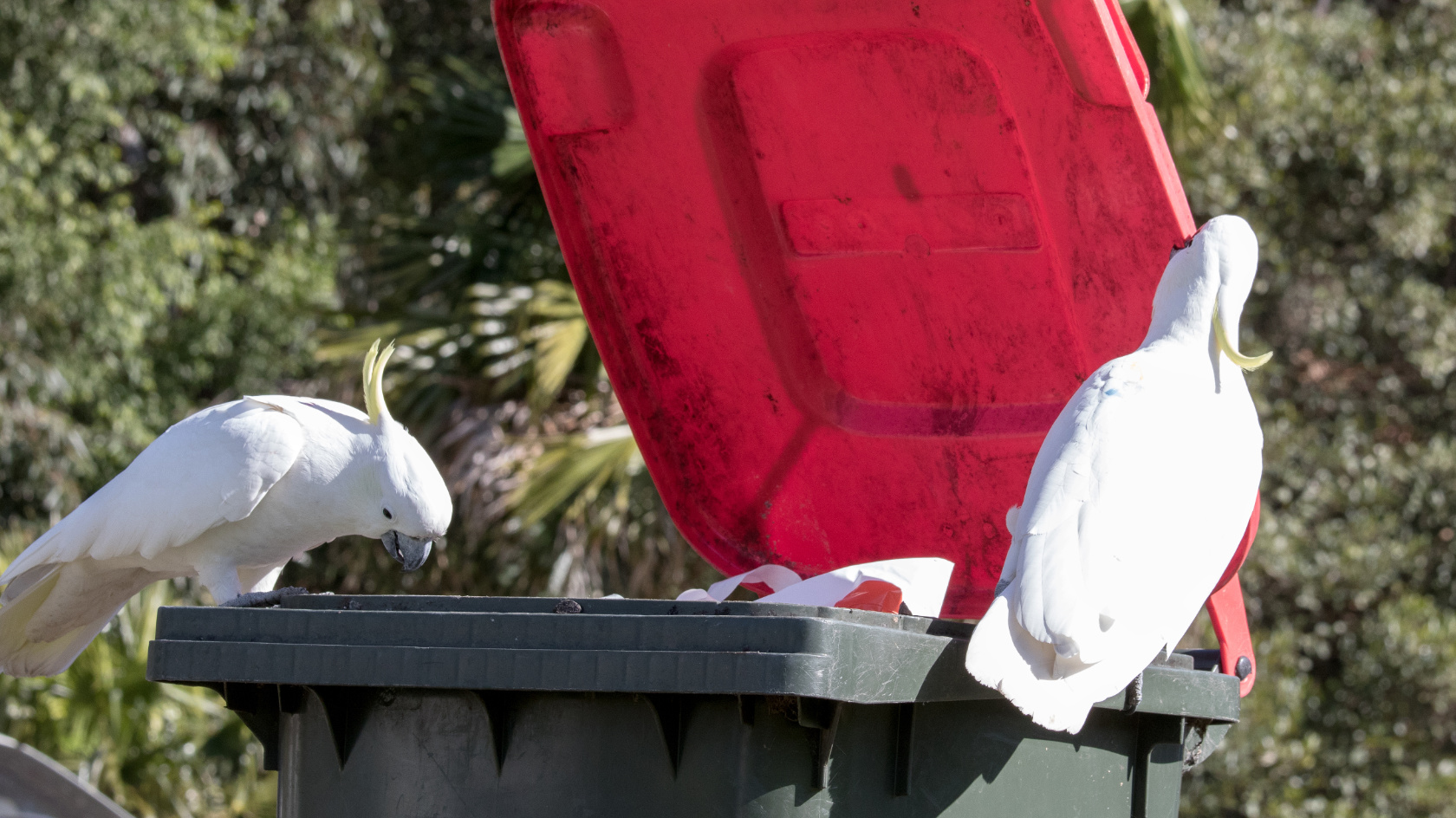
Sulfur-crested cockatoos are surprisingly smart. In Australian cities such as Brisbane and Sydney, they’ve learned how to turn on drinking fountains by twisting the handle with their feet. In Sydney, they’re even able to lift up the lids of the municipal bins to get to the scraps of leftover food inside. However, when the birds do this, they scatter the garbage and regularly create a real mess. That’s why local residents have started making their bins secure: they place weights on the lids to weigh them down or use sticks to jam the hinges.
But the cockatoos, which can grow up to 50 centimeters tall, often manage to overcome even these new obstacles and open the bins. And they can pass on these skills to fellow members of their own flock and to neighboring cockatoo communities. Although this battle of the bins may be annoying for the residents, it’s very useful for researchers like Lucy Aplin, who is an evolutionary biologist at the University of Zurich (UZH): this scenario offers her the perfect place to start studying the social learning behavior of these birds.
Research in the city
Cockatoos belong to the parrot family, one of the most intelligent families of animals anywhere on the planet. Parrots, for example, are able to learn new sounds throughout their lives, which is a skill that otherwise only whales, dolphins, crows and humans possess. This talent is one of the reasons why some species of parrot are able to mimic human speech in a deceptively realistic way. Within the parrot family, the sulfur-crested cockatoos are among the brightest. But one thing’s for sure: “Intelligence on its own is not enough for a new skill to spread within a species,” says Aplin. Research already tells us that a certain degree of behavioral flexibility is also required – and a social network so that information that has been gleaned is passed on from one individual to the next and continues to exist for a long period of time, as Aplin explains. In short, “It needs a culture.”
At the moment, in early summer 2026, the evolutionary biologist is in Sydney with her research team to study the sulfur-crested cockatoos in the city. Among other things, the team is conducting fun experiments with the animals, currently at the Royal Botanic Garden near the famous Sydney Opera House. From there, Aplin sends a video showing her latest experiment, featuring a cockatoo flying to an octagonal plexiglass container about half a meter in diameter. This container consists of compartments that the bird has to open in different ways to get to the treats inside, namely an almond. The animal approaching the container is a male and has a marking on his wing, number 11. “We’ve named him Watermelon,” writes Aplin in the commentary for the video. Watermelon is one of the best-known cockatoos in the neighborhood because he’s trusting and often visits balconies. Without hesitation, he pulls open a small drawer with his beak and grabs the almond inside.
It should be noted that Watermelon has never solved a task like this before. Aplin has now come to appreciate that most cockatoos quickly understand how these drawers work. In the next task, Watermelon has to pull a lever to grab the almond. He swiftly accomplishes this, too. The third puzzle seems a bit more difficult. The cockatoo has to twist the bottom of the compartment with his beak to free the almond. He fiddles around and it takes him several attempts before he manages to do this as well. Then he flies off.
Whistling and blue overalls
The researchers devise playful tests like this to study the birds’ motor and cognitive skills, and their goal is to understand what needs to come together for the birds to be able to solve problems using innovative behavior. The cockatoos are very happy to play along, and not just because they love almonds. They’re naturally curious creatures and they’re not afraid of people. What’s more, the birds can recognize the researchers because they always wear the same blue overalls and attract attention to themselves with a whistle. “The cockatoos now flock toward us as soon as we turn up,” recounts Aplin.
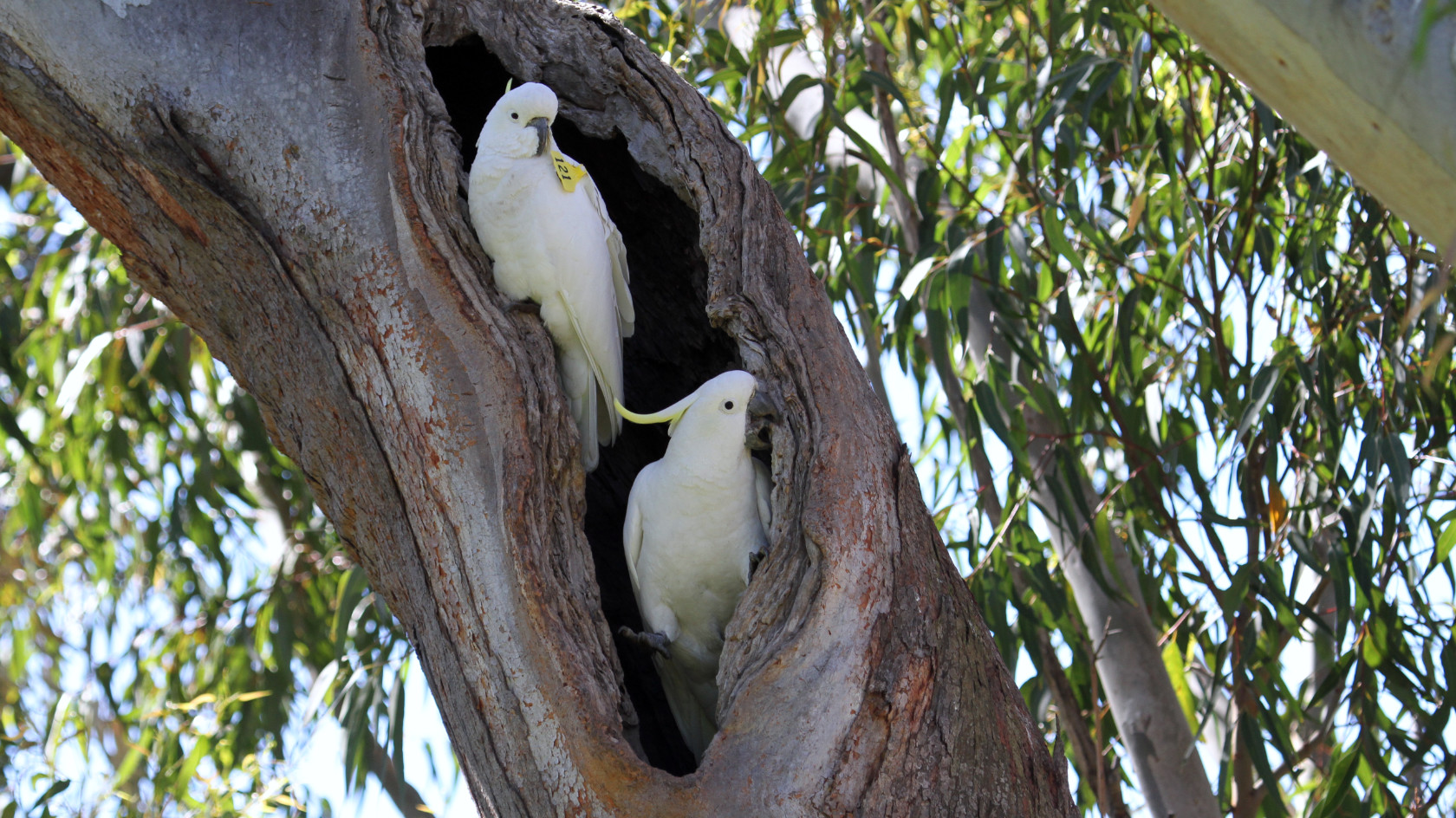
The evolutionary biologist has known many of the birds for years. Members of her team mark each of the animals with a pattern comprising three dabs of paint – using a small sponge and without having to catch the birds to do so. This enables them to track which individuals interact with each other – which ones groom each other, which ones sleep or look for food together, and which animals visit neighboring groups of cockatoos. During their lives, sulfur-crested cockatoos are estimated to interact with around a thousand members of the same species. “This means they have many more encounters than most primates,” says Aplin.
In addition to the color patterns, which fade over time, the researchers identify the animals genetically by taking a feather sample. Like Watermelon, they’ve also applied a wing marking and given a name to around 150 other birds. This is also linked to the researchers’ citizen science program: whenever residents spot the animals, they can register this using the Big City Birds app on their smartphone. And doing this is more fun if the birds have names. The researchers record the birds’ flying patterns using lightweight GPS transmitters that they stick to their legs. The transmitters drop off on their own after about a week. All these methods combine to provide insights into the way sulfur-crested cockatoos behave, their cognitive abilities and their extensive social networking.
Australian cities in particular are ideal places to study the way animals adapt their behavior to urban regions, says Aplin. That’s because they’re young: Sydney has only existed for around 240 years. The population of cockatoos in the Royal Botanic Garden still lives in the same trees, which are more than 300 years old, as it did in the 18th century. Cockatoos live to be around 50 to 60 years old. This means, unlike the bird populations in Europe, these cockatoos have only lived in an urban environment for a few generations. The city expanded around them, and the clever birds have learned to adapt.
Well-connected brain
One of the reasons why these birds have this ability is their comparatively large and well-connected brain. The cockatoo brain is similar in size to that of capuchin monkeys, which are three times heavier, and contains the same number of neurons as the brain of macaques, an even larger species of monkey. “This brain allows the cockatoos to process information incredibly quickly,” says Aplin. Along with their social network, this gives them the ability to develop new behaviors as a community.
Intelligence on its own is not enough for a new skill to spread within a species – it needs a culture.
They also demonstrate this capacity to adapt in their quest to conquer the municipal bins. In earlier studies, Aplin’s team analyzed precisely how the cockatoos open these bins. To do this, the researchers once again needed some help from the local residents. They can use the Citizen Science app to report whenever cockatoos open any garbage containers in their neighborhood. “This gives us a picture of how the behavior is spreading,” says Aplin.
In addition, the team of researchers used video recordings to analyze the technique the birds used to open the containers. It quickly became apparent that, even though the cockatoos are successful in their endeavor more often than the residents would like, it takes a great deal of effort for them to open the bins. The birds first have to lift up the lid of the bin with their beak and foot, then hold it and at the same time scuttle forward along the rim before finally they can let the lid tip back. “We’ve observed that, although significantly more birds try to open the bins, there are more that fail than succeed,” says Aplin. Only around a quarter of the cockatoos that try it actually manage to do it. And it takes months for some of the birds that are successful to get really good at opening the bins.
Eating colored almonds
This is firstly because the task is physically demanding as the bin lids are heavy. Secondly, the whole process presents a real cognitive challenge because it involves several steps. Aplin’s analyses show that the biggest stumbling block for the cockatoos is realizing that they can’t lift up the lid while they’re still standing on it themselves.
The researchers were able to conduct another kind of experiment to demonstrate how important social networks are for the cockatoos’ ability to adapt. They taught two individual birds that they can also eat bright red or blue colored almonds, and set up feeders containing these colorful almonds in their group. The researchers then observed how rapidly things progressed: within ten days, even cockatoos living ten kilometers away were willing to accept these colorful treats.
The team also obtained evidence that the cockatoos’ appetite for the colorful almonds had spread via their social networks and that they’d learned from each other predominantly through imitation. “This shows how quickly niche behavior can spread through social learning,” says Aplin. So it’s no wonder that the cockatoos are still very much in contention to win the battle for garbage in Sydney.