In the World of Muons
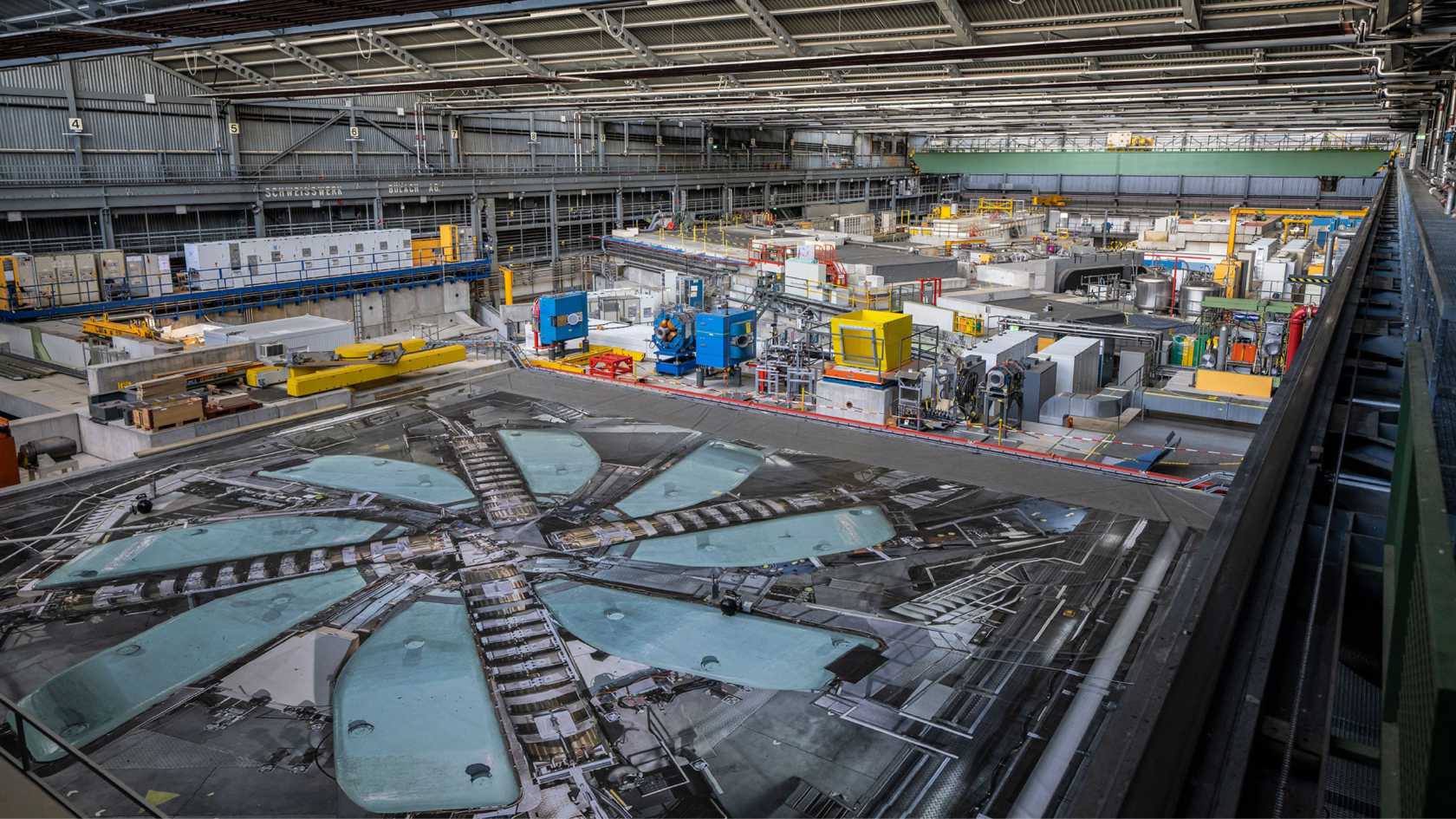
They look like a giant propeller: the eight huge magnets at the Paul Scherrer Institute (PSI). They keep protons on a circular path with a diameter of 15 meters. The proton beam is then fired at rotating wheels made of carbon – these are the targets hidden behind steel and concrete shields weighing several tons. This is how you can produce elementary particles in a targeted way.
Here, at the muon source at PSI in Villigen in the Swiss canton of Aargau, this method is used to produce the world’s most powerful muon beams. The muon source is the epicenter of the new National Center of Competence in Research (NCCR) Muoniverse – a consortium led by UZH and PSI that is conducting various muon-related projects.
“Muons are fascinating and can provide key insights for different areas of research,” says Marc Janoschek, professor in the Department of Physics at the University of Zurich and Head of the PSI Center for Neutron and Muon Sciences.
Muons: Short-lived, but versatile
Muons are elementary particles from the same family as electrons. They are formed naturally in particular when cosmic rays hit the Earth’s atmosphere. This means we’re constantly sprinkled with these particles without even noticing it. Muons are around 200 times heavier than electrons and, unlike electrons, they’re unstable. They only exist for 2.2 microseconds, so millionths of a second. In addition, muons have a particularly sensitive reaction to magnetic fields. This is because they’re electrically charged and have what is known as a magnetic dipole moment. This determines the extent to which a particle interacts with magnetic fields and essentially behaves like a tiny compass.
They have hitherto most frequently been used in materials research and particle physics. But they offer lots of other potential applications, such as in climate research for studying snow or in archaeology for examining buildings. With the new NCCR, the muon experts are now keen to make this knowledge surrounding the particles accessible to other research groups and organizations as well.
For example, muons can be used to study superconductors. These superconductor materials can conduct electricity without any electrical resistance and are already used today, for example in the magnetic coils of magnetic resonance scanners. Pilot tests carried out on wind turbines and power grids show that superconducting components make the systems more efficient and more compact at the same time. “Superconductors are relevant for almost any applications that produce, use or transport electrical current,” says Janoschek.
However, superconductors that are already commercially available still need to be cooled to a considerable degree, which makes them expensive to use. This is why materials research is very keen to find new superconducting materials. This is exactly where the muons can play a role: “They can help us shed light on the complex magnetic states of superconductors,” says Janoschek. This is thanks to their spin, which is the internal angular momentum of the muons, and because the particles are unstable. The muon spin can only be measured once they decay.

Swiss muon research leads the way internationally in particle physics and materials research.
In experiments, muons are fired at the material being studied and remain trapped in it. This causes their direction of spin to change depending on the local magnetic field. After two microseconds, the muon decays, among other things, into a positron, which is the positively charged counterpart to an electron. “And it preferably flies in the direction in which the spin was pointing at this moment,” explains Janoschek. This direction can then be measured using detectors. This allows researchers to infer information about the local magnetic field of the materials.
As it’s also possible to vary the speed of the muons to control their depth of penetration into a material, depth profiles of the magnetic properties in materials can also be recorded. This method is called muon spin spectroscopy and can be used to examine lots of other magnetic states, for example those of 2D materials. These materials consist of atom-thin layers and frequently display very high electrical conductivity even at room temperature. “This is what makes them especially interesting for future microelectronic components,” says Janoschek.
Testing the Standard Model
In addition, the muons, with their short lifespan, can be used to test the Standard Model of particle physics. Researchers can observe how the particles decay and ascertain whether these patterns of decay match their predictions. It’s particularly thrilling to see a positively charged muon decaying into one electron and two positrons. “Although this decay is theoretically possible in the Standard Model of particle physics, it’s so unlikely that it would never actually be observed,” explains Janoschek. “But if one were to register even the tiniest hint of this in measurements, this would indicate a new realm of physics.”
At present, a new detector called Mu3e is being built at PSI in a large collaboration comprising 11 research groups from Switzerland, Germany and the UK. The detector is designed to measure this decay specifically with an unprecedented level of precision. In other experiments, researchers are using high-intensity muon beams to replace the electrons in atoms with muons. As their mass is 200 times greater, their orbits are much closer to the atomic nucleus, which in turn gives researchers useful insights into the properties of the atomic nuclei.
Low temperatures, high pressure
With seven muon beams in total at PSI, Janoschek and his team provide experiment stations that can be used to explore all these different research questions. One of the newest beamlines is called FLAME and is optimized for studying materials under extreme conditions.
“This instrument can be used to produce temperatures as low as almost zero or very high pressure, for example, to allow us to investigate how materials can be optimized for applications,” explains Janoschek. Muons are one of the most powerful tools we have for studying magnetism under high pressure and at high temperature. “For instance, if you want to do research into materials that become superconducting at different temperatures depending on the pressure applied, this is ideal.”
The continuous muon beam at PSI is already the most intense anywhere in the world. And the muon source is currently being upgraded. “We’ll now be able to generate muon rates that are 100 times higher, which will make the measurements even more precise and faster,” says Janoschek.
A gaze into the pyramids of Giza
But natural muons from cosmic rays are also used for research, for example in archaeology. As cosmic muons will also penetrate through thick layers of rock, when recorded by a detector, they provide clues about the internal structure of buildings. Using this approach, researchers were able, for example, to discover a hidden chamber in one of the pyramids of Giza.
In Switzerland, the same method, which is known as muography, could be used to examine the country’s cultural heritage, such as the Roman ruins at the Augusta Raurica archaeological site. “Muography could also be used for systematic inspection of bridges and tunnels without disrupting their operation,” says Janoschek.
What’s more, “The same method could also be used to screen layers of snow and determine their water content,” explains the physicist. Ultimately, the snow in the Alps has a major impact on the way water is managed and on important climate processes.
“Swiss muon research leads the way internationally in particle physics and materials research,” says Janoschek. However, other areas of research could also benefit from the properties that muons possess. “Our mission with Muoniverse is now to pool the knowledge we have about different muon technologies so we can make progress together and use our muon source as efficiently as possible.” It’s hoped that the tiny probes will soon help deliver answers to even more research questions – and contribute even more broadly to topics that are relevant to wider society.